Parts of a poem worksheet for Years 3–6: Read like a poet
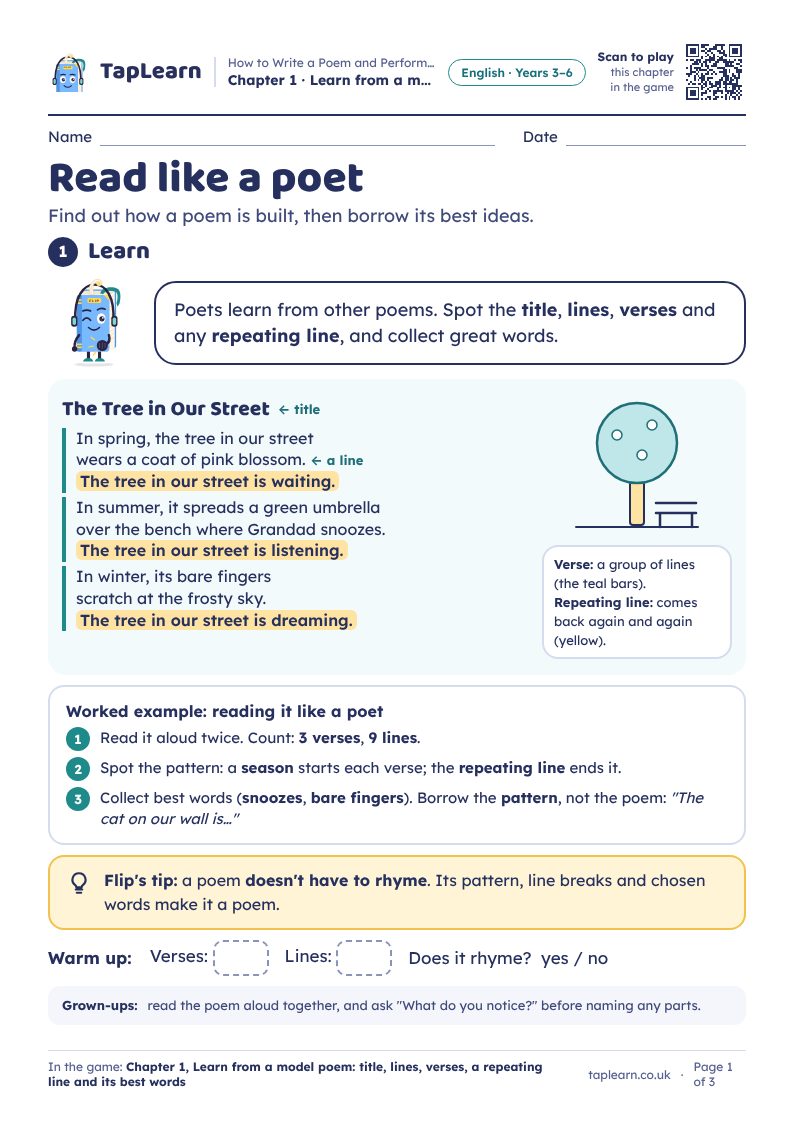
Read Like a Poet is a printable parts of a poem worksheet for Years 3 to 6 (ages 7 to 11) that teaches children to spot the title, lines, verses and repeating line in a model poem, and that a poem doesn't have to rhyme. It covers the Years 3 to 4 statement on discussing similar writing to learn from its structure, vocabulary and grammar.
Free to print, no account needed.
Print it on A4, in colour or black and white. Do it after the chapter, or before it to see what your child already knows.
What's on the worksheet
Your child spots how a poem is built (title, lines, verses and a repeating line), learns that poems don't have to rhyme, and collects words to borrow. Includes a poem detectives activity and an answers sheet.
- Page 1 · Learn
- A model poem, The Tree in Our Street, labelled with its title, lines, verses and repeating line, a worked example reading it like a poet, Flip's tip on rhyme, and a counting warm-up.
- Page 2 · Try it together
- Poem detectives: read two short poems aloud line by line, count the verses and lines, check for a repeating line and rhyme, and each choose a word to borrow.
- Page 3 · Practise
- Match poem words to their meanings, answer questions about a rain poem, true or false about poems, borrow the pattern to write a verse, and a challenge about rhyme.
- Answers sheet
- Every answer, mix-ups like a line and a verse, and a rhyme-or-not bedtime idea.
3 A4 pages and an answers sheet · about 30 minutes
Using it at home
- Read the poem aloud together and ask "What do you notice?" before naming any parts.
- In poem detectives, point and say "this group is a verse; each row is a line". Borrowing one word is fine.
- At bedtime, read a poem or rhyme and decide together whether it rhymes.
Watch out for
- Thinking a poem has to rhyme.
- Read a non-rhyming poem and ask "Is this still a poem?"
- Mixing up a line and a verse.
- A line is one row of words; a verse is a group of lines with a gap after it.
- Copying the whole poem.
- Praise borrowing a word or pattern, then ask "What will you write about?"
Questions from the worksheet
- Draw a line to match each word to what it means: title, line, verse, repeating line.
- Read the poem Rain aloud. How many lines and verses? Which words rhyme? What words start every line?
- True or false? A poem must rhyme. A verse is a group of lines. Poets can borrow a pattern from another poem.
- Borrow the pattern of The Tree in Our Street. Choose something near you, like the cat on our wall, and write one verse.
- Leo says, "The Tree in Our Street isn't a real poem, because it doesn't rhyme." Is he right? What makes it a poem?
The answers are on the answers sheet, for grown-ups.
National curriculum in England
This worksheet practises this statement from the Years 3–4 english programme of study:
- Plan their writing by: discussing writing similar to that which they are planning to write in order to understand and learn from its structure, vocabulary and grammar
In the classroom
- Display the model poem and label its parts together as a starter.
- Run poem detectives in pairs with two contrasting poems from the class library.
Questions and answers
What are the parts of a poem?
A poem can have a title, lines (rows of words), verses (groups of lines) and sometimes a repeating line that comes back again and again.
Does a poem have to rhyme?
No. Many poems don't rhyme. A poem's pattern, line breaks and chosen words make it a poem. Poems with no set rhyme are called free verse.
What is the difference between a line and a verse?
A line is one row of words. A verse is a group of lines, with a gap before the next group.
More worksheets from How to Write a Poem and Perform It: Wren's Poetry Tree
- Chapter 2: Powerful words in poetry worksheet: Powerful words Members
- Chapter 3: Similes and the five senses worksheet: Senses and similes Members
- Chapter 4: Haiku and kennings worksheet: Kennings and haiku Members
- Chapter 5: Writing a poem worksheet: Write a poem Members
- Chapter 6: Performing poetry worksheet: Perform your poem Members
 TapLearn