Similes and the five senses worksheet for Years 3–6: Senses and similes
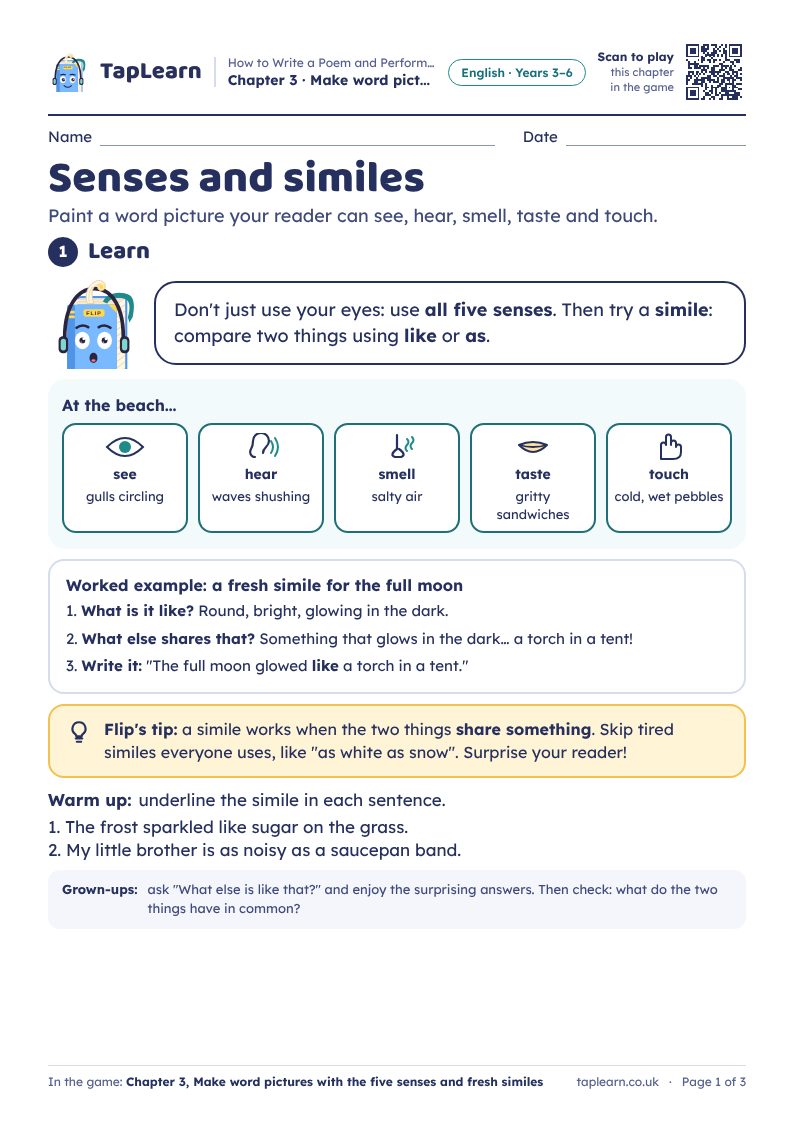
Senses and Similes is a printable similes and the five senses worksheet for Years 3 to 6 (ages 7 to 11) that teaches children to describe with sight, sound, smell, taste and touch, and to write fresh similes where the two things really share something. It covers the Years 5 to 6 statement on selecting vocabulary and understanding how such choices can change and enhance meaning.
This worksheet is for members
Membership opens every chapter of every game and every worksheet, for all your children.
See the plansAlready a member? Log in to print it.
Start with the free one: Read like a poet (chapter 1).
Print it on A4, in colour or black and white. Do it after the chapter, or before it to see what your child already knows.
What's on the worksheet
Your child paints word pictures with all five senses and writes fresh similes with like or as, checking the two things really share something. Includes a senses window-watch and an answers sheet.
- Page 1 · Learn
- A beach described with all five senses, a worked example writing a fresh simile for the full moon, Flip's tip on tired similes, and an underline-the-simile warm-up.
- Page 2 · Try it together
- Senses window-watch: stand quietly at a window or door, notice what you see, hear, smell and feel, taste a snack slowly, then turn two of your notes into similes.
- Page 3 · Practise
- Sort words by sense, finish similes by matching what the two things share, tick fresh or tired similes, write a word picture of a place, and a challenge about the sun and a sock.
- Answers sheet
- Every answer, mix-ups like only describing what you can see, and simile-ping-pong and mystery-sense ideas.
3 A4 pages and an answers sheet · about 30 minutes
Using it at home
- Ask "What else is like that?" and enjoy the surprising answers. Then check: what do the two things have in common?
- In the window-watch, give it a full minute of quiet before talking about what you noticed.
- On a walk, take turns finishing "The clouds look like..." with surprising answers.
Watch out for
- Using tired similes like "as white as snow".
- Say "Everyone uses that one. What else is that white?"
- Comparing two things with nothing in common.
- Ask "What is the same about them?" If there's no answer, try again.
- Only describing what you can see.
- Ask "What could you hear? Smell? Feel?"
Questions from the worksheet
- Which sense does each word use? glittering, sour, whispering, smoky, prickly, buzzing, minty, velvety.
- Draw a line to finish each simile: The hailstones bounced like... The kitten's fur was as soft as... The rusty gate screeched like...
- Fresh or tired? as white as snow. The puddle shone like a dropped mirror. as busy as a bee. Then make one tired simile fresh.
- Write a word picture of a place you know. Use three senses and one simile.
- Ava wrote: "The sun was like a sock." Does her simile work? What would a good simile for the sun need?
The answers are on the answers sheet, for grown-ups.
National curriculum in England
This worksheet practises these statements from the Years 5–6 english programme of study:
- Draft and write by: selecting appropriate grammar and vocabulary, understanding how such choices can change and enhance meaning
- Draft and write by: composing and rehearsing sentences orally (including dialogue), progressively building a varied and rich vocabulary and an increasing range of sentence structures (English appendix 2) (Years 3–4 english)
In the classroom
- Collect tired similes as a class and challenge groups to make each one fresh.
- Play mystery sense in pairs: describe a food using only smell and touch for a partner to guess.
Questions and answers
What is a simile?
A simile compares two things using like or as, such as "The frost sparkled like sugar on the grass".
What makes a good simile?
A good simile compares two things that share something, like brightness or sound, and surprises the reader instead of using a tired phrase.
Why use the five senses in a poem?
Describing what you can hear, smell, taste and touch, not just see, helps the reader feel they are really there.
More worksheets from How to Write a Poem and Perform It: Wren's Poetry Tree
- Chapter 1: Parts of a poem worksheet: Read like a poet Free
- Chapter 2: Powerful words in poetry worksheet: Powerful words Members
- Chapter 4: Haiku and kennings worksheet: Kennings and haiku Members
- Chapter 5: Writing a poem worksheet: Write a poem Members
- Chapter 6: Performing poetry worksheet: Perform your poem Members
 TapLearn