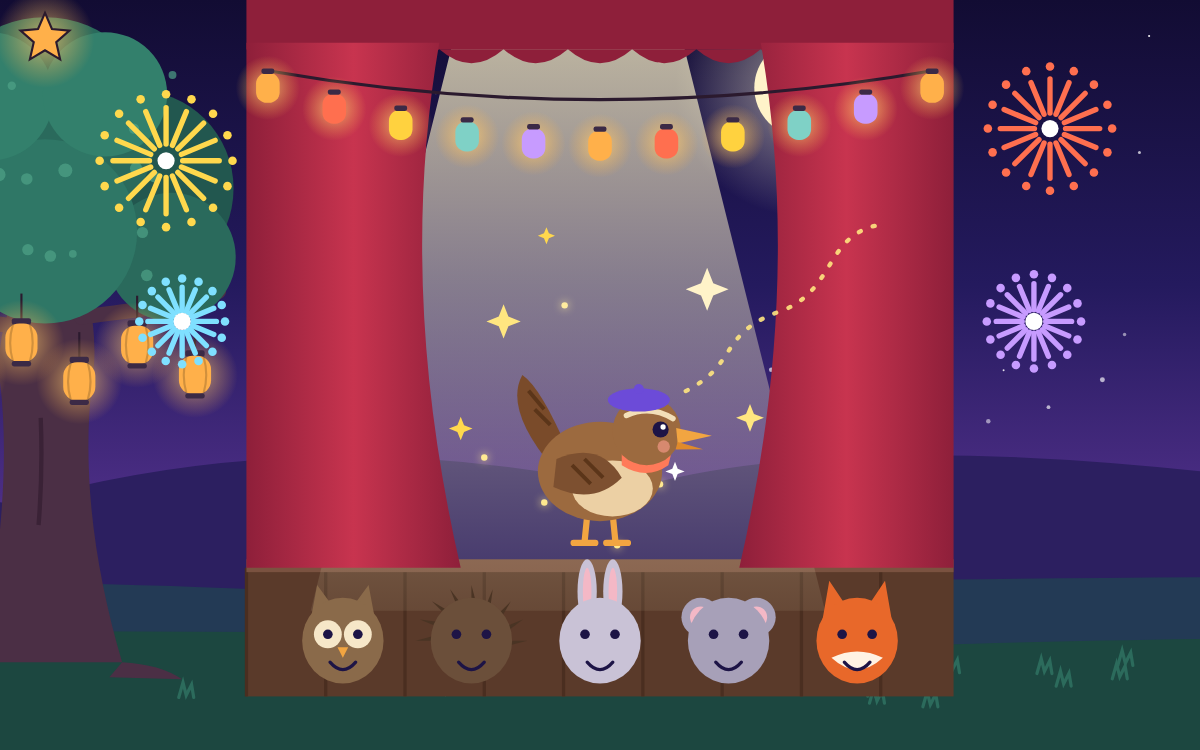
How to Write a Poem and Perform It: Wren's Poetry Tree
Learn how to write a poem: pick powerful words, fresh similes and a form like haiku, then write your own poem and perform it on a stage.
- Ages 7–11
- About 60 min
- Some thinking
- Poetry & Drama
Learn how to write a poem: pick powerful words, fresh similes and a form like haiku, then write your own poem and perform it on a stage.
Years 3–4 english · 1
Years 5–6 english · 2 Years 3–4 english · 3
Years 3–4 english · 3 Years 5–6 english · 2
Years 3–4 english · 1 Years 3–4 english · 3
Years 3–4 english · 3 Years 5–6 english · 2 Years 3–4 english · 1
Years 5–6 english · 4
See every English chapter in the chapter library
What the chapters cover in the national curriculum in England:
How to Write a Poem and Perform It is an interactive game that teaches children aged 7–11, mainly Year 4, how to plan, write and improve a poem of their own, then read it aloud so the meaning is clear.
Guided by Wren, a small bird poet, players study a model poem to spot its title, lines, verses and repeating line. They swap vague words for precise nouns and powerful verbs, try onomatopoeia (words that sound like their noise), and build similes that compare two things using like or as. They meet three poem forms: free verse, kennings (two-word clues such as whale-road for the sea) and haiku, with 5, 7 and 5 syllables.
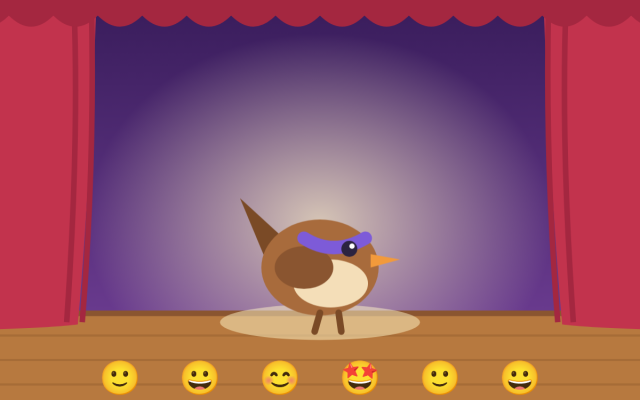
Players then choose a subject and a form, say each line aloud before writing it, and fix forced rhymes. Finally they practise volume, tone, pace, pauses and actions in front of an animal audience, and perform their own poem.
Start by reading a poem you like and noticing how it is built. Choose a subject and a form, collect powerful words, then say each line aloud before writing it down. Finally, read your draft back and change any words that are vague or don't make sense.
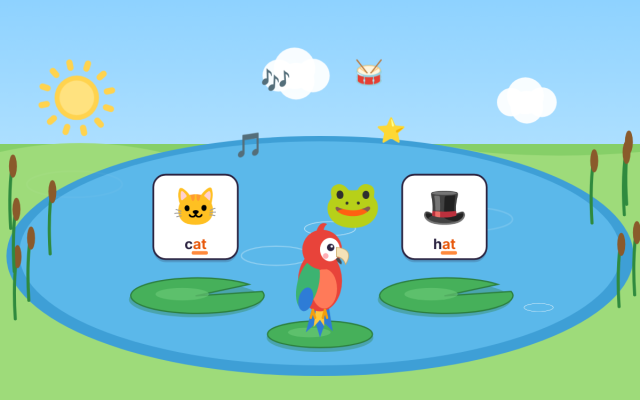
No, a poem does not have to rhyme. Many poems, called free verse, have no fixed rules about rhyme or line length. Rhyme can be fun, but choosing a word only because it rhymes often makes a line that doesn't make sense.
A kenning is a two-word phrase, usually joined by a hyphen, that describes something without naming it. Old English poets called the sea the whale-road and the sun the sky-candle. Children can write a kenning poem as a riddle, such as mouse-catcher for a cat.
The game is designed for children aged 7 to 11 and is pitched mainly at Year 4. It matches the KS2 English curriculum for planning, drafting and performing writing, and an optional warm-up recaps nouns, verbs and adjectives first.
It has six chapters and a 10-question Poetry Slam quiz, taking about an hour to play in full. Children can start any chapter from the Poetry Tree map and come back later to carry on where they stopped.


 TapLearn
Getting it ready…
Great work on chapter 1! To open the next chapters, ask a grown-up to take a look.
To play this game, ask a grown-up to take a look. There are lots of free games you can play right now too!
Playing in class? Ask your teacher to get a free class link. Then your teacher can open every chapter on the board, and you can keep playing at home.
Teachers: play every chapter with your class, free
taplearn.co.uk/teachers
A free teacher account: games on the board, a class link for home, and no pupil data.
A teacher? Every chapter is free for your class. Get a free teacher account
A teacher? Every chapter is free for your class. Get a free teacher account
Create a free family account and your child can play every chapter of every game for 7 days, with no card needed. Their progress is kept. After that, the free plan is free for ever, and membership is £6.99 (about $9.35) a month if you'd like to keep every chapter.
That's all the learning time for today. Great work! Flip will be ready to play again tomorrow.