Haiku and kennings worksheet for Years 3–6: Kennings and haiku
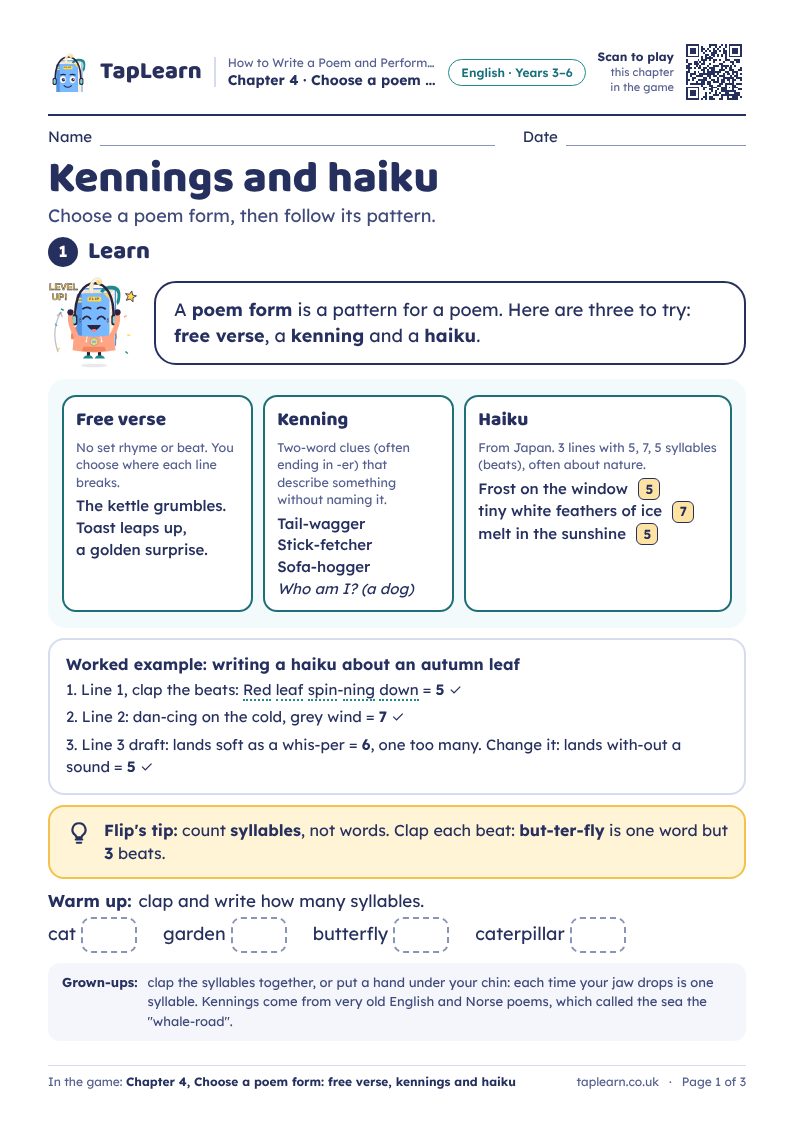
Kennings and Haiku is a printable haiku and kennings worksheet for Years 3 to 6 (ages 7 to 11) that teaches children three poem forms: free verse, kennings that give two-word clues, and haiku with 5, 7 and 5 syllables. It covers the Years 3 to 4 statement on learning from the structure of similar writing.
This worksheet is for members
Membership opens every chapter of every game and every worksheet, for all your children.
See the plansAlready a member? Log in to print it.
Start with the free one: Read like a poet (chapter 1).
Print it on A4, in colour or black and white. Do it after the chapter, or before it to see what your child already knows.
What's on the worksheet
Your child meets free verse, kennings and haiku, claps syllables, checks a 5-7-5 haiku and writes two-word kenning clues. Includes a kenning guess-who game at home and an answers sheet.
- Page 1 · Learn
- Examples of free verse, a kenning and a haiku, a worked example writing a haiku about an autumn leaf, Flip's tip to count syllables and not words, and a clapping warm-up.
- Page 2 · Try it together
- Kenning guess-who at home: clap the syllables in everyone's names, secretly choose a thing at home, make up two kenning clues for it, and see if the other person can guess.
- Page 3 · Practise
- Clap and count syllables, match kennings to what they describe, check a haiku's 5-7-5 pattern, write a kenning and a weather haiku, and a challenge about counting words.
- Answers sheet
- Every answer, mix-ups like naming the thing in a kenning, and family-kennings and spoken-haiku ideas.
3 A4 pages and an answers sheet · about 30 minutes
Using it at home
- Clap the syllables together, or put a hand under your chin: each time your jaw drops is one syllable.
- Kennings come from very old English and Norse poems, which called the sea the "whale-road".
- Make a kenning for each person in the family, like "biscuit-dunker" or "joke-teller".
Watch out for
- Counting words instead of syllables.
- Clap or use the hand-under-chin trick for every beat.
- Naming the thing in a kenning.
- A kenning gives two-word clues like "milk-lapper" so the reader can guess.
Questions from the worksheet
- Clap and count. Write the number of syllables: rainbow, snow, umbrella, thunderstorm, sunshine, hippopotamus.
- Draw a line from each kenning to what it describes: Night-hooter, mouse-catcher. Web-spinner, fly-catcher. Puddle-maker, window-tapper.
- Is this a haiku? Count the syllables: Snow falls on the hill / a sledge waits by the back door / children laughing loudly. Which line breaks the pattern?
- Write your own haiku about the weather. Count each line.
- Mia's haiku starts: "Big brown bears eat honey". She counted 5 words, so she says it is 5 syllables. Is she right?
The answers are on the answers sheet, for grown-ups.
National curriculum in England
This worksheet practises these statements from the Years 3–4 english programme of study:
- Plan their writing by: discussing writing similar to that which they are planning to write in order to understand and learn from its structure, vocabulary and grammar
- Draft and write by: composing and rehearsing sentences orally (including dialogue), progressively building a varied and rich vocabulary and an increasing range of sentence structures (English appendix 2)
In the classroom
- Play kenning guess-who as a class: pupils read clues and others guess the animal or object.
- Make up a spoken haiku together, counting syllables on fingers.
Questions and answers
What is a haiku?
A haiku is a short poem from Japan with 3 lines of 5, 7 and 5 syllables, often about nature.
What is a kenning?
A kenning is a two-word clue, often ending in -er, that describes something without naming it, like "tail-wagger" for a dog.
What is free verse?
Free verse is a poem with no set rhyme or beat. The poet chooses where each line breaks.
More worksheets from How to Write a Poem and Perform It: Wren's Poetry Tree
- Chapter 1: Parts of a poem worksheet: Read like a poet Free
- Chapter 2: Powerful words in poetry worksheet: Powerful words Members
- Chapter 3: Similes and the five senses worksheet: Senses and similes Members
- Chapter 5: Writing a poem worksheet: Write a poem Members
- Chapter 6: Performing poetry worksheet: Perform your poem Members
 TapLearn