Powerful words in poetry worksheet for Years 3–6: Powerful words
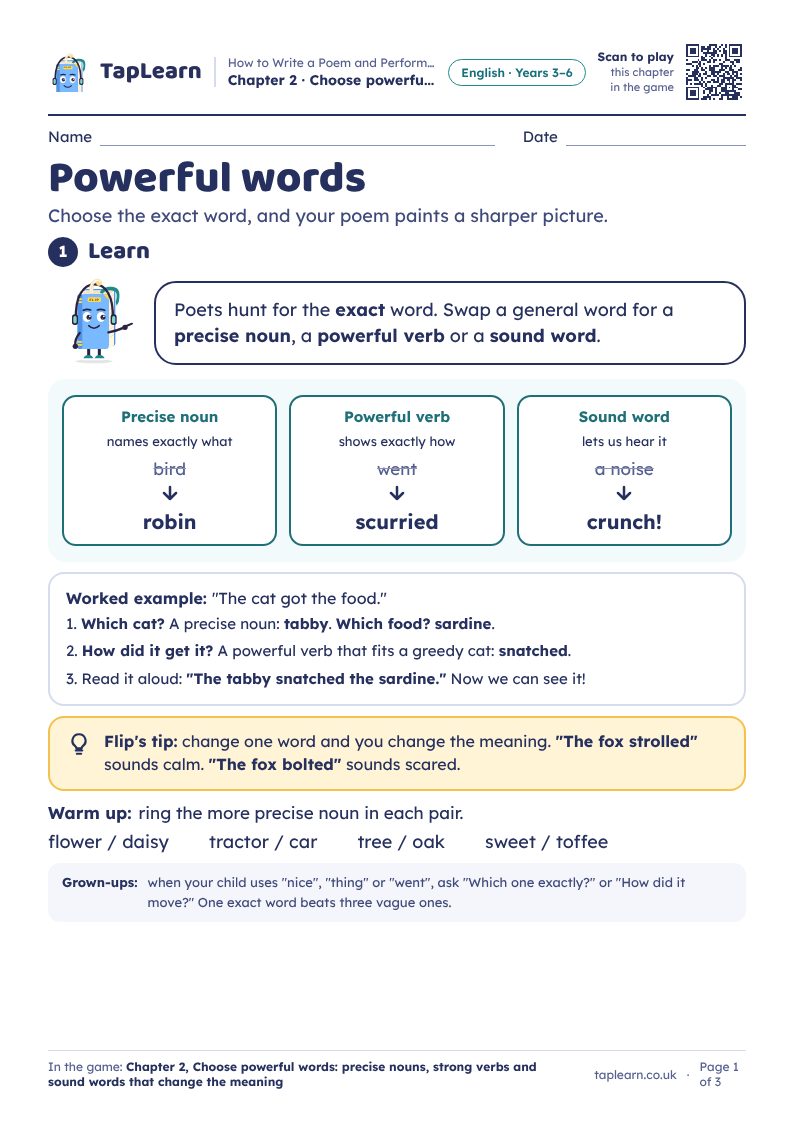
Powerful Words is a printable powerful words in poetry worksheet for Years 3 to 6 (ages 7 to 11) that teaches children to swap general words for precise nouns, powerful verbs and sound words, so "The cat got the food" becomes "The tabby snatched the sardine". It covers the Years 5 to 6 statement on selecting vocabulary and understanding how such choices can change and enhance meaning.
This worksheet is for members
Membership opens every chapter of every game and every worksheet, for all your children.
See the plansAlready a member? Log in to print it.
Start with the free one: Read like a poet (chapter 1).
Print it on A4, in colour or black and white. Do it after the chapter, or before it to see what your child already knows.
What's on the worksheet
Your child swaps general words for precise nouns, powerful verbs and sound words, and explains how changing one word changes a line's meaning. Includes a kitchen word-swap game and an answers sheet.
- Page 1 · Learn
- Precise nouns, powerful verbs and sound words with examples, a worked example improving "The cat got the food", Flip's tip on how one word changes meaning, and a warm-up.
- Page 2 · Try it together
- Kitchen word swap: hold up a safe kitchen thing and name it precisely, move it in a special way and name the move with a powerful verb, invent a sound word, then make a line of poetry.
- Page 3 · Practise
- Ring the clearest word, ring the verb that matches the meaning, match sound words to what makes them, make a dull line powerful, and a challenge about one changed verb.
- Answers sheet
- Every answer, mix-ups like piling up describing words, and verb-walk and sound-hunt ideas.
3 A4 pages and an answers sheet · about 30 minutes
Using it at home
- When your child uses "nice", "thing" or "went", ask "Which one exactly?" or "How did it move?"
- One exact word beats three vague ones. Praise a single precise word over a list of describing words.
- Take turns calling a powerful verb like stomp, tiptoe or wade, and moving that way.
Watch out for
- Using vague words like thing, went, nice or got.
- Ask "Which one exactly?" or "How did it move?"
- Piling up describing words that mean the same, like "a big, huge, giant tree".
- One precise noun or verb often does more.
- Choosing a verb that doesn't fit the meaning, like "strolled" for a frightened fox.
- Ask "How would it feel? So how would it move?"
Questions from the worksheet
- Ring the word that gives the clearest picture: The (thing / acorn / stuff) dropped from the oak tree.
- Ring the verb that matches the meaning: The frightened mouse (strolled / scurried / sat) under the cupboard.
- Draw a line from each sound word to what makes it: sizzle, crunch, plink, buzz.
- Make this line powerful. Use a precise noun, a powerful verb and a sound word: The bird went up into the sky and made a noise.
- Sam changed "The fox strolled through the wood" to "The fox raced through the wood". How does the change of one word change the picture?
The answers are on the answers sheet, for grown-ups.
National curriculum in England
This worksheet practises these statements from the Years 5–6 english programme of study:
- Draft and write by: selecting appropriate grammar and vocabulary, understanding how such choices can change and enhance meaning
- Draft and write by: composing and rehearsing sentences orally (including dialogue), progressively building a varied and rich vocabulary and an increasing range of sentence structures (English appendix 2) (Years 3–4 english)
In the classroom
- Build a class bank of powerful verbs for moving, sorted by mood.
- Do a one-minute sound hunt in the classroom and invent a sound word for each noise.
Questions and answers
What are powerful words in poetry?
Powerful words are exact words that paint a sharp picture: precise nouns (robin, not bird), powerful verbs (scurried, not went) and sound words (crunch).
What is a precise noun?
A precise noun names exactly what something is, like oak instead of tree, or daisy instead of flower.
How does one word change the meaning of a line?
Changing a verb changes the mood. "The fox strolled" sounds calm, but "The fox bolted" sounds scared.
More worksheets from How to Write a Poem and Perform It: Wren's Poetry Tree
- Chapter 1: Parts of a poem worksheet: Read like a poet Free
- Chapter 3: Similes and the five senses worksheet: Senses and similes Members
- Chapter 4: Haiku and kennings worksheet: Kennings and haiku Members
- Chapter 5: Writing a poem worksheet: Write a poem Members
- Chapter 6: Performing poetry worksheet: Perform your poem Members
 TapLearn