Writing a poem worksheet for Years 3–6: Write a poem
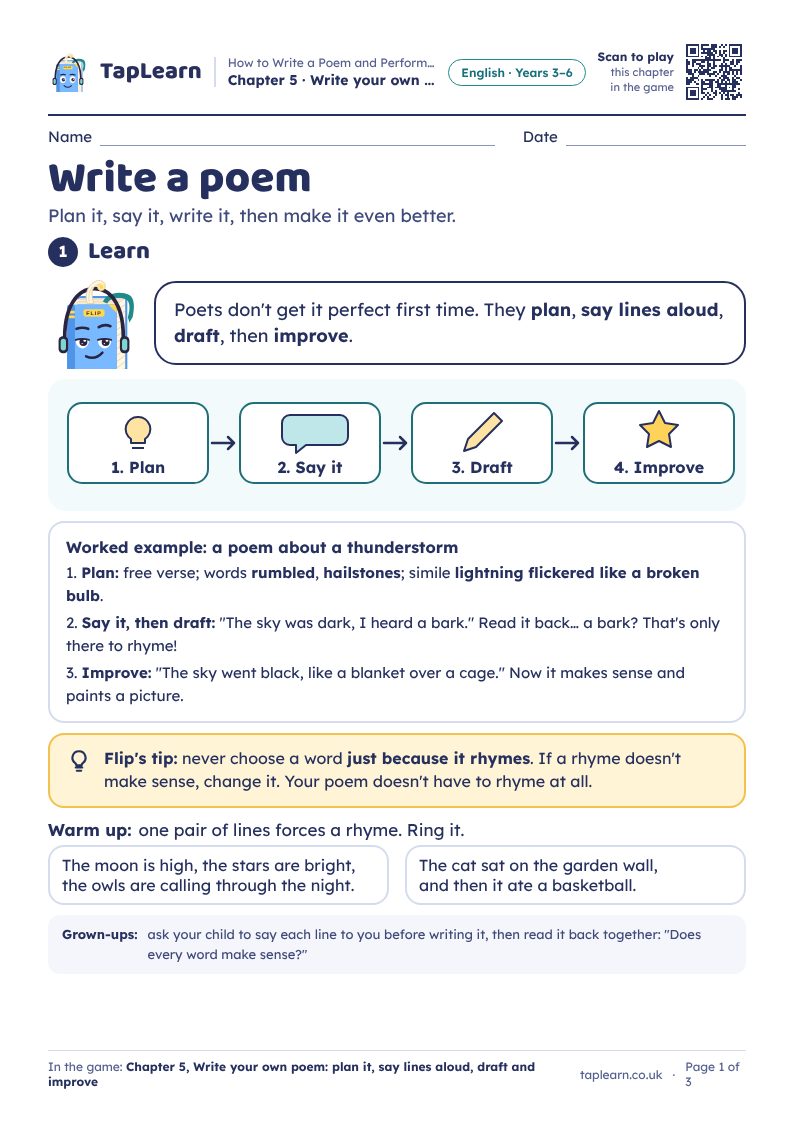
Write a Poem is a printable writing a poem worksheet for Years 3 to 6 (ages 7 to 11) that teaches children to plan, say each line aloud, draft and then improve, changing any word chosen only because it rhymes. It covers the Years 3 to 4 statement on composing and rehearsing sentences orally, and choosing vocabulary that changes and enhances meaning.
This worksheet is for members
Membership opens every chapter of every game and every worksheet, for all your children.
See the plansAlready a member? Log in to print it.
Start with the free one: Read like a poet (chapter 1).
Print it on A4, in colour or black and white. Do it after the chapter, or before it to see what your child already knows.
What's on the worksheet
Your child plans a poem, says lines aloud before writing, then fixes forced rhymes, muddled lines and vague words in a draft. Includes a poem-planning chat and an answers sheet.
- Page 1 · Learn
- Four steps from plan to improve, a worked example drafting a thunderstorm poem and fixing a forced rhyme, Flip's tip never to choose a word just because it rhymes, and a warm-up.
- Page 2 · Try it together
- Poem-planning chat: the child chooses a subject and the grown-up asks what they can see and hear, then the child says a first line aloud two ways and picks one.
- Page 3 · Practise
- Tick the second line that rhymes and makes sense, fix lines with missing words or muddled order, improve a vague line, draft your own poem, and a challenge about a forced rhyme.
- Answers sheet
- Every answer, mix-ups like forced rhymes, and line-tasting and rhyme-rescue ideas.
3 A4 pages and an answers sheet · about 35 minutes
Using it at home
- Ask your child to say each line to you before writing it, then read it back together: "Does every word make sense?"
- If a rhyme sounds silly, ask "Would you say that if it didn't rhyme?" The poem doesn't have to rhyme at all.
- Say one line three different ways and vote on which works.
Watch out for
- Forced rhymes.
- Ask "Would you say that if it didn't rhyme?" If not, change the word or drop the rhyme.
- Missing words or muddled order.
- Reading aloud with a finger under each word catches most of these.
- Vague words and piled-up adjectives.
- Ask "Which one exactly? How did it move?"
Questions from the worksheet
- Tick the second line that rhymes and makes sense: Our kitten pounced upon the string, / then curled up purring like a king. / and wore a shiny diamond ring.
- Each line has a missing word or a muddled order. Say it aloud, then write it correctly: Shone the moon the over hill.
- Improve this line with a precise noun, a powerful verb and better describing words: The thing went across the nice garden.
- Sam's poem is about a scary storm at sea: "The waves were huge and grey, / they wanted to come and play." Does "play" fit the poem? Why?
The answers are on the answers sheet, for grown-ups.
National curriculum in England
This worksheet practises these statements from the Years 3–4 english programme of study:
- Plan their writing by: discussing writing similar to that which they are planning to write in order to understand and learn from its structure, vocabulary and grammar
- Draft and write by: selecting appropriate grammar and vocabulary, understanding how such choices can change and enhance meaning (Years 5–6 english)
- Draft and write by: composing and rehearsing sentences orally (including dialogue), progressively building a varied and rich vocabulary and an increasing range of sentence structures (English appendix 2)
In the classroom
- Play rhyme rescue as a starter: share a silly forced rhyme and fix it together.
- Pair pupils to read each other's drafts aloud and spot one line to improve.
Questions and answers
How do you write a poem step by step?
Plan your subject, form and words, say each line aloud, write a draft, then read it back and improve it.
What is a forced rhyme?
A forced rhyme is a word chosen only because it rhymes, even though it doesn't make sense, like a basketball in a poem about a cat on a wall.
Why say a line aloud before writing it?
Saying it aloud helps children hear whether the line makes sense and sounds right before they commit it to paper.
More worksheets from How to Write a Poem and Perform It: Wren's Poetry Tree
- Chapter 1: Parts of a poem worksheet: Read like a poet Free
- Chapter 2: Powerful words in poetry worksheet: Powerful words Members
- Chapter 3: Similes and the five senses worksheet: Senses and similes Members
- Chapter 4: Haiku and kennings worksheet: Kennings and haiku Members
- Chapter 6: Performing poetry worksheet: Perform your poem Members
 TapLearn