Performing poetry worksheet for Years 3–6: Perform your poem
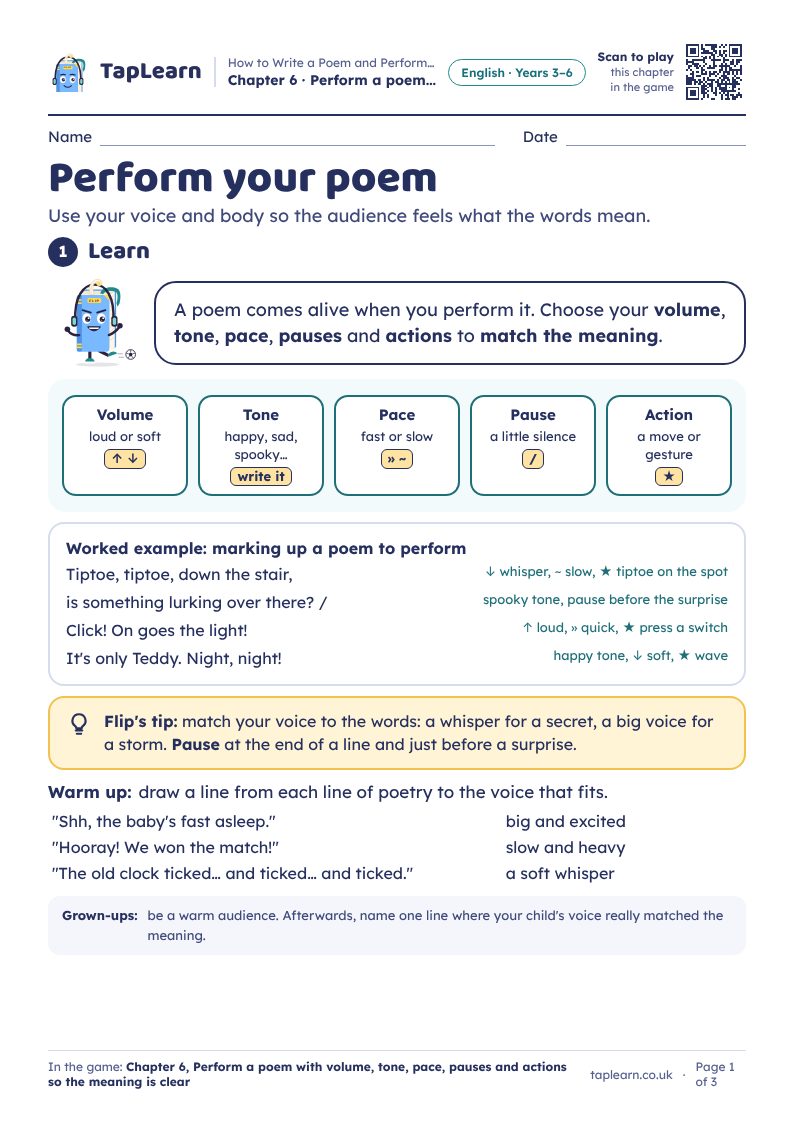
Perform Your Poem is a printable performing poetry worksheet for Years 3 to 6 (ages 7 to 11) that teaches children to match their voice and actions to the words, with a whisper for a secret and a pause before a surprise. It covers the Years 5 to 6 statement on performing their own compositions using intonation, volume and movement so that meaning is clear.
This worksheet is for members
Membership opens every chapter of every game and every worksheet, for all your children.
See the plansAlready a member? Log in to print it.
Start with the free one: Read like a poet (chapter 1).
Print it on A4, in colour or black and white. Do it after the chapter, or before it to see what your child already knows.
What's on the worksheet
Your child marks up a poem for volume, tone, pace, pauses and actions that match its meaning, then performs it. Includes a living-room stage performance and an answers sheet.
- Page 1 · Learn
- Volume, tone, pace, pauses and actions with symbols, a worked example marking up a spooky poem about Teddy, Flip's tip to match your voice to the words, and a warm-up.
- Page 2 · Try it together
- Living-room stage: read a poem together, plan volume, pace, pauses and an action for the first four lines, then perform it by a cushion stage and get a star and a wish.
- Page 3 · Practise
- Ring the way to perform each line, match lines to actions, mark pauses and the loudest word in a cupboard poem, plan the last line's performance, and a challenge about a lullaby.
- Answers sheet
- Every answer, mix-ups like rushing without pauses, and same-line-new-mood and after-tea-show ideas.
3 A4 pages and an answers sheet · about 30 minutes
Using it at home
- Be a warm audience. Afterwards, name one line where your child's voice really matched the meaning.
- In the living-room stage, give one star (something that worked) and one wish (one thing to try), then let your child perform it again.
- Say "It's time for bed" as if happy, scared, then bored, and talk about how the voice changed.
Watch out for
- Using a voice that doesn't match the meaning, like shouting a quiet line.
- Ask "How does this line feel? So how should it sound?"
- Rushing without pauses.
- Rushing hides the meaning. Practise a "one-elephant" pause at line ends.
- Choosing actions that don't match the words.
- Fewer, clearer actions work better than lots of random ones.
Questions from the worksheet
- Ring the way to perform each line: "The giant stamped across the hill." (whisper / big, heavy voice). "Run! The bull is coming!" (calm and slow / quick and urgent).
- Draw a line from each line to an action that matches it: "The rocket blasted into space." "I yawned and stretched and closed my eyes."
- Read the cupboard poem aloud. Mark a / where you would pause. Then underline the word you would say loudest.
- Plan how you would perform the last line of the poem: volume, tone, pace and action. Explain your choices.
- Leo performs his gentle lullaby poem by shouting it as fast as he can, jumping about. What advice would you give him?
The answers are on the answers sheet, for grown-ups.
National curriculum in England
This worksheet practises this statement from the Years 5–6 english programme of study:
- Perform their own compositions, using appropriate intonation, volume, and movement so that meaning is clear
In the classroom
- Hold a class poetry performance with star-and-wish feedback from the audience.
- Use the warm-up as a drama starter: pupils say each line in the matching voice.
Questions and answers
How do you perform a poem?
Choose a volume, tone, pace, pauses and actions that match what the words mean, then practise and perform it to an audience.
Where should you pause when reading a poem aloud?
Pause at the end of a line and just before a surprise, so the audience can take in the meaning.
Why does tone of voice matter when performing poetry?
Tone shows how a line feels, such as spooky, happy or sad, so the audience understands the meaning.
More worksheets from How to Write a Poem and Perform It: Wren's Poetry Tree
- Chapter 1: Parts of a poem worksheet: Read like a poet Free
- Chapter 2: Powerful words in poetry worksheet: Powerful words Members
- Chapter 3: Similes and the five senses worksheet: Senses and similes Members
- Chapter 4: Haiku and kennings worksheet: Kennings and haiku Members
- Chapter 5: Writing a poem worksheet: Write a poem Members
 TapLearn