Counting objects worksheet for Reception: One number each
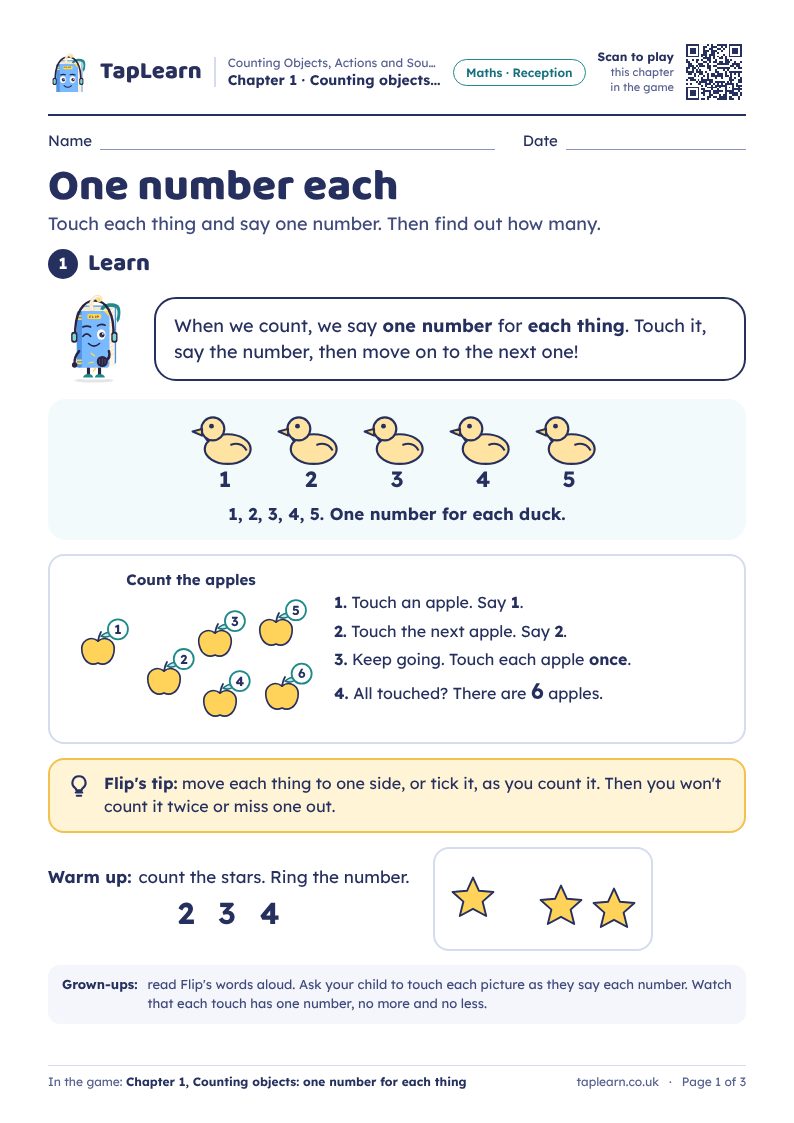
One Number Each is a printable counting objects worksheet for Reception (ages 4 to 5) that teaches children to touch or move each thing as they say one number for it, so nothing is counted twice or missed. It covers the Reception (EYFS) maths goals to count objects, actions and sounds and to count confidently with a deep understanding of the numbers to 10, using things like small pebbles and tens frames.
Free to print, no account needed.
Print it on A4, in colour or black and white. Do it after the chapter, or before it to see what your child already knows.
What's on the worksheet
Your child counts objects up to 10, saying one number for each thing and touching or moving each one so nothing is counted twice or missed. Includes a move-and-count activity and an answers sheet.
- Page 1 · Learn
- Ducks counted with one number each, a worked example touching each apple to count 6, Flip's tip to move or tick things as you count, and a count-the-stars warm-up.
- Page 2 · Try it together
- Move and count: put up to 10 socks, spoons or toy cars in a pile on a tray, move them across one at a time saying a number for each, then say how many and draw or write it.
- Page 3 · Practise
- Count and ring the number, count and write how many, draw 4 balls and 7 dots, and a challenge about Leo counting one duck twice.
- Answers sheet
- Every answer, mix-ups like skipping a number, and snack-count and stair-count ideas.
3 A4 pages and an answers sheet · about 20 minutes
Using it at home
- Watch that each touch has one number, no more and no less, as your child counts the pictures on page 1.
- In move and count, start with 3 to 5 things, then try up to 10. If a number is missed or said twice, put them back and count again slowly.
- Count grapes or crackers onto a plate at snack time, one number for each.
Watch out for
- Counting the same thing twice, so the total is too big.
- Move or tick each thing as it is counted.
- Missing things out when they are spread about.
- Start at one side and work across, or line them up first.
- Saying numbers faster than touching, or skipping a number.
- Slow down: one touch, one number. Say the numbers together or sing a counting song first.
Questions from the worksheet
- Count. Ring the number.
- Draw 4 balls. Draw 7 dots.
- Leo counted these ducks. He said, "There are 6!" He counted one duck twice. Count them carefully. How many ducks are there?
The answers are on the answers sheet, for grown-ups.
National curriculum in England
This worksheet practises these statements from the Reception maths programme of study:
- Count objects, actions and sounds
- Developing a strong grounding in number is essential so that all children develop the necessary building blocks to excel mathematically. Children should be able to count confidently, develop a deep understanding of the numbers to 10, the relationships between them and the patterns within those numbers. By providing frequent and varied opportunities to build and apply this understanding - such as using manipulatives, including small pebbles and tens frames for organising counting - children will develop a secure base of knowledge and vocabulary from which mastery of mathematics is built
In the classroom
- Run move and count in small groups with trays of classroom objects.
- Count steps together on the way to the hall, one number for each step.
Questions and answers
How do you teach a child to count objects?
Ask them to touch or move each thing as they say one number for it. The last number they say is how many there are.
Why does my child count the same thing twice?
It's common when things are spread out. Moving each one to the side, or ticking it, helps make sure each is counted once.
How many objects should Reception children count?
On this sheet children count up to 10 things, starting with 3 to 5 and building up.
 TapLearn