Counting how many worksheet for Reception: How many?
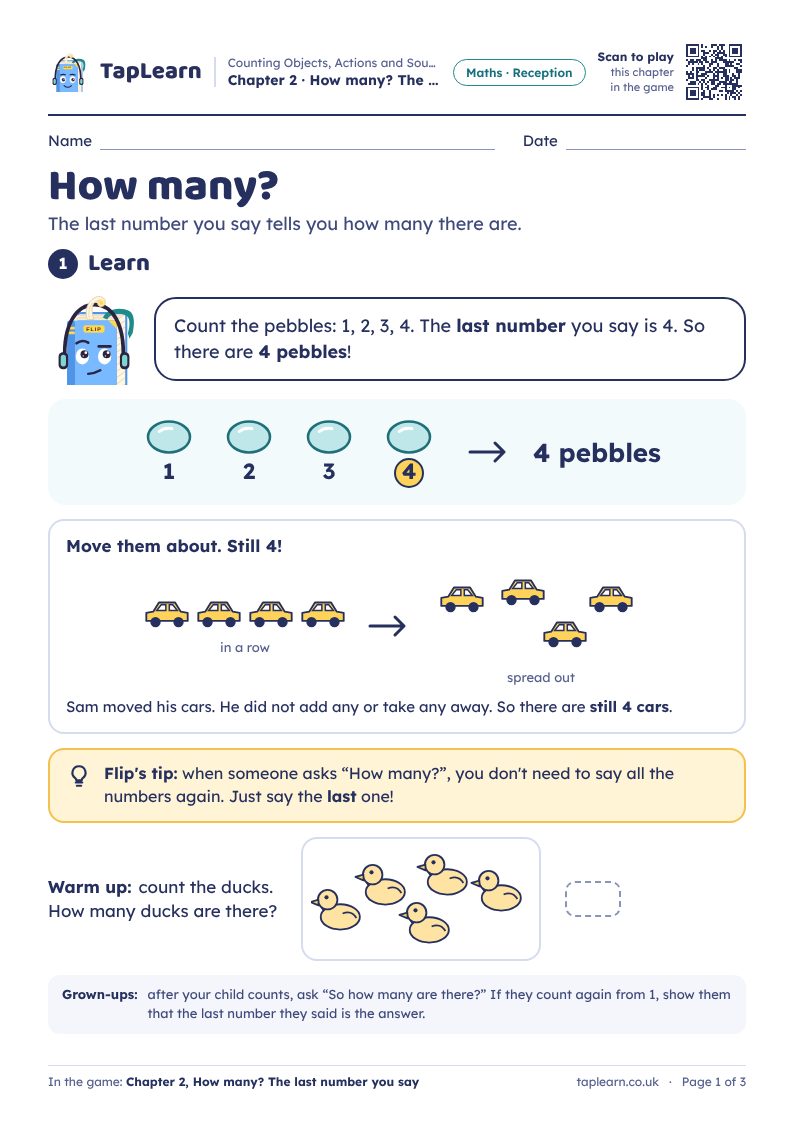
How Many? is a printable counting how many worksheet for Reception (ages 4 to 5) that teaches children that the last number they say is how many there are, and that spreading things out doesn't change the number. It covers the Reception (EYFS) maths goals to count objects, actions and sounds and to count confidently with a deep understanding of the numbers to 10, using things like small pebbles and tens frames.
This worksheet is for members
Membership opens every chapter of every game and every worksheet, for all your children.
See the plansAlready a member? Log in to print it.
Start with the free one: One number each (chapter 1).
Print it on A4, in colour or black and white. Do it after the chapter, or before it to see what your child already knows.
What's on the worksheet
Your child learns that the last number they say when counting tells them how many, and that moving things about doesn't change how many. Includes a hide-and-count activity and an answers sheet.
- Page 1 · Learn
- Four pebbles counted, then shown in a row and spread out, Sam's cars moved about but still 4, Flip's tip to just say the last number, and a count-the-ducks warm-up.
- Page 2 · Try it together
- Hide and count: count up to 10 toys together, hide them under a tea towel and ask "How many are hiding?", then spread them out and count again to see it's the same.
- Page 3 · Practise
- Count and ring the last number you say, say how many teddies and fish there are after Sam moves them, draw and count 6 dots, and a challenge about Mia saying 5 for 4 teddies.
- Answers sheet
- Every answer, mix-ups like saying the next number, and shoe-count and peek-a-boo ideas.
3 A4 pages and an answers sheet · about 20 minutes
Using it at home
- After your child counts, ask "So how many are there?" If they count again from 1, show them the last number they said is the answer.
- In hide and count, it's fine if your child peeks and counts again at first. Ask again next time without peeking.
- Count the shoes by the door, then line them up and ask "How many now?"
Watch out for
- Saying the next number, like 5 for 4 things.
- Ask "What was the last number you said when you touched the last one?"
- Counting again from 1 when asked how many.
- Praise the counting, then show that the last number is already the answer.
- Thinking moving things changes how many.
- Spread things out or bunch them up and count again together: it stays the same.
Questions from the worksheet
- Count. Ring the last number you say.
- Sam moved them about. He didn't add any or take any away. How many now?
- Mia counts her teddies: "1, 2, 3, 4." Then she says, "There are 5 teddies!" Is she right? How many teddies are there?
The answers are on the answers sheet, for grown-ups.
National curriculum in England
This worksheet practises these statements from the Reception maths programme of study:
- Count objects, actions and sounds
- Developing a strong grounding in number is essential so that all children develop the necessary building blocks to excel mathematically. Children should be able to count confidently, develop a deep understanding of the numbers to 10, the relationships between them and the patterns within those numbers. By providing frequent and varied opportunities to build and apply this understanding - such as using manipulatives, including small pebbles and tens frames for organising counting - children will develop a secure base of knowledge and vocabulary from which mastery of mathematics is built
In the classroom
- Play hide and count as a group, covering counters with a cloth and asking how many are hiding.
- Show a set of objects in a row, then spread them out and ask the class if the number has changed.
Questions and answers
What does "the last number tells you how many" mean?
When you count, the last number you say is the total. If you count 1, 2, 3, 4, there are 4.
Why does my child say the next number after counting?
Some children say one more, like 5 for 4 things. Asking what number they said on the last one helps.
Does moving objects change how many there are?
No. If nothing is added or taken away, spreading things out or bunching them up keeps the same number.
 TapLearn