Counting sounds worksheet for Reception: Listen and count
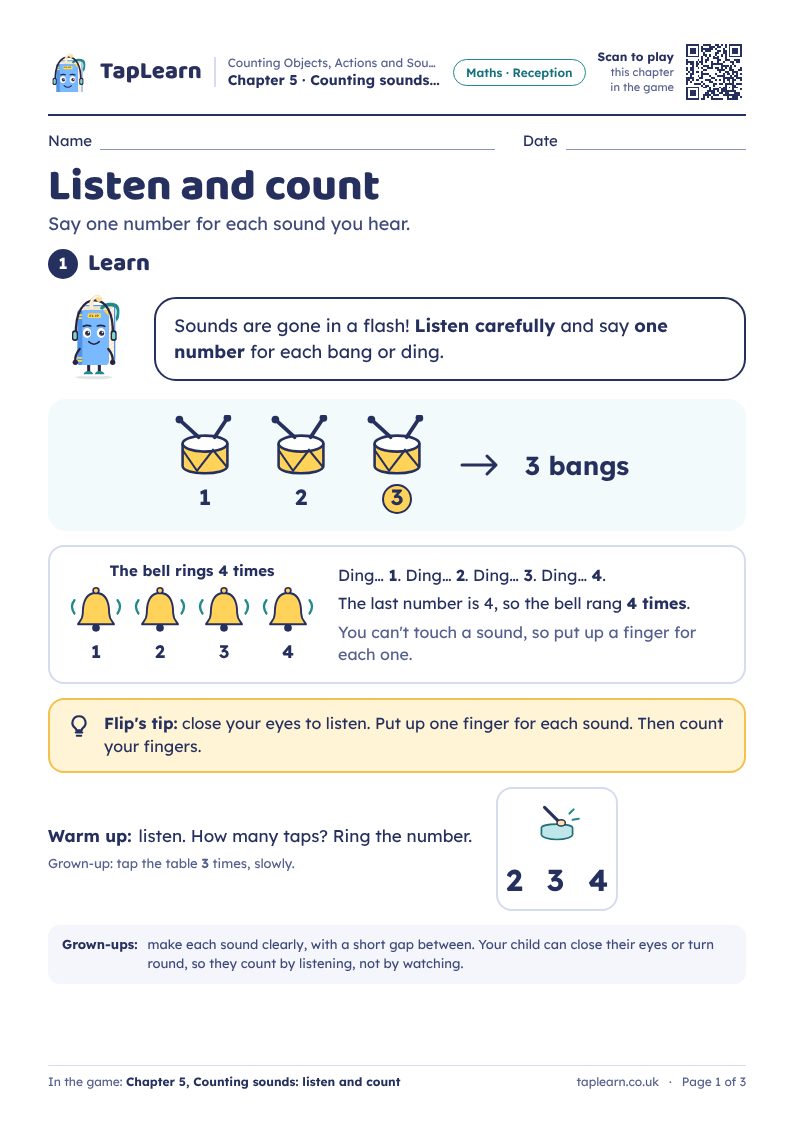
Listen and Count is a printable counting sounds worksheet for Reception (ages 4 to 5) that teaches children to close their eyes, listen and put up a finger for each bang or ding. It covers the Reception (EYFS) maths goal to count objects, actions and sounds.
This worksheet is for members
Membership opens every chapter of every game and every worksheet, for all your children.
See the plansAlready a member? Log in to print it.
Start with the free one: One number each (chapter 1).
Print it on A4, in colour or black and white. Do it after the chapter, or before it to see what your child already knows.
What's on the worksheet
Your child counts sounds like drum beats, taps and bells by listening carefully and saying one number for each sound. Includes a pan band listening game and an answers sheet.
- Page 1 · Learn
- Counting 3 bangs and a bell ringing 4 times, putting up a finger for each sound, Flip's tip to close your eyes and listen, and a listen-to-the-taps warm-up.
- Page 2 · Try it together
- Pan band: the grown-up taps a pan behind their back up to 10 times, the child counts aloud or with fingers, then you swap and try a bell or a rice tub.
- Page 3 · Practise
- Count sound pictures and write how many, colour a box for each clap, tap or bang a grown-up makes, ring the number of sounds, and a challenge about fast drum bangs.
- Answers sheet
- Every answer, mix-ups like watching instead of listening, and clock-chime and echo-me ideas.
3 A4 pages and an answers sheet · about 20 minutes
In the classroom
- Play pan band with a drum or tambourine behind a screen and have children show the count on fingers.
- Use echo me as a carpet-time warm-up: clap a number and the class claps it back.
Questions from the worksheet
- Listen. Colour one box for each sound you hear. Grown-up: clap 2 times. Tap 6 times. Bang a pan 9 times.
- Each picture is one sound. Count the sounds. Write how many.
- A drum goes bang, bang, bang, bang, bang, very fast. Leo says, "3 bangs!" Is he right? How many bangs were there?
The answers are on the answers sheet, for grown-ups.
National curriculum in England
This worksheet practises this statement from the Reception maths programme of study:
- Count objects, actions and sounds
Using it at home
- Make each sound clearly with a short gap between. Your child can close their eyes or turn round, so they count by listening.
- In pan band, write down how many taps you will make before you start, so you can check.
- Clap a number of times and ask your child to count, then clap the same number back.
Watch out for
- Missing sounds that come quickly.
- Start slowly with clear gaps, then speed up a little at a time.
- Watching instead of listening.
- Make the sounds out of sight, so your child counts with their ears.
- Counting an echo or a long ring as two.
- Use short sounds, like a tap, at first.
Questions and answers
How do children count sounds?
They listen carefully and say one number, or put up one finger, for each sound. Then they count their fingers.
Why close your eyes to count sounds?
It helps children count by listening rather than by watching the action that makes the sound.
What if my child misses sounds?
Make the sounds slower with clear gaps, then speed up a little at a time.
 TapLearn