Tens frame worksheet for Reception: Fill the frame
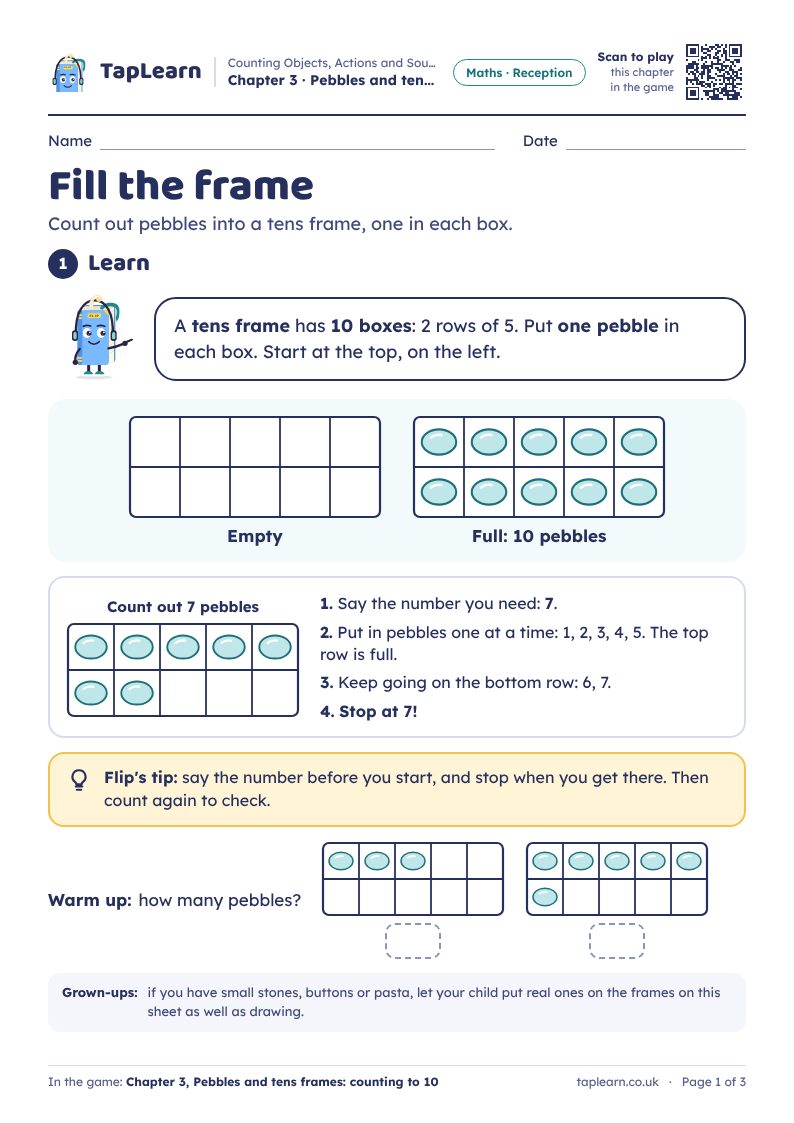
Fill the Frame is a printable tens frame worksheet for Reception (ages 4 to 5) that teaches children to count out a number of pebbles, one in each box starting top left, and to stop when they reach it. It covers the Reception (EYFS) maths goals to count objects, actions and sounds and to count confidently with a deep understanding of the numbers to 10, using things like small pebbles and tens frames.
This worksheet is for members
Membership opens every chapter of every game and every worksheet, for all your children.
See the plansAlready a member? Log in to print it.
Start with the free one: One number each (chapter 1).
Print it on A4, in colour or black and white. Do it after the chapter, or before it to see what your child already knows.
What's on the worksheet
Your child counts out a set number of pebbles, up to 10, into a tens frame, one in each box, and stops at the right number. Includes a pasta frames activity and an answers sheet.
- Page 1 · Learn
- An empty and a full tens frame with 2 rows of 5, a worked example counting out 7 pebbles, Flip's tip to say the number before you start, and a how-many-pebbles warm-up.
- Page 2 · Try it together
- Pasta frames: use the frame on the sheet or draw 2 rows of 5 boxes, the grown-up says a number up to 10, and the child counts out that many pasta pieces and checks.
- Page 3 · Practise
- Draw dots in tens frames to show numbers, say how many pebbles, tick the frame that shows 6, and a challenge about Leo putting in 9 pebbles instead of 8.
- Answers sheet
- Every answer, mix-ups like keeping going past the number, and egg-box and finger-frame ideas.
3 A4 pages and an answers sheet · about 20 minutes
Using it at home
- Let your child put real stones, buttons or pasta on the frames on the sheet as well as drawing.
- In pasta frames, try 5 first (a full top row), then 10, then numbers in between.
- Use an empty egg box as a frame and count pegs or pasta pieces into it.
Watch out for
- Keeping going past the number, like 9 when asked for 8.
- Say the number before starting, and say "Stop!" together when you reach it.
- Stopping too soon.
- Count what is in the frame again, then add more one at a time.
- Putting two in one box, or leaving gaps.
- One thing in each box, top row first, makes it easy to check.
Questions from the worksheet
- Draw dots in the tens frame to show the number.
- Ava needs 6 pebbles. Tick the frame that shows 6.
- Leo needs 8 pebbles. Look at his frame. Is he right? What should he do?
The answers are on the answers sheet, for grown-ups.
National curriculum in England
This worksheet practises these statements from the Reception maths programme of study:
- Count objects, actions and sounds
- Developing a strong grounding in number is essential so that all children develop the necessary building blocks to excel mathematically. Children should be able to count confidently, develop a deep understanding of the numbers to 10, the relationships between them and the patterns within those numbers. By providing frequent and varied opportunities to build and apply this understanding - such as using manipulatives, including small pebbles and tens frames for organising counting - children will develop a secure base of knowledge and vocabulary from which mastery of mathematics is built
In the classroom
- Give pairs a tens frame and counters: one says a number, the other counts it out.
- Show tens frames on the board and ask children to hold up fingers for how many.
Questions and answers
What is a tens frame?
A tens frame is a grid of 10 boxes in 2 rows of 5. Children put one thing in each box to count up to 10.
Why use a tens frame for counting?
It organises counting: one thing per box, top row first. A full top row is 5, so numbers like 7 are easy to see as 5 and 2.
How do you count out a number of objects?
Say the number first, put things in one at a time while counting, and stop when you reach it. Then count again to check.
 TapLearn