Counting actions worksheet for Reception: Claps and jumps
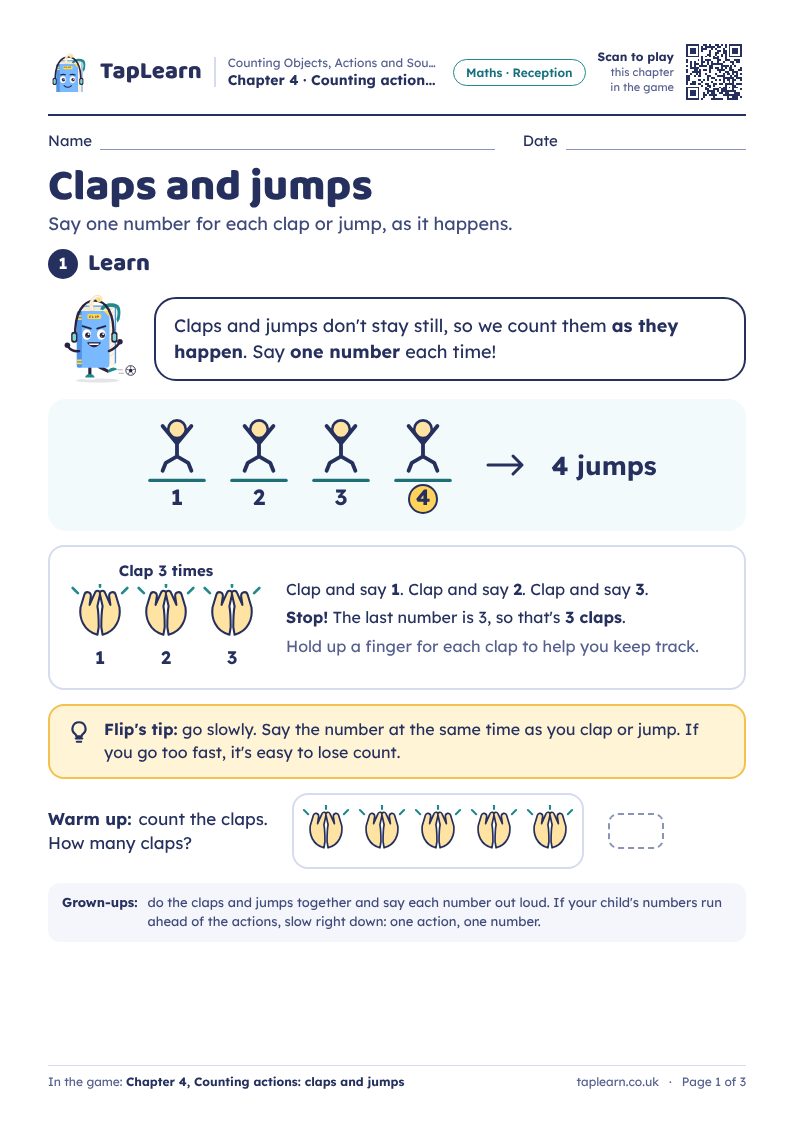
Claps and Jumps is a printable counting actions worksheet for Reception (ages 4 to 5) that teaches children to say one number at the same time as each clap or jump, using fingers to keep track. It covers the Reception (EYFS) maths goal to count objects, actions and sounds.
This worksheet is for members
Membership opens every chapter of every game and every worksheet, for all your children.
See the plansAlready a member? Log in to print it.
Start with the free one: One number each (chapter 1).
Print it on A4, in colour or black and white. Do it after the chapter, or before it to see what your child already knows.
What's on the worksheet
Your child counts actions like claps, jumps, stamps and hops as they happen, saying one number for each one. Includes a copy-my-moves activity and an answers sheet.
- Page 1 · Learn
- Counting 4 jumps and 3 claps as they happen, holding up a finger for each clap, Flip's tip to go slowly, and a count-the-claps warm-up.
- Page 2 · Try it together
- Copy my moves: the grown-up does up to 10 slow jumps while the child counts aloud, then you swap, and try claps, stamps and hops too.
- Page 3 · Practise
- Count actions and write how many, clap 4, jump 7 and stamp 2 while colouring a box for each, match actions to numbers, and a challenge about Sam's fast jumps.
- Answers sheet
- Every answer, mix-ups like losing track of quick actions, and bounce-count and Simon-says ideas.
3 A4 pages and an answers sheet · about 20 minutes
In the classroom
- Play Simon says count: "Simon says clap 6 times!" with the class counting aloud.
- Use copy my moves in pairs during a PE warm-up.
Questions from the worksheet
- Do it! Colour one box for each one: clap 4, jump 7, stamp 2.
- Count the actions. Write how many.
- Sam did 5 jumps very fast. He only counted "1, 2, 3." What went wrong? What could help Sam count his jumps?
The answers are on the answers sheet, for grown-ups.
National curriculum in England
This worksheet practises this statement from the Reception maths programme of study:
- Count objects, actions and sounds
Using it at home
- Do the claps and jumps together and say each number aloud. If your child's numbers run ahead, slow right down: one action, one number.
- In copy my moves, start slow and clear, then try a little faster, using fingers to keep count.
- Count bounces of a soft ball, or steps along the path to the door.
Watch out for
- Losing track with quick actions.
- Slow the actions down and say each number with each action.
- Saying numbers in a sing-song run that doesn't match the actions.
- Pause after each action, then say its number.
- Counting the last action twice as they stop.
- Ask "Was that a new jump, or the same one?"
Questions and answers
How do children count actions?
They say one number at the same time as each action, like a clap or jump. Holding up a finger for each one helps keep track.
Why is counting actions harder than counting objects?
Actions don't stay still, so you can't touch or move them. Children have to count as they happen.
What helps when counting fast actions?
Go slower, say one number with each action, or hold up a finger for each one.
 TapLearn