Column subtraction worksheet for Years 2–3
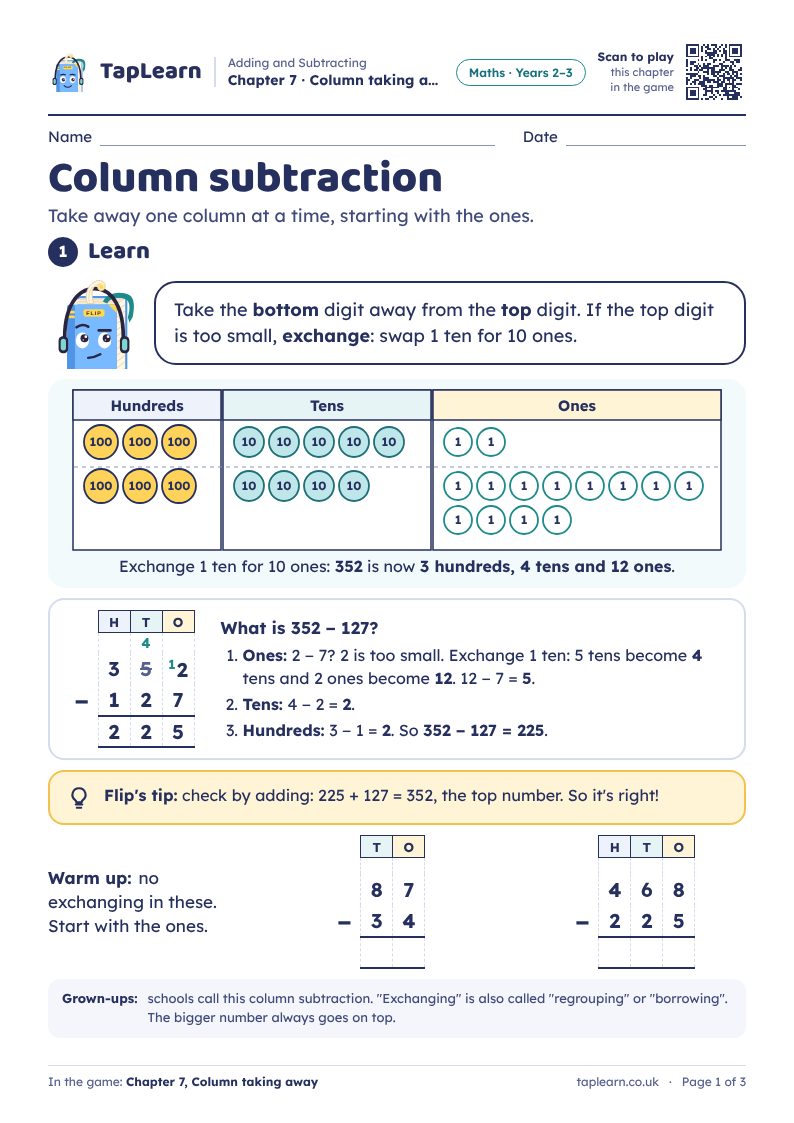
Column Subtraction is a printable column subtraction worksheet for Years 2 and 3 (ages 6 to 8) that teaches children to subtract 2- and 3-digit numbers in columns, exchanging a ten or a hundred when the top digit is too small. Children work up from sums with no exchanging to one that exchanges twice, and check each answer by adding.
This worksheet is for members
Membership opens every chapter of every game and every worksheet, for all your children.
See the plansAlready a member? Log in to print it.
Start with the free one: Bonds to 10 and 100 (chapter 1).
▶ Play chapter 7 in the game · How the column subtraction works
Print it on A4, in colour or black and white. Do it after the chapter, or before it to see what your child already knows.
What's on the worksheet
Your child subtracts 2- and 3-digit numbers with the column method, exchanging a ten or a hundred when the top digit is too small, and checks by adding. Includes a swap shop activity with coins or paper counters and an answers sheet.
- Page 1 · Learn
- Place value counters show 352 being exchanged into 3 hundreds, 4 tens and 12 ones, with a worked column subtraction of 352 − 127 and a no-exchanging warm-up.
- Page 2 · Try it together
- The swap shop: make 342 with paper counters or coins, take away 118, and swap 1 ten for 10 ones when there aren't enough ones. Then subtract with no exchanging.
- Page 3 · Practise
- Column subtractions that exchange a ten, ones that exchange a hundred including one that exchanges twice, and a challenge about taking the smaller digit from the bigger.
- Answers sheet
- Every answer with the exchanges shown, mix-ups like forgetting to cross out, and will-it-exchange and change-from-a-pound games.
3 A4 pages and an answers sheet · about 25 minutes
Using it at home
- "Exchanging" is also called "regrouping" or "borrowing". Use the word your child's school uses.
- After each swap in the swap shop, ask your child to count the number again to see it is still 342, just shown a different way.
- Take turns being the shopkeeper with your own numbers, keeping the bigger number on top.
Watch out for
- Taking the smaller digit from the bigger one instead of exchanging, as in 74 − 38 = 44.
- Say: "Always top take away bottom. Is the top digit big enough?"
- Adding 10 ones but not making the tens digit 1 smaller.
- Cross out the tens digit and write the new, smaller digit above it every time.
- Small slips of one or two.
- Check by adding the answer to the bottom number: it should make the top number.
Questions from the worksheet
- Exchange a ten for 10 ones: 63 − 27
- Exchange a ten for 10 ones: 452 − 128
- Exchange a hundred for 10 tens: 648 − 375
- The last one exchanges twice: 423 − 158
- Leo works out 74 − 38 and gets 44. Is he right? What did he do?
The answers are on the answers sheet, for grown-ups.
National curriculum in England
This worksheet practises these statements from the Year 2 maths programme of study:
- Add and subtract numbers using concrete objects, pictorial representations, and mentally, including: a two-digit number and 1s; a two-digit number and 10s; 2 two-digit numbers; adding 3 one-digit numbers
- Add and subtract numbers mentally, including: a three-digit number and 1s; a three-digit number and 10s; a three-digit number and 100s (Year 3 maths)
Source: National curriculum in England: mathematics programmes of study (DfE)
In the classroom
- Model the swap shop with place value counters on a visualiser, then have pairs run their own shop with numbers they choose.
- Use the will-it-exchange question as a starter: show a take-away and children decide before calculating.
Questions and answers
What is exchanging in column subtraction?
Exchanging means swapping 1 ten for 10 ones (or 1 hundred for 10 tens) when the top digit is too small to take away from. The number stays the same, just shown differently.
Is exchanging the same as borrowing?
Yes. Exchanging, regrouping and borrowing all describe the same step.
How do you check a column subtraction?
Add your answer to the number you took away. If you get the top number, the answer is right: 225 + 127 = 352.
More worksheets from Adding and Subtracting: Hop Along with Hopper the Frog
- Chapter 1: Number bonds to 10 worksheet: Bonds to 10 and 100 Free
- Chapter 2: Number line addition worksheet: Hop on a number line Members
- Chapter 3: Adding three numbers worksheet: Add in any order Members
- Chapter 4: Number line subtraction worksheet: Hop back to take away Members
- Chapter 5: Inverse operations worksheet: Check it with the inverse Members
- Chapter 6: Column addition worksheet Members
 TapLearn