Number line addition worksheet for Years 2–3: Hop on a number line
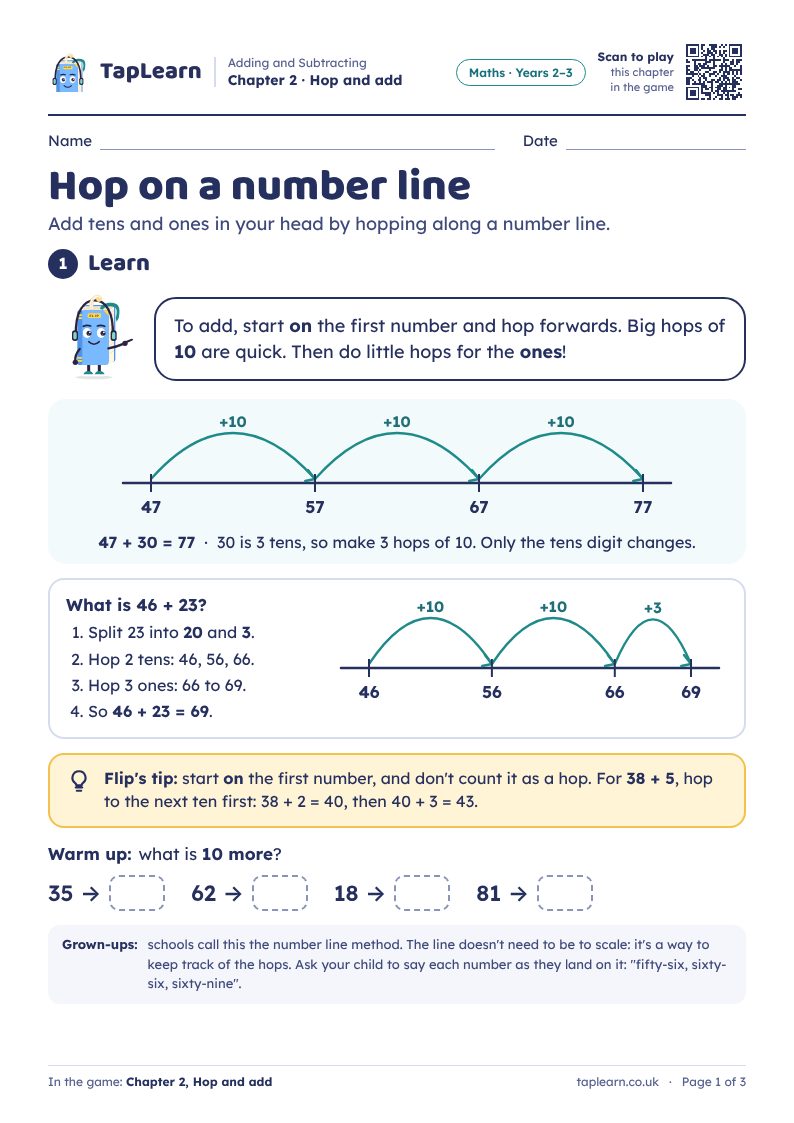
Hop on a Number Line is a printable number line addition worksheet for Years 2 and 3 (ages 6 to 8) that teaches children to add in their head by hopping on in tens and then ones. It covers adding a two-digit number and tens, two two-digit numbers, and ones, tens and hundreds to a three-digit number, as in the Year 2 and Year 3 national curriculum.
This worksheet is for members
Membership opens every chapter of every game and every worksheet, for all your children.
See the plansAlready a member? Log in to print it.
Start with the free one: Bonds to 10 and 100 (chapter 1).
▶ Play chapter 2 in the game · How the number line method works
Print it on A4, in colour or black and white. Do it after the chapter, or before it to see what your child already knows.
What's on the worksheet
Your child adds tens and ones in their head by hopping forwards on a number line, from 47 + 30 to 38 + 26, then adds ones, tens and hundreds to 3-digit numbers. Includes a tape measure hopping activity and an answers sheet.
- Page 1 · Learn
- Hops of 10 from 47 to 77, a worked example splitting 23 into 20 and 3 to work out 46 + 23, a tip on crossing a ten, and a 10-more warm-up.
- Page 2 · Try it together
- Tape measure hops: move a toy frog along a ruler or tape measure, predicting where it will land when you add 10, 20 or a number like 23. Then draw hops on number lines.
- Page 3 · Practise
- Add tens where only the tens digit changes, add 2-digit numbers in your head, add ones, tens and hundreds to 245 and 362, a sticker word problem, and a counting-on challenge.
- Answers sheet
- Every answer with worked hops for the trickier sums, the slips of one and ten to watch for, and two quick mental adding games.
3 A4 pages and an answers sheet · about 25 minutes
Using it at home
- Ask your child to say each number out loud as they land on it: "fifty-six, sixty-six, sixty-nine".
- With a 30 cm ruler, keep the answers up to 30. With a long tape measure, try bigger sums like 45 + 32.
- The number lines don't need to be to scale. They are just a way to keep track of the hops.
Watch out for
- Slipping by ten when adding tens, such as 36 + 20 = 66.
- Ask "How many tens are you adding? How many hops of 10?" and count the hops together.
- Landing one out by counting the start number.
- Say: "Put your finger on 35. Now hop: 36 is one."
- Getting stuck crossing a ten, like 47 + 5.
- Hop to the next ten first (47 + 3 = 50), then add the rest (50 + 2 = 52).
Questions from the worksheet
- Add the tens. Only the tens digit changes! 58 + 30 = ___
- Add in your head: 38 + 26 = ___
- Bigger numbers. Which digit changes? 245 + 3, 245 + 30, 245 + 300
- Leo has 48 stickers. He gets 30 more. How many stickers does he have now?
- Mia works out 35 + 4. She counts on her fingers: "35, 36, 37, 38. It's 38!" Is she right? What should she do?
The answers are on the answers sheet, for grown-ups.
National curriculum in England
This worksheet practises these statements from the Year 2 maths programme of study:
- Add and subtract numbers using concrete objects, pictorial representations, and mentally, including: a two-digit number and 1s; a two-digit number and 10s; 2 two-digit numbers; adding 3 one-digit numbers
- Add and subtract numbers mentally, including: a three-digit number and 1s; a three-digit number and 10s; a three-digit number and 100s (Year 3 maths)
Source: National curriculum in England: mathematics programmes of study (DfE)
In the classroom
- Draw a large empty number line on the playground and let children hop the tens and ones of a sum with their feet.
- Use Practise D as a whole-class check: children say which digit changes before working out each answer.
Questions and answers
What is the number line method for addition?
The number line method means starting on the first number and hopping forwards, tens first and then ones. For 46 + 23, hop 56, 66, then 67, 68, 69.
Which digit changes when you add tens?
When you add tens to a number, only the tens digit changes, unless you go past 100. So 36 + 20 = 56.
Why do children get counting on wrong by one?
They often count the start number as the first hop. The first hop from 35 lands on 36, so 35 + 4 is 39, not 38.
More worksheets from Adding and Subtracting: Hop Along with Hopper the Frog
- Chapter 1: Number bonds to 10 worksheet: Bonds to 10 and 100 Free
- Chapter 3: Adding three numbers worksheet: Add in any order Members
- Chapter 4: Number line subtraction worksheet: Hop back to take away Members
- Chapter 5: Inverse operations worksheet: Check it with the inverse Members
- Chapter 6: Column addition worksheet Members
- Chapter 7: Column subtraction worksheet Members
 TapLearn