Number line subtraction worksheet for Years 2–3: Hop back to take away
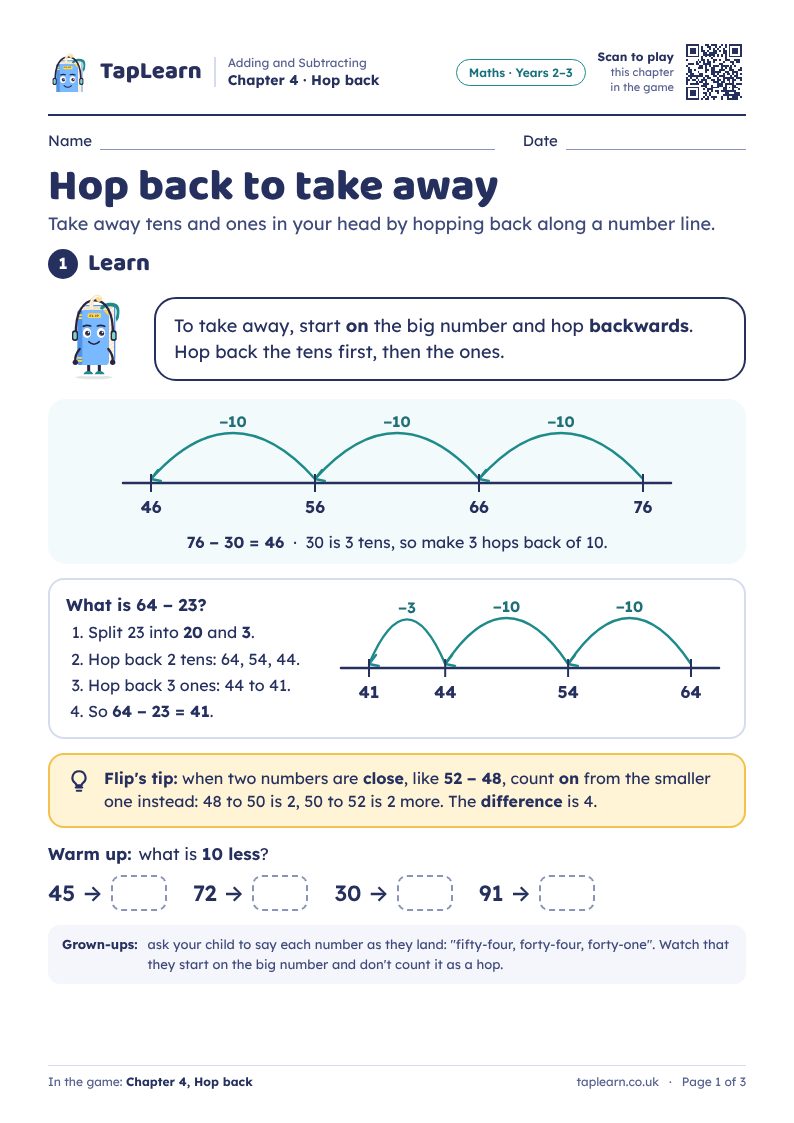
Hop Back to Take Away is a printable number line subtraction worksheet for Years 2 and 3 (ages 6 to 8) that teaches children to subtract in their head by hopping back in tens and then ones, and to count on to find the difference. It covers subtracting tens and two-digit numbers, and ones, tens and hundreds from a three-digit number, as in the Year 2 and Year 3 national curriculum.
This worksheet is for members
Membership opens every chapter of every game and every worksheet, for all your children.
See the plansAlready a member? Log in to print it.
Start with the free one: Bonds to 10 and 100 (chapter 1).
▶ Play chapter 4 in the game · How the number line method works
Print it on A4, in colour or black and white. Do it after the chapter, or before it to see what your child already knows.
What's on the worksheet
Your child takes away tens and ones in their head by hopping back on a number line, and counts on to find the difference between close numbers like 52 and 48. Includes a frog-hopping activity on a ruler and an answers sheet.
- Page 1 · Learn
- Hops back of 10 from 76 to 46, a worked example for 64 − 23, a tip on counting on when numbers are close, and a 10-less warm-up.
- Page 2 · Try it together
- The frog hops home: hop a toy frog back along a ruler to take away tens and ones, then put two coins on the ruler and count the hops between them to find the difference.
- Page 3 · Practise
- Take away tens, subtract 2-digit numbers in your head, take ones, tens and hundreds from 487 and 659, find differences by counting on, and a challenge about 63 − 20.
- Answers sheet
- Every answer with worked hops for the trickier sums, the slips of one and ten to watch for, and two counting-back games.
3 A4 pages and an answers sheet · about 25 minutes
Using it at home
- Ask your child to say each number as they land: "fifty-four, forty-four, forty-one".
- Watch that your child starts on the bigger number and doesn't count it as a hop. That's the usual reason for landing one out.
- Find the difference between two ages in the family by counting on from the younger age.
Watch out for
- Slipping by ten when taking away tens, such as 63 − 20 = 61.
- Ask "How many tens are you taking away?" and count the hops back together: 63, 53, 43.
- Landing one out by counting the start number.
- Start on 43: the first hop back lands on 42.
- Counting back a long way for close numbers, like 52 − 48.
- When the numbers are close, count on from the smaller one instead: 48 to 50 is 2, 50 to 52 is 2 more.
Questions from the worksheet
- Take away the tens: 81 − 60 = ___
- Take away in your head. Hop back the tens, then the ones: 61 − 27 = ___
- Bigger numbers. Which digit changes? 487 − 5, 487 − 50, 487 − 300
- These numbers are close. Count on to find the difference: 303 − 298 = ___
- Ava works out 63 − 20 and gets 61. Is she right? What did she do?
The answers are on the answers sheet, for grown-ups.
National curriculum in England
This worksheet practises these statements from the Year 2 maths programme of study:
- Add and subtract numbers using concrete objects, pictorial representations, and mentally, including: a two-digit number and 1s; a two-digit number and 10s; 2 two-digit numbers; adding 3 one-digit numbers
- Add and subtract numbers mentally, including: a three-digit number and 1s; a three-digit number and 10s; a three-digit number and 100s (Year 3 maths)
Source: National curriculum in England: mathematics programmes of study (DfE)
In the classroom
- Count back in tens from 97 round the class, then from a 3-digit number, to warm up before Practise B and D.
- Use Practise E as a discussion: which is quicker for 303 − 298, counting back or counting on?
Questions and answers
How do you subtract on a number line?
Start on the bigger number and hop back, tens first and then ones. For 64 − 23, hop back to 54 and 44, then 3 more to 41.
What does find the difference mean?
Finding the difference means working out how far apart two numbers are. For close numbers like 52 and 48, count on from 48 to 52: the difference is 4.
When should children count on instead of counting back?
Counting on is quicker when the two numbers are close together, like 61 − 58 or 100 − 95.
More worksheets from Adding and Subtracting: Hop Along with Hopper the Frog
- Chapter 1: Number bonds to 10 worksheet: Bonds to 10 and 100 Free
- Chapter 2: Number line addition worksheet: Hop on a number line Members
- Chapter 3: Adding three numbers worksheet: Add in any order Members
- Chapter 5: Inverse operations worksheet: Check it with the inverse Members
- Chapter 6: Column addition worksheet Members
- Chapter 7: Column subtraction worksheet Members
 TapLearn