Column addition worksheet for Years 2–3
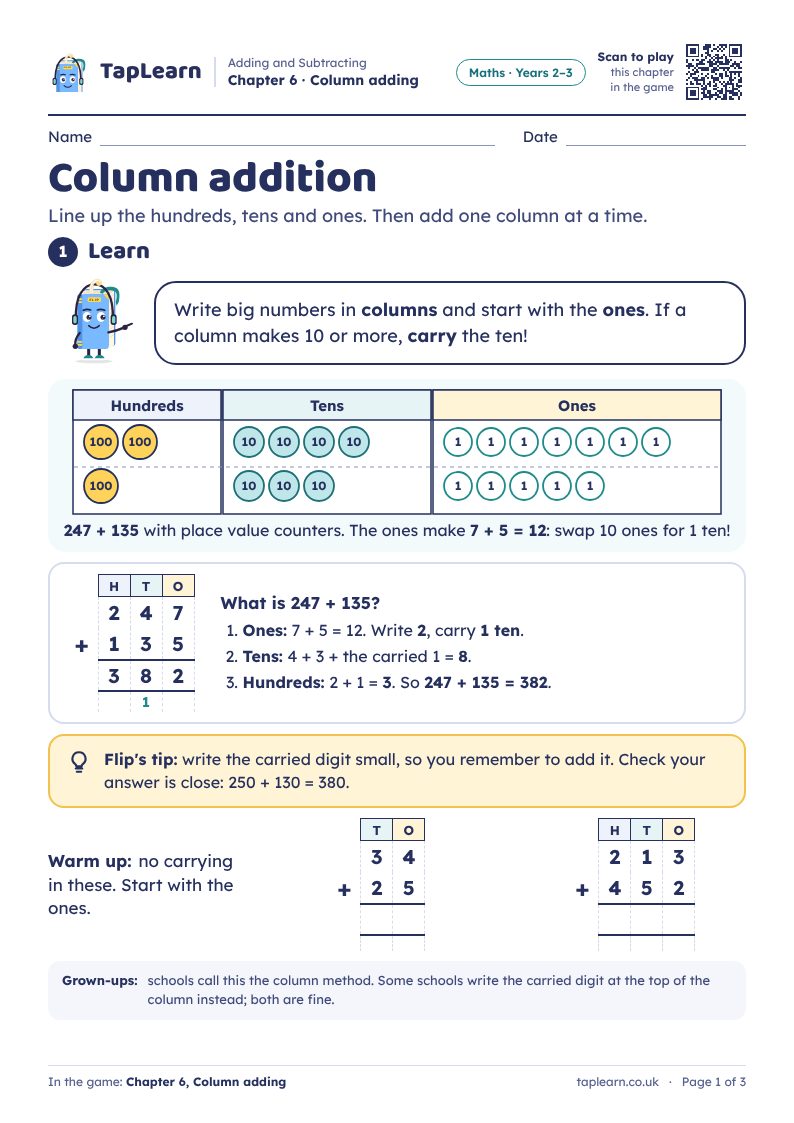
Column Addition is a printable column addition worksheet for Years 2 and 3 (ages 6 to 8) that teaches children to add 2- and 3-digit numbers in columns, starting with the ones and carrying a ten or a hundred. Children work up from sums with no carrying to sums that carry twice, using place value counters to see what carrying means.
This worksheet is for members
Membership opens every chapter of every game and every worksheet, for all your children.
See the plansAlready a member? Log in to print it.
Start with the free one: Bonds to 10 and 100 (chapter 1).
▶ Play chapter 6 in the game · How the column addition works
Print it on A4, in colour or black and white. Do it after the chapter, or before it to see what your child already knows.
What's on the worksheet
Your child adds 2- and 3-digit numbers with the column method, starting with the ones and carrying a ten or a hundred when a column makes 10 or more. Includes a counter columns activity with coins or paper counters and an answers sheet.
- Page 1 · Learn
- Place value counters show 247 + 135, with a step-by-step column sum carrying a ten, a tip on checking against an estimate, and a no-carrying warm-up.
- Page 2 · Try it together
- Counter columns: make 156 and 128 with paper counters or coins in H, T and O columns, push each column together and swap 10 ones for a ten. Then add with no carrying.
- Page 3 · Practise
- Column sums that carry a ten, sums that carry a hundred including one that carries twice, and a challenge about a forgotten carried ten in 156 + 38.
- Answers sheet
- Every answer with the column that carries, mix-ups like writing 12 in the ones column, and swap shop and will-it-carry games.
3 A4 pages and an answers sheet · about 25 minutes
Using it at home
- Let your child do the swap with their hands in Counter columns before they write the carried digit: the swap is what carrying means.
- Some schools write the carried digit at the top of the column instead of underneath. Follow whichever your child's school uses.
- Ask your child to estimate first, like 250 + 130 = 380, so they can spot a slip in their answer.
Watch out for
- Forgetting to carry a ten or a hundred into the next column.
- Ask "Did that column make 10 or more? Where does the extra ten go?"
- Writing both digits in the answer, like 12 in the ones column.
- Only one digit fits in each column: the ten moves next door.
- Lining up a 2-digit number from the left, as in 419 + 46.
- Ones go under ones and tens under tens. Write H, T and O above the columns.
Questions from the worksheet
- Carry a ten. The ones make 10 or more: 38 + 45
- Carry a ten: 419 + 46
- Carry a hundred. The tens make 10 or more: 274 + 152
- The last one carries twice: 168 + 257
- Mia works out 156 + 38 and gets 184. Is she right? What has she forgotten?
The answers are on the answers sheet, for grown-ups.
National curriculum in England
This worksheet practises these statements from the Year 2 maths programme of study:
- Add and subtract numbers using concrete objects, pictorial representations, and mentally, including: a two-digit number and 1s; a two-digit number and 10s; 2 two-digit numbers; adding 3 one-digit numbers
- Add and subtract numbers mentally, including: a three-digit number and 1s; a three-digit number and 10s; a three-digit number and 100s (Year 3 maths)
Source: National curriculum in England: mathematics programmes of study (DfE)
In the classroom
- Run Counter columns as a group activity with place value counters on large H, T and O mats before moving to written sums.
- Use the will-it-carry question as a quick starter: say two numbers and children show yes or no before calculating.
Questions and answers
What is carrying in column addition?
Carrying means moving a ten into the next column when a column adds up to 10 or more. 10 ones become 1 ten, and 10 tens become 1 hundred.
Why do you start column addition with the ones?
Starting with the ones means any ten you carry can be added into the tens column before you work it out.
Where should the carried digit go?
Schools write it small, either under the answer line or at the top of the next column. Both are fine as long as it gets added.
More worksheets from Adding and Subtracting: Hop Along with Hopper the Frog
- Chapter 1: Number bonds to 10 worksheet: Bonds to 10 and 100 Free
- Chapter 2: Number line addition worksheet: Hop on a number line Members
- Chapter 3: Adding three numbers worksheet: Add in any order Members
- Chapter 4: Number line subtraction worksheet: Hop back to take away Members
- Chapter 5: Inverse operations worksheet: Check it with the inverse Members
- Chapter 7: Column subtraction worksheet Members
 TapLearn