Adding three numbers worksheet for Years 2–3: Add in any order
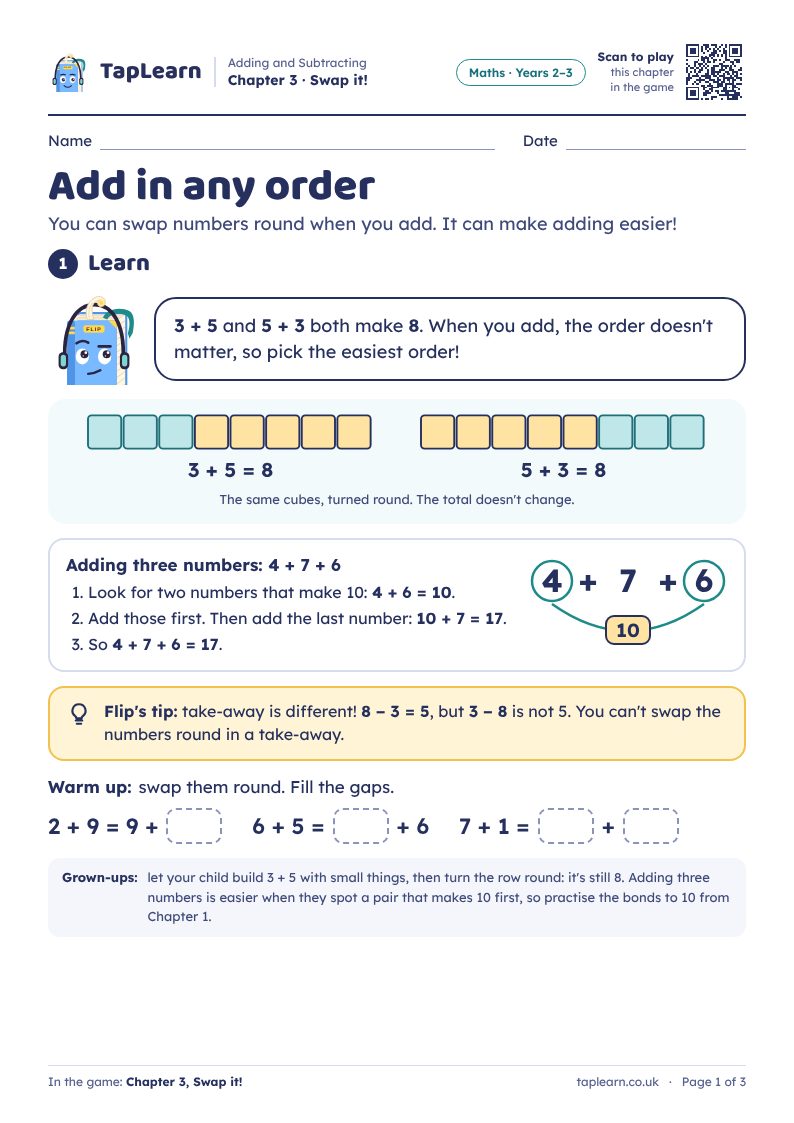
Add in Any Order is a printable adding three numbers worksheet for Years 2 and 3 (ages 6 to 8) that teaches children that addition can be done in any order and how to add three one-digit numbers by finding a pair that makes 10. It covers the Year 2 national curriculum statement on adding three one-digit numbers.
This worksheet is for members
Membership opens every chapter of every game and every worksheet, for all your children.
See the plansAlready a member? Log in to print it.
Start with the free one: Bonds to 10 and 100 (chapter 1).
Print it on A4, in colour or black and white. Do it after the chapter, or before it to see what your child already knows.
What's on the worksheet
Your child learns that adding works in any order but taking away does not, and adds three one-digit numbers by spotting a pair that makes 10 first. Includes a three-card totals game and an answers sheet.
- Page 1 · Learn
- Cubes show 3 + 5 and 5 + 3 both make 8, a worked example for 4 + 7 + 6 by making 10 first, why take-away can't be swapped, and a turnaround warm-up.
- Page 2 · Try it together
- Three-card totals: turn over three playing cards, look for two that make 10, add the third, then add again in a different order to check the total is the same.
- Page 3 · Practise
- True or false turnaround facts, ring the pair that makes 10 and add all three, fill the gaps, a pencils word problem, and a challenge about swapping in a take-away.
- Answers sheet
- Every answer with the pair to add first, the mix-ups to watch for, and fruit bowl and turnaround games for home.
3 A4 pages and an answers sheet · about 25 minutes
Using it at home
- Let your child build 3 + 5 with small things, then turn the row round so they can see it still makes 8.
- In three-card totals, ask "Which order was easiest? Why?" after each go.
- Finish with a take-away using two cards, like 9 − 4, and ask whether you can take 9 away from 4.
Watch out for
- Swapping the numbers in a take-away, like writing 4 − 9 for 9 − 4.
- Act it out: you can't eat 9 grapes from a bowl of 4.
- Always adding three numbers from left to right.
- That's fine, but slower. Ask "Can you see two that make 10?"
- Forgetting the third number after making 10.
- Let your child tick each number as they use it.
Questions from the worksheet
- True or false? 9 − 4 = 4 − 9
- Ring the two numbers that make 10. Then add all three: 3 + 8 + 7
- Fill the gaps: 3 + 5 + 7 = 5 + ___ + 3
- Sam has 6 red, 7 blue and 4 green pencils. How many pencils does he have? Write the sum in the easiest order.
- Leo says, "12 − 5 is the same as 5 − 12, because you can swap the numbers round." Is he right? Why?
The answers are on the answers sheet, for grown-ups.
National curriculum in England
This worksheet practises these statements from the Year 2 maths programme of study:
- Add and subtract numbers using concrete objects, pictorial representations, and mentally, including: a two-digit number and 1s; a two-digit number and 10s; 2 two-digit numbers; adding 3 one-digit numbers
- Add and subtract numbers mentally, including: a three-digit number and 1s; a three-digit number and 10s; a three-digit number and 100s (Year 3 maths)
Source: National curriculum in England: mathematics programmes of study (DfE)
In the classroom
- Play three-card totals in pairs, with each child adding in a different order and checking they reach the same total.
- Use Practise A as a show-me check: thumbs up for true, thumbs down for false.
Questions and answers
How do you add three one-digit numbers?
Look for two numbers that make 10, add those first, then add the third. For 4 + 7 + 6, add 4 + 6 = 10, then 10 + 7 = 17.
Can you add numbers in any order?
Yes. Addition gives the same answer in any order, so 3 + 5 = 5 + 3. Schools may call these turnaround facts.
Can you swap the numbers in a subtraction?
No. 8 − 3 is 5, but 3 − 8 is not 5, so the numbers in a take-away can't be swapped.
More worksheets from Adding and Subtracting: Hop Along with Hopper the Frog
- Chapter 1: Number bonds to 10 worksheet: Bonds to 10 and 100 Free
- Chapter 2: Number line addition worksheet: Hop on a number line Members
- Chapter 4: Number line subtraction worksheet: Hop back to take away Members
- Chapter 5: Inverse operations worksheet: Check it with the inverse Members
- Chapter 6: Column addition worksheet Members
- Chapter 7: Column subtraction worksheet Members
 TapLearn