Number bonds to 10 worksheet for Years 2–3: Bonds to 10 and 100
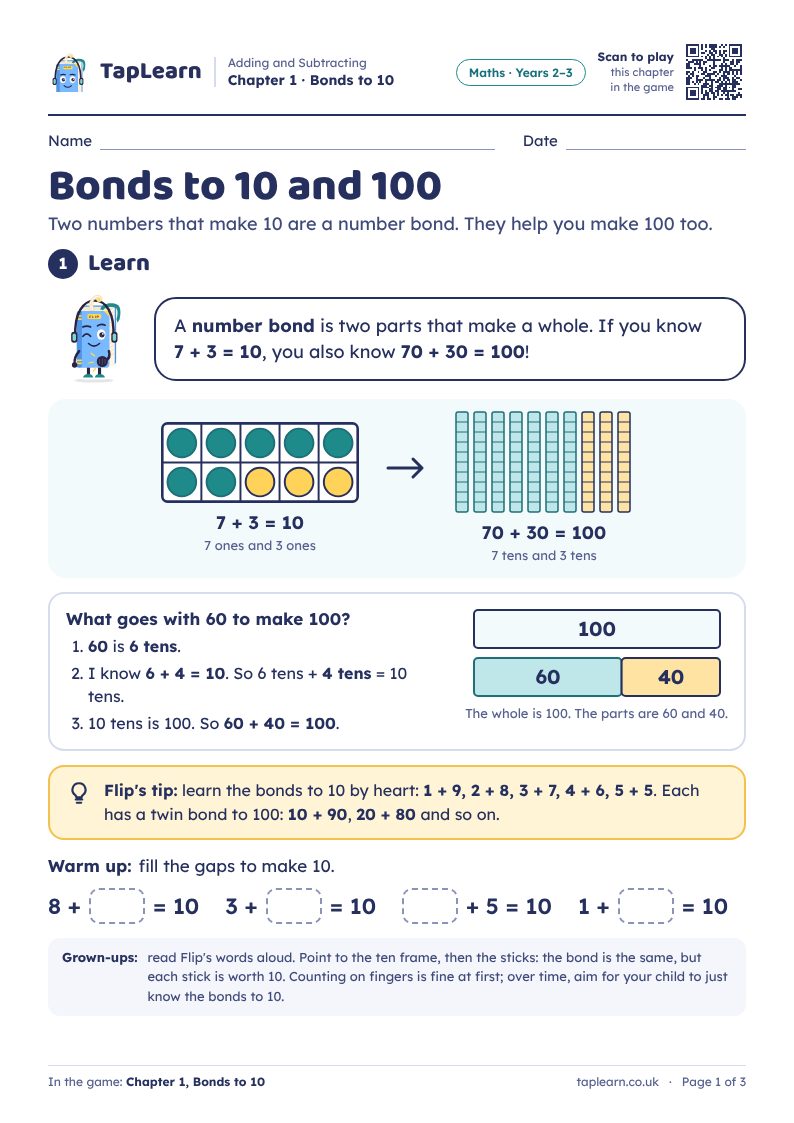
Bonds to 10 and 100 is a printable number bonds to 10 worksheet for Years 2 and 3 (ages 6 to 8) that teaches children to recall the pairs that make 10 and use them to find pairs of tens that make 100. Children fill ten frames, join pairs that make 100 and use take-away facts from 100.
Free to print, no account needed.
▶ Play chapter 1 in the game · How the number bonds works
Print it on A4, in colour or black and white. Do it after the chapter, or before it to see what your child already knows.
What's on the worksheet
Your child practises number bonds to 10, then uses each one to find a pair of tens that makes 100, like 60 + 40. Includes a hide-and-seek counting game with pasta or buttons and an answers sheet.
- Page 1 · Learn
- A ten frame and tens sticks show that 7 + 3 = 10 means 70 + 30 = 100, with a worked example finding what goes with 60 to make 100 and a bonds-to-10 warm-up.
- Page 2 · Try it together
- Hide and seek bonds: hide some of 10 small things under a cup, work out how many are hiding, then say the matching bond to 100. Then fill in ten frames.
- Page 3 · Practise
- Join pairs that make 100, fill gaps like 100 − 30, write bonds to 100 from bonds to 10, and a challenge about whether 64 + 46 makes 100.
- Answers sheet
- Every answer, why 64 + 46 is 110 not 100, the mix-ups to watch for, and two quick bond games with no paper.
3 A4 pages and an answers sheet · about 25 minutes
Using it at home
- In hide and seek bonds, ask "How many more to make 10?" if your child gets stuck, and try hiding none or all 10 too.
- Counting on fingers is fine at first. Over a few weeks, aim for your child to just know the bonds to 10.
- When your child gives a bond to 10, ask them to say its twin straight away: "3 + 7 = 10, so 30 + 70 = 100".
Watch out for
- Mixing ones and tens, such as 60 + 4 = 100.
- Say it in tens: "6 tens and 4 tens make 10 tens", so the answer is 40.
- Counting from 1 each time to find a bond.
- It works but it's slow. Play quick bond games until the bonds to 10 are known by heart.
- Getting stuck on take-away from 100, like 100 − 30.
- Show it is the same bond: 30 + 70 = 100, so 100 − 30 = 70.
Questions from the worksheet
- Join the pairs that make 100: 30, 90, 50, 20, 60 with 50, 80, 10, 40, 70.
- Fill the gaps: 40 + ___ = 100
- Fill the gaps: 100 − 30 = ___
- Sam says, "I know 2 + 8 = 10, so I know 20 + 80 = 100." Write two more like Sam.
- Leo says, "64 + 46 = 100, because 6 + 4 = 10." Is he right? What goes with 64 to make 100?
The answers are on the answers sheet, for grown-ups.
National curriculum in England
This worksheet practises these statements from the Year 2 maths programme of study:
- Add and subtract numbers using concrete objects, pictorial representations, and mentally, including: a two-digit number and 1s; a two-digit number and 10s; 2 two-digit numbers; adding 3 one-digit numbers
- Add and subtract numbers mentally, including: a three-digit number and 1s; a three-digit number and 10s; a three-digit number and 100s (Year 3 maths)
Source: National curriculum in England: mathematics programmes of study (DfE)
In the classroom
- Play bond ping-pong as a starter: call a number up to 10 and the class calls back its partner, then switch to tens to 100.
- Use Practise B as a mini-whiteboard check: show a multiple of 10 and children write the number that makes 100.
Questions and answers
What are number bonds to 10?
Number bonds to 10 are pairs of numbers that add up to 10: 1 + 9, 2 + 8, 3 + 7, 4 + 6 and 5 + 5, plus 10 + 0.
How do number bonds to 10 help with bonds to 100?
Each bond to 10 has a twin bond to 100 using tens. Because 6 + 4 = 10, 6 tens and 4 tens make 10 tens, so 60 + 40 = 100.
Why is 64 + 46 not 100?
64 + 46 is 110. The ones make 4 + 6 = 10, a new ten, so the tens need to make 9, not 10: 64 + 36 = 100.
More worksheets from Adding and Subtracting: Hop Along with Hopper the Frog
- Chapter 2: Number line addition worksheet: Hop on a number line Members
- Chapter 3: Adding three numbers worksheet: Add in any order Members
- Chapter 4: Number line subtraction worksheet: Hop back to take away Members
- Chapter 5: Inverse operations worksheet: Check it with the inverse Members
- Chapter 6: Column addition worksheet Members
- Chapter 7: Column subtraction worksheet Members
 TapLearn