Inverse operations worksheet for Years 2–3: Check it with the inverse
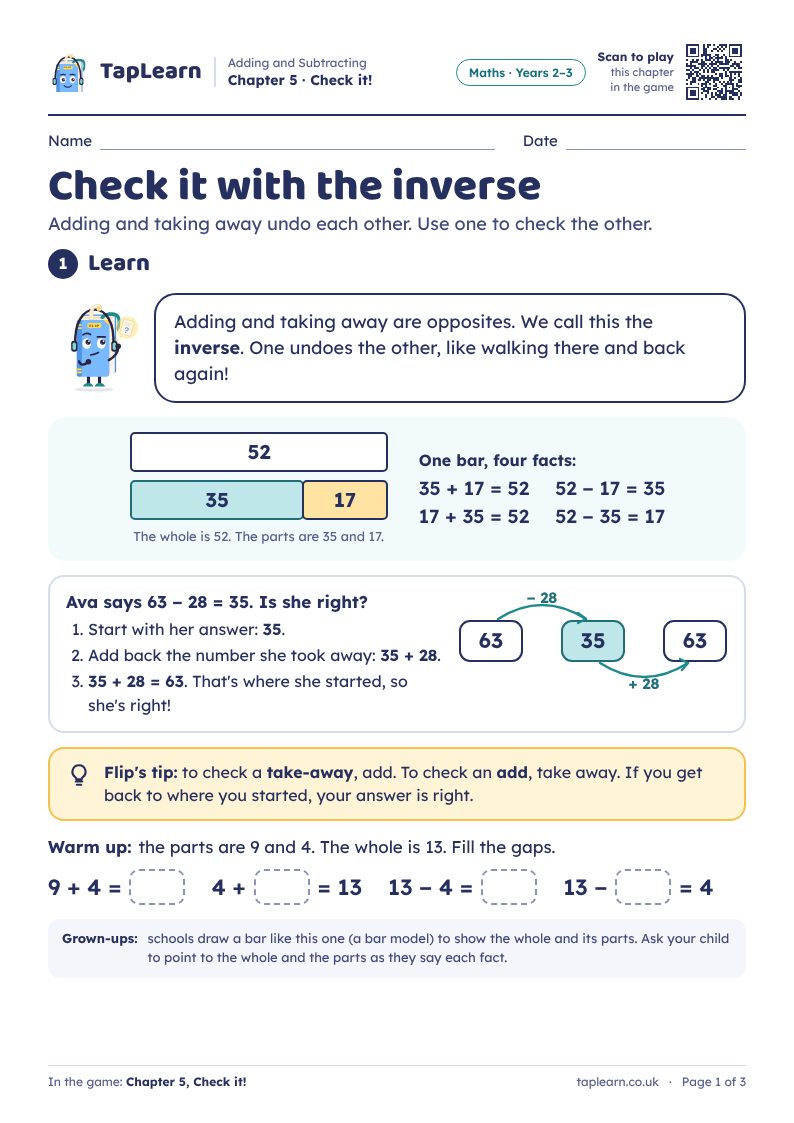
Check It with the Inverse is a printable inverse operations worksheet for Years 2 and 3 (ages 6 to 8) that teaches children that adding and taking away undo each other, and how to use this to check answers. Children write checks, spot wrong answers, find missing numbers and write the four facts for a bar model.
This worksheet is for members
Membership opens every chapter of every game and every worksheet, for all your children.
See the plansAlready a member? Log in to print it.
Start with the free one: Bonds to 10 and 100 (chapter 1).
▶ Play chapter 5 in the game · How the inverse operations works
Print it on A4, in colour or black and white. Do it after the chapter, or before it to see what your child already knows.
What's on the worksheet
Your child uses the inverse to check answers, adding to check a take-away and taking away to check an add, and writes the four facts for a bar model. Includes an undo-it counting activity and an answers sheet.
- Page 1 · Learn
- A bar model shows four facts for 35, 17 and 52, with a worked example checking 63 − 28 = 35 by adding back, and a fact family warm-up.
- Page 2 · Try it together
- Undo it: take some things from a pile of 20 to 30 into a cup, write the take-away, then tip the cup back to check that left + took away makes the start number.
- Page 3 · Practise
- Write the check for four sums, check answers and ring right or wrong, find missing numbers, write four facts for a bar, and a challenge about checking a take-away.
- Answers sheet
- Every answer, including which sums are wrong and why, mix-ups like checking a take-away by taking away again, and fact family games.
3 A4 pages and an answers sheet · about 25 minutes
Using it at home
- Ask your child to point to the whole and the parts of the bar as they say each of the four facts.
- In Undo it, if the last column doesn't match the first, count again together: it means a counting slip, not a wrong idea.
- After the activity, ask "What did tipping the cup back do?" so your child says in their own words that it undid the take-away.
Watch out for
- Checking a take-away by taking away again.
- Ask "What undoes taking away?" Adding does: add the answer to the number taken away.
- Adding the wrong two numbers to check, like 90 + 36.
- Point to the bar: the two parts add up to the whole.
- Missing numbers at the start, like ___ − 15 = 40.
- Draw a bar: 40 and 15 are the parts, so the whole is 40 + 15 = 55.
Questions from the worksheet
- Use the inverse. Fill the gap to write the check: 68 − 25 = 43. Check: 43 + ___ = 68
- Check each answer with the inverse, then ring right or wrong: 90 − 36 = 64
- Find the missing number. Use the inverse to help: ___ − 15 = 40
- Write the four facts for this bar: 100, 65 and 35.
- Sam checks 53 − 18 = 35 by working out 35 − 18. Is that a good check? What should Sam do?
The answers are on the answers sheet, for grown-ups.
National curriculum in England
This worksheet practises these statements from the Year 2 maths programme of study:
- Add and subtract numbers using concrete objects, pictorial representations, and mentally, including: a two-digit number and 1s; a two-digit number and 10s; 2 two-digit numbers; adding 3 one-digit numbers
- Add and subtract numbers mentally, including: a three-digit number and 1s; a three-digit number and 10s; a three-digit number and 100s (Year 3 maths)
Source: National curriculum in England: mathematics programmes of study (DfE)
In the classroom
- Run Undo it in pairs with counters and have each pair record three take-aways and their checks.
- Give three numbers such as 6, 9 and 15 on the board and ask children to write the four facts on mini-whiteboards.
Questions and answers
What is the inverse in maths?
The inverse is the opposite operation that undoes another one. Adding and taking away are inverses, so 35 + 17 = 52 can be undone by 52 − 17 = 35.
How do you check a subtraction answer?
Add your answer to the number you took away. If you get back to the start number, the answer is right: 35 + 28 = 63 checks 63 − 28 = 35.
What is a fact family?
A fact family is the set of four facts made from one whole and its two parts. For 9, 4 and 13: 9 + 4 = 13, 4 + 9 = 13, 13 − 4 = 9 and 13 − 9 = 4.
More worksheets from Adding and Subtracting: Hop Along with Hopper the Frog
- Chapter 1: Number bonds to 10 worksheet: Bonds to 10 and 100 Free
- Chapter 2: Number line addition worksheet: Hop on a number line Members
- Chapter 3: Adding three numbers worksheet: Add in any order Members
- Chapter 4: Number line subtraction worksheet: Hop back to take away Members
- Chapter 6: Column addition worksheet Members
- Chapter 7: Column subtraction worksheet Members
 TapLearn