Learn Year 6 mental maths strategies for big numbers and mixed operations, then fly a rocket home by solving calculations in your head.
Online game, chapter 1 free · Year 6 (KS2) · ages 10–11 · national curriculum in England · no adverts · plays on a phone, tablet or computer · no sign-up to start.
An online maths game for Year 6 (KS2). It covers the national curriculum in England, Year 6 maths: “Perform mental calculations, including with mixed operations and large numbers”.
6 short chapters, about 45 minutes in all. Children can stop after any chapter.
Start playing for free. Plays in the browser on phones, tablets and computers: no app, no adverts.
Methods taught, by the names schools use: partitioning, doubling and halving, round and adjust.
Free for teachers: every chapter on the whiteboard with a free teacher account.
Last updated · Checked against the national curriculum in England by the TapLearn team
What you'll learn
Use times-table facts and place value to solve 80 × 700
Round numbers like 2,998 to 3,000, then adjust the right way
Use constant difference to turn tricky subtractions into easy ones
Partition numbers to multiply and divide large numbers mentally
Double one factor and halve the other without changing the product
Multiply or divide before adding or subtracting, and estimate to check
Chapter by chapter
Use known facts with huge numbersStart playing for free
What the chapters cover in the national curriculum in England:
Year 6 maths: Perform mental calculations, including with mixed operations and large numbers
About this adventure
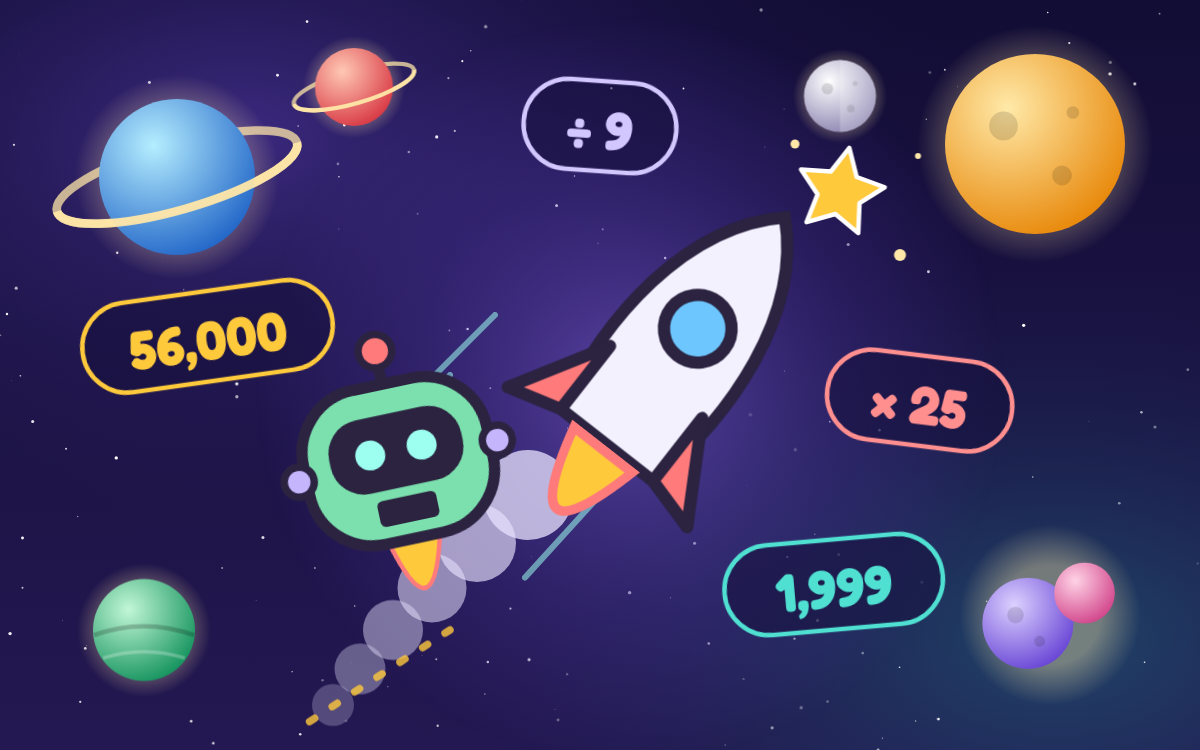
Year 6 Mental Maths: A Brainstorm Rocket Mission is an interactive game that teaches children aged 10–11 to work out calculations with large numbers and mixed operations in their head. The rocket's calculator has broken, so Nova the robot guides the player planet by planet, learning a different mental strategy on each one.
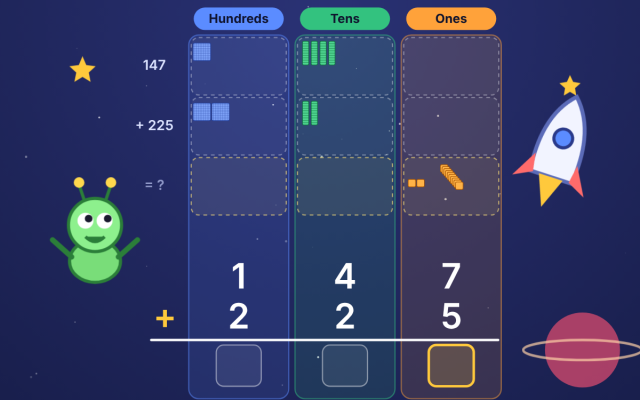
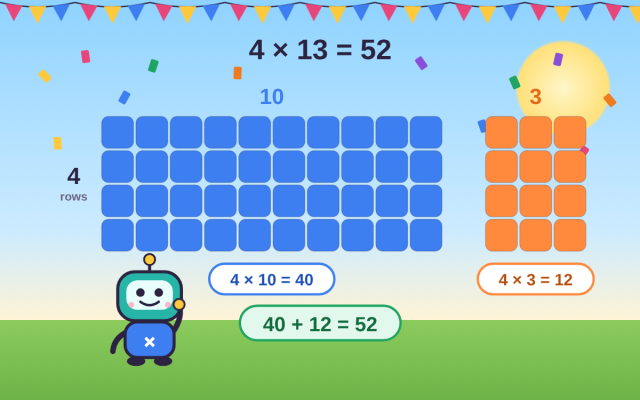
Players slide digits along a place value chart, jump along number lines, split area models into easy parts and reshape rectangles to see why tricks work. They meet compensation (rounding a number like 1,999 to 2,000, then adjusting), constant difference, partitioning, and doubling and halving. Every planet ends with typed and multiple-choice practice that gives a tailored hint when a common mistake shows up.
The last planet brings the strategies together: doing multiplication before subtraction, choosing whether a calculation suits mental or written methods, and estimating to check whether an answer is sensible.
Questions and answers
What mental maths strategies are taught in Year 6?
Year 6 children are expected to use mental methods with large numbers and mixed operations. Common strategies include using known facts and place value, rounding and adjusting, constant difference, partitioning, and doubling and halving, plus doing multiplication and division before addition and subtraction.
How do you subtract a number like 2,998 in your head?
Subtract 3,000, then add 2 back, because taking away 3,000 removes 2 too many. For example, 7,240 − 2,998 is 7,240 − 3,000 = 4,240, then 4,240 + 2 = 4,242.
What is the constant difference method in subtraction?
Constant difference means adding or taking away the same amount from both numbers, which keeps the answer the same. So 23,004 − 18,998 becomes 23,006 − 19,000, which is much easier to work out: 4,006.
What age is this mental maths game for?
The game is designed for children aged 10 to 11, matching the Year 6 national curriculum in England. Confident Year 5 pupils and older children revising before KS2 SATs or starting Year 7 can also use it to practise.
What does the Brainstorm Rocket game include and how long does it take?
It includes six planets, each teaching one mental strategy with hands-on visuals and five practice questions, followed by a 10-question launch challenge. Playing everything takes about 45 minutes, and children can start from any planet.
We count visits to make TapLearn better.We use one cookie, only on this site, to see how families find and use it. No adverts, and nothing is shared.One cookie, only on this site. No adverts.How we measure

 TapLearn