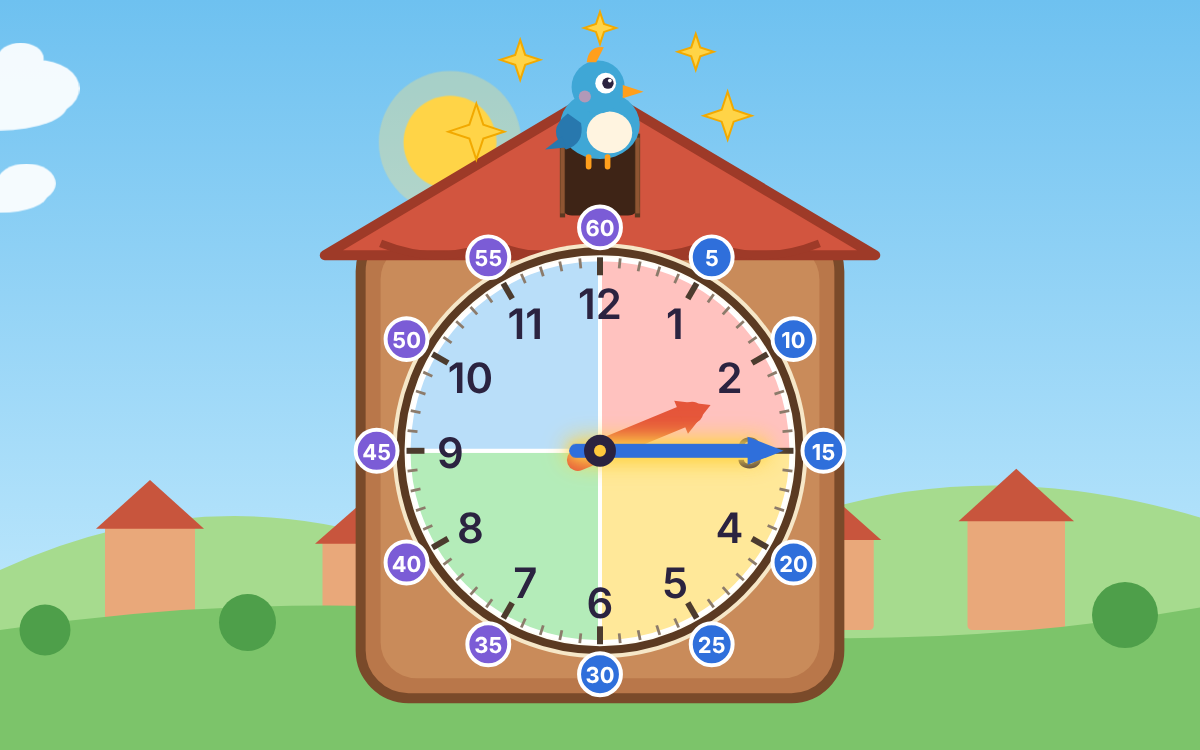
Telling the Time: Fix the Clocks of Time Town with Koo
Learn all about telling the time: read clocks to five minutes, quarter past and quarter to, draw the hands and compare how long things take.
- Ages 6–8
- About 50 min
- Easy start
- Shapes & Measures
Learn all about telling the time: read clocks to five minutes, quarter past and quarter to, draw the hands and compare how long things take.
Year 2 maths · 1
Year 2 maths · 1 Year 2 maths · 2
Year 2 maths · 1
Year 2 maths · 1
Year 2 maths · 2
Year 2 maths · 3 Year 2 maths · 2
What the chapters cover in the national curriculum in England:
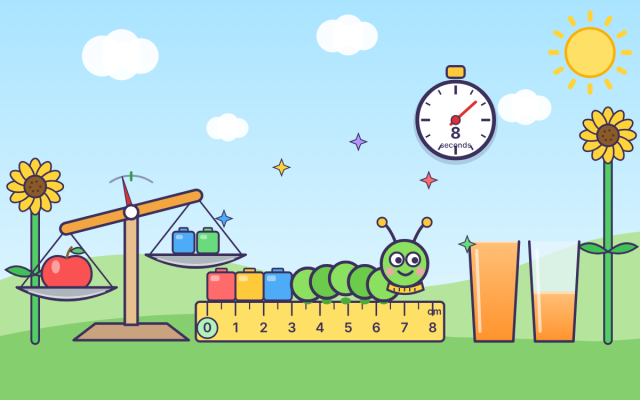
Telling the Time is an interactive maths game that teaches children aged 6–8 to read and write the time to five minutes, draw the hands on a clock and compare lengths of time, following Year 2 of the national curriculum in England.
Koo the cuckoo guides each step out loud on a cuckoo clock in Time Town. Children drag the long minute hand and watch the short hour hand creep along, count round the clock in fives, build written times such as "25 to 9" from word tiles and type answers on a number pad.
They meet the key ideas of the 'past' side and the 'to' side of the clock face, why the hour hand sits between two numbers, and duration, meaning how long something takes. Hints respond to common slips, such as saying "4 past" instead of "20 past".
Start by counting round the clock in fives, because each number on the clock face stands for 5 minutes. Once a child can count from the 12 to wherever the minute hand points, they can say times such as 20 past 4 or 25 to 9.
Quarter past means 15 minutes after the hour, with the minute hand pointing to the 3. Quarter to means 15 minutes before the next hour, with the minute hand on the 9 and the hour hand nearly at the next number.
There are 60 minutes in an hour and 24 hours in a day. The minute hand goes all the way round the clock once every hour, while the hour hand goes round twice a day: from midnight to midday, then from midday to midnight.
In England, children learn o'clock and half past in Year 1 (ages 5–6) and telling the time to five minutes in Year 2 (ages 6–7). This game is made for ages 6–8, so it also suits older children who need a refresher.
It has six guided chapters and a 10-question challenge, taking about 50 minutes to play everything. Every instruction is read aloud, children answer by dragging clock hands, tapping, building written times and typing numbers, and they can pick any chapter from the map.



 TapLearn
Getting it ready…
Great work on chapter 1! To open the next chapters, ask a grown-up to take a look.
To play this game, ask a grown-up to take a look. There are lots of free games you can play right now too!
Create a free family account and your child can play every chapter of every game for 7 days, with no card needed. Their progress is kept. After that, the free plan is free for ever, and membership is £6.99 a month if you'd like to keep every chapter.
That's all the learning time for today. Great work! Flip will be ready to play again tomorrow.