What you'll learn
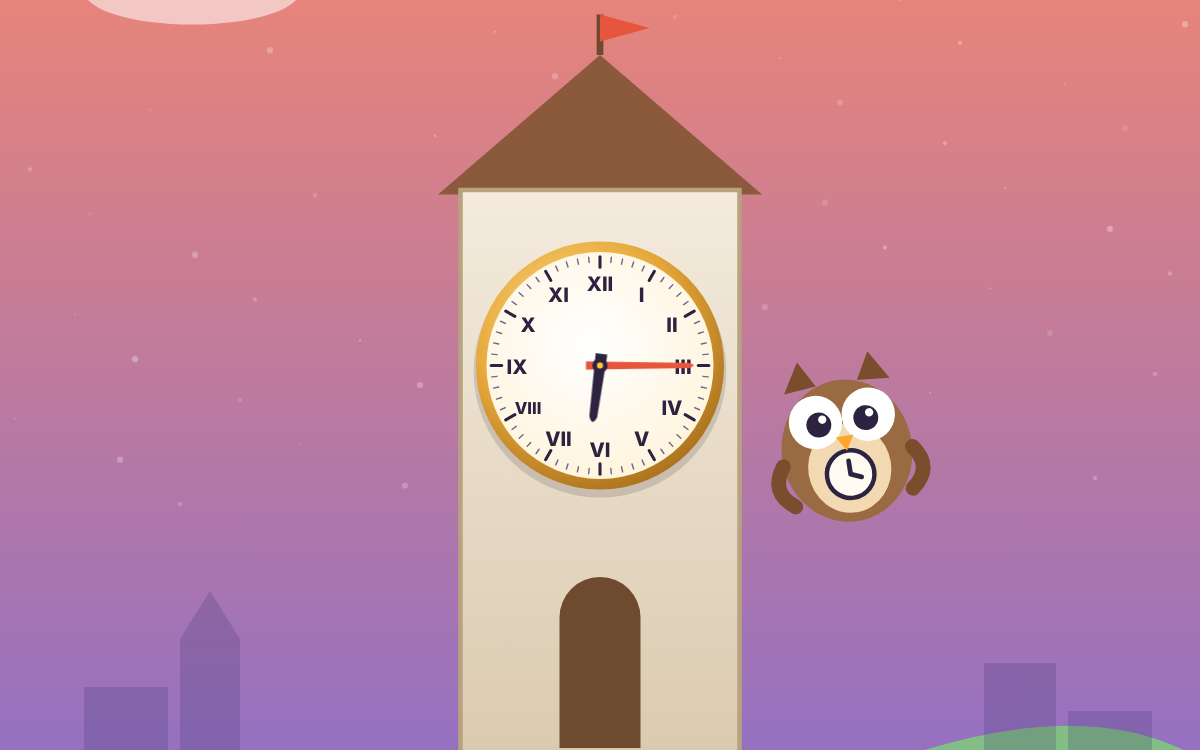
- Read Roman numerals I to XII on an analogue clock
- Tell the time to the nearest minute using past and to
- Use am, pm, noon and midnight for times of day
- Read 24-hour times like 15:30 and match them to pm times
- Know 60 seconds make a minute and the days in each month
- Work out how long an event takes by counting on
Chapter by chapter
- Roman numerals I to XII on analogue clocks Free to try
Year 3 maths · 1
- Telling the time to the nearest minute: past and to
Year 3 maths · 1 Year 3 maths · 2
- am, pm, morning, afternoon, noon and midnight
Year 3 maths · 2
- 12-hour and 24-hour clocks
Year 3 maths · 1
- Seconds, minutes and hours: 60 seconds in a minute
Year 3 maths · 2 Year 3 maths · 3
- Days in each month, year and leap year
Year 3 maths · 3
- How long does it take? Working out and comparing durations
Year 3 maths · 4
- Time Master Challenge (11 questions)
What the chapters cover in the national curriculum in England:
- Year 3 maths: Tell and write the time from an analogue clock, including using Roman numerals from I to XII, and 12-hour and 24-hour clocks
- Year 3 maths: Estimate and read time with increasing accuracy to the nearest minute; record and compare time in terms of seconds, minutes and hours; use vocabulary such as o'clock, am/pm, morning, afternoon, noon and midnight
- Year 3 maths: Know the number of seconds in a minute and the number of days in each month, year and leap year
- Year 3 maths: Compare durations of events
About this adventure
Telling the Time is an interactive maths game that teaches children aged 7–9 to read analogue and digital clocks to the nearest minute, use am and pm, and work out how long events take. It follows the Year 3 national curriculum for England.
Guided by Tock the owl, players drag clock hands, build a clock with Roman numerals, travel through a whole day as the sky changes from sunrise to midnight, and watch a 24-hour clock count on past 12 to 23:59. They count minutes in fives and ones, say times as minutes past or minutes to the hour, and learn that a minute has 60 seconds.
Later they use the knuckle trick to remember the days in each month, discover why a leap year has 366 days, and find durations by counting on along a time line. A final challenge checks everything they have learned.
Questions and answers
How do you tell the time to the nearest minute?
Look at the short hour hand to find the hour, then count the minutes on the long minute hand. Count in fives to the last number it has passed, then count on in ones to the exact mark.
What is the difference between am and pm?
Am means the times from midnight until noon, and pm means the times from noon until midnight. So 7:00 am is in the morning and 7:00 pm is in the evening.
How do you read a 24-hour clock?
A 24-hour clock keeps counting after 12 noon, so 13:00 is 1 pm and 18:30 is half past 6 in the evening. Morning times start with a zero, such as 07:15, and midnight is 00:00.
What age is this telling the time game for?
It suits children aged 7 to 9 and matches the Year 3 maths curriculum in England. Older children who need to practise reading clocks, am and pm or durations will also find it useful.
What does the telling the time game include and how long does it take?
It has seven chapters and an 11-question final challenge, taking about 75 minutes to play in full. Each chapter starts with a short animated introduction, so children can play one chapter at a time.



 TapLearn