2D and 3D Shapes: A Shape Town Adventure with Polly
Learn the properties of 2D and 3D shapes: count sides, faces, edges and vertices, fold shapes to find symmetry and sort everyday objects.
- Ages 5–8
- About 60 min
- Easy start
- Shapes & Measures
Learn the properties of 2D and 3D shapes: count sides, faces, edges and vertices, fold shapes to find symmetry and sort everyday objects.
Year 2 maths · 1
Year 2 maths · 1
Year 2 maths · 2
Year 2 maths · 2
Year 2 maths · 3
Year 2 maths · 4
What the chapters cover in the national curriculum in England:
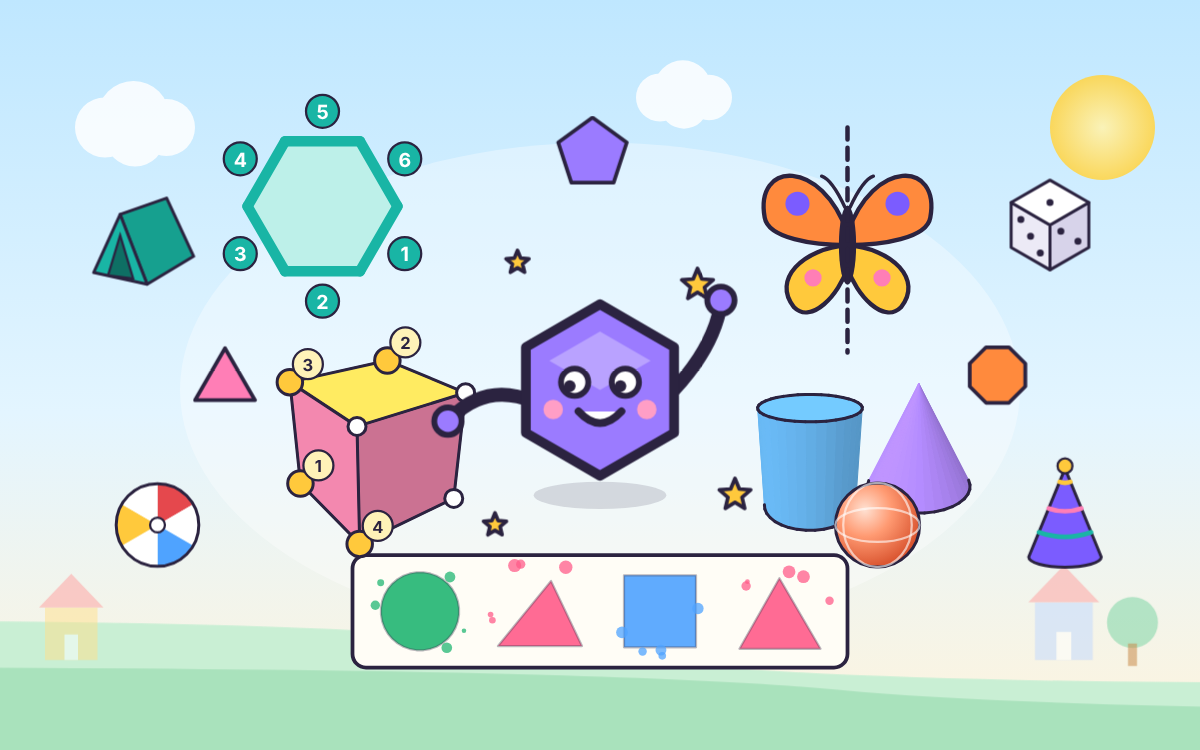
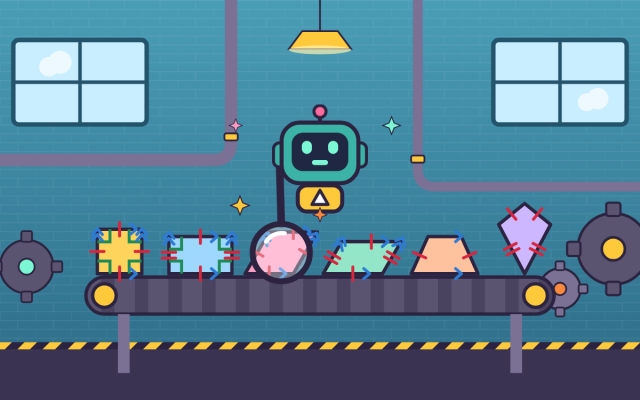
2D and 3D Shapes is an interactive maths game that teaches children aged 5–8 the Year 2 properties of shapes: sides, vertices, vertical lines of symmetry, and the faces, edges and vertices of solid shapes.
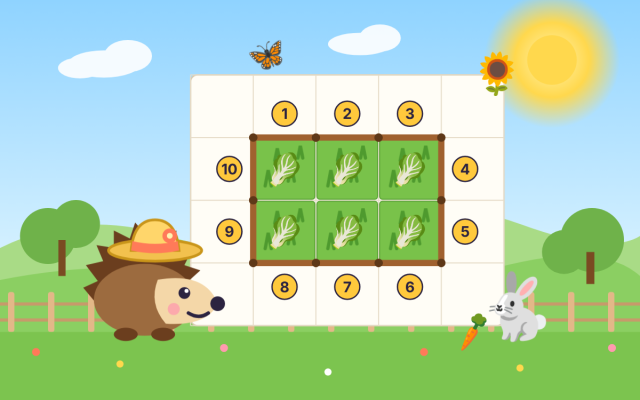
Guided by Polly, a talking hexagon, children tap each side of a pentagon to count it, fold a heart to test its line of symmetry and spin a cube to find the faces hidden at the back. They roll a sphere and slide a cube down a ramp to see why curved surfaces roll, and dip 3D shapes in paint to print the 2D shape on each face.
The game uses the correct words: a vertex is a corner where sides or edges meet, a face is a flat surface and an edge is where two faces meet. It also tackles mix-ups like calling a turned square a diamond or a ball a circle.
2D shapes are flat, like a square drawn on paper, and have sides and vertices. 3D shapes are solid, like a dice or a ball, and have faces, edges and vertices. A dice is a cube, not a square, because it is solid.
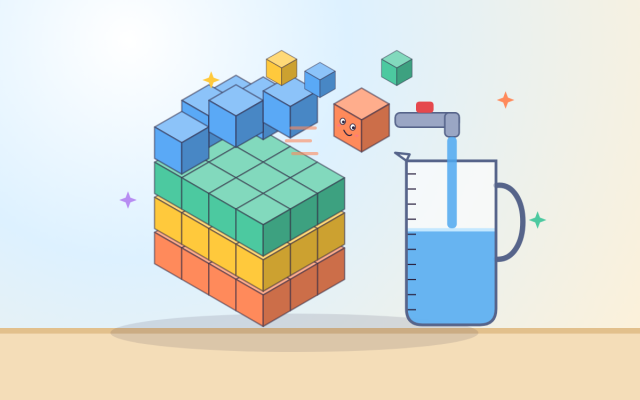
A cube has 6 faces, 12 edges and 8 vertices. Every face is a square. A cuboid, such as a cereal box, has the same numbers, but its faces are rectangles, or a mix of rectangles and squares.
A vertical line of symmetry is a straight up-and-down line that splits a shape into two halves that match exactly. If you fold the shape along that line, one half lies perfectly on top of the other, like the wings of a butterfly.
The game is made for children aged 5 to 8 and follows the Year 2 properties of shapes objectives in the national curriculum for England. Younger children can use the voice-over, and a Year 1 shape warm-up is included.
Playing everything takes about an hour. There are six chapters, each with an animated introduction, hands-on activities and a short check, followed by a ten-question Shape Master quiz. Children can start any chapter from the map.
 TapLearn
Getting it ready…
Great work on chapter 1! To open the next chapters, ask a grown-up to take a look.
To play this game, ask a grown-up to take a look. There are lots of free games you can play right now too!
Create a free family account and your child can play every chapter of every game for 7 days, with no card needed. Their progress is kept. After that, the free plan is free for ever, and membership is £6.99 a month if you'd like to keep every chapter.
That's all the learning time for today. Great work! Flip will be ready to play again tomorrow.