Summarising for Kids: Find the Main Ideas with Pip
Learn summarising: find the main idea of a paragraph, drop small details and sum up texts and stories in a few words on a balloon trip.
- Ages 7–9
- About 40 min
- Some thinking
- Reading & Stories
Learn summarising: find the main idea of a paragraph, drop small details and sum up texts and stories in a few words on a balloon trip.
Years 3–4 english · 1
Years 3–4 english · 1
Years 3–4 english · 1
Years 3–4 english · 1
Years 3–4 english · 1
See every English chapter in the chapter library
What the chapters cover in the national curriculum in England:
Summarising for Kids is an interactive reading game that teaches children aged 7–9 how to find the main ideas across several paragraphs and sum them up in a few words of their own. It follows the Year 3 and 4 English curriculum in England.
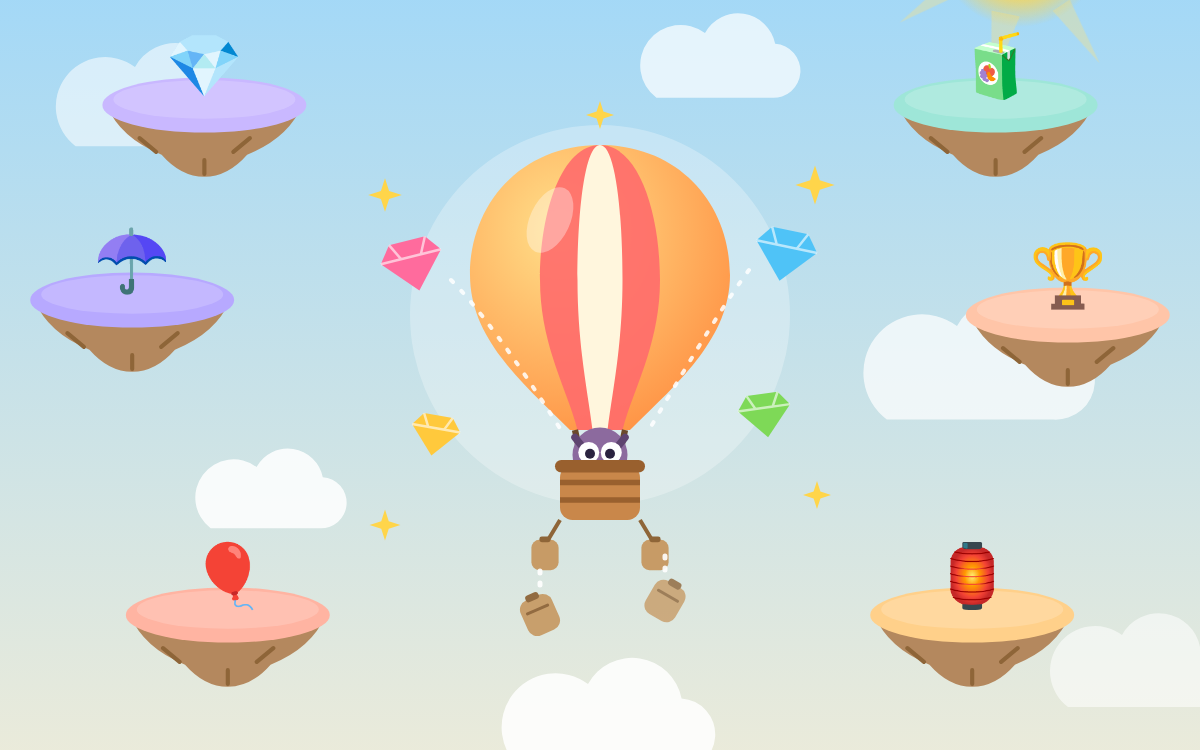
Children fly Pip the owl's hot-air balloon to five islands. They tap the sentence that covers all the others, drop small details like sandbags, collect one idea from each paragraph and join them into one big idea. A main idea is what a paragraph is mostly about; details are the smaller facts that sit underneath it.
Later islands practise cutting extra words, swapping a list for one group word such as "fruit", and summarising a story with Somebody, Wanted, But, So, Then. Every text can be read aloud, and a 10-question challenge checks what they have learned.
Summarising means retelling the main ideas of a text in a few words, without all the small details. A good summary is much shorter than the original, keeps the important points in the right order and uses the reader's own words.
Ask what the whole paragraph is mostly about, then check that every other sentence fits underneath that idea. The main idea can come first, last or anywhere in between, and sometimes it is not written down at all, so you put it into your own words.
Somebody, Wanted, But, So, Then is a five-step way to summarise a story. You name the main character, what they wanted, the problem that got in the way, how they solved it and how the story ended.
The game is made for children aged 7 to 9, in Year 3 and Year 4. It teaches the national curriculum statement on identifying main ideas drawn from more than one paragraph and summarising them, which is assessed later in the KS2 reading test.
The game has five islands and a final 10-question challenge, and takes about 40 minutes to play through. Children can pick any island from the map, every text can be read aloud, and each island ends with a short recap.
 TapLearn
Getting it ready…
Great work on chapter 1! To open the next chapters, ask a grown-up to take a look.
To play this game, ask a grown-up to take a look. There are lots of free games you can play right now too!
Create a free family account and your child can play every chapter of every game for 7 days, with no card needed. Their progress is kept. After that, the free plan is free for ever, and membership is £6.99 (about $9.35) a month if you'd like to keep every chapter.
That's all the learning time for today. Great work! Flip will be ready to play again tomorrow.