What you'll learn
- How to choose the right kind of text for a job
- When to read a whole text and when to dip in
- What the contents page, index and glossary are each for
- How to pick out key words in a question
- How skimming and scanning help you find facts fast
- How to record facts as short key-word notes and labels
Chapter by chapter
- Reading for a purpose: picking the right kind of text Free to try
Years 3–4 english · 1
- Contents, index and glossary: finding your way round a non-fiction book
Years 3–4 english · 2 Years 3–4 english · 1
- Skimming and scanning: finding key words fast
Years 3–4 english · 2
- Retrieving answers: finding facts in the text and checking them
Years 3–4 english · 2
- Recording information: notes, fact files and labelled diagrams
Years 3–4 english · 2
- Fact Finder Challenge: finding and recording information (10 questions)
See every English chapter in the chapter library
What the chapters cover in the national curriculum in England:
- Years 3–4 english: Develop positive attitudes to reading, and an understanding of what they read, by: reading books that are structured in different ways and reading for a range of purposes
- Years 3–4 english: Retrieve and record information from non-fiction
About this adventure
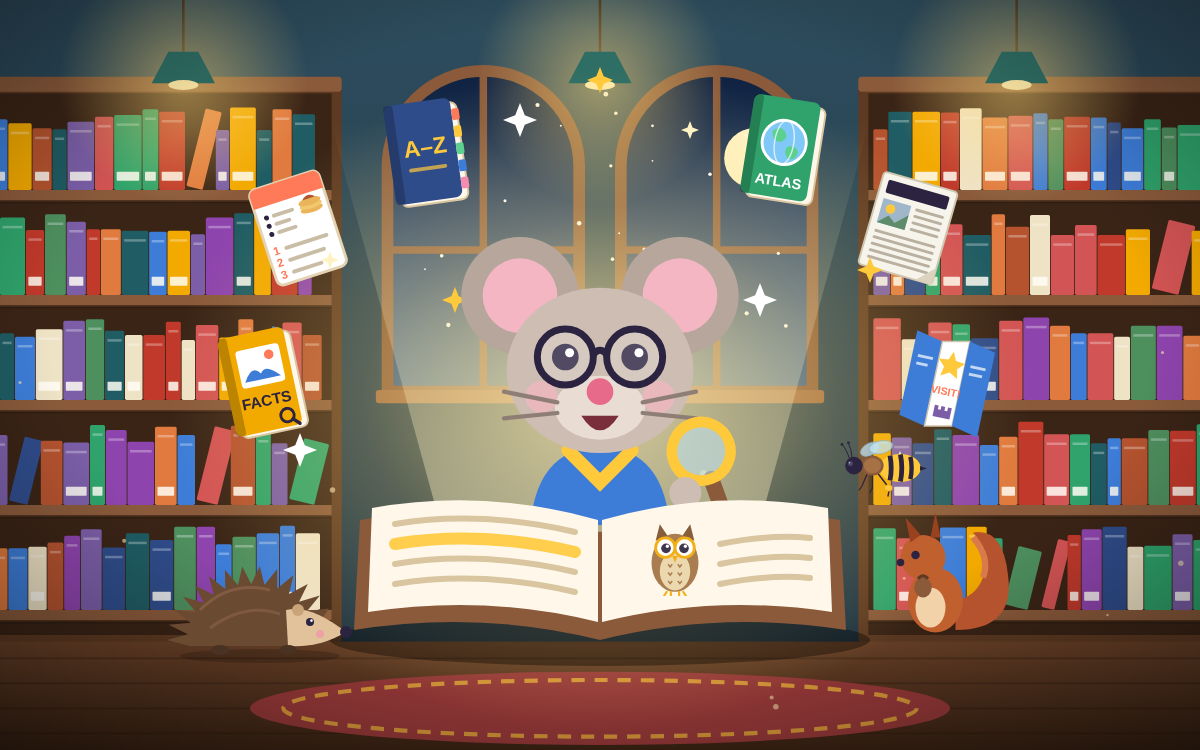
Reading Retrieval is an interactive game that teaches children aged 7–9 how to find and record information in non-fiction, matching the Year 3 and 4 English curriculum. Scout the library mouse guides them room by room through a cosy night-time library.
Players match readers to the right text, such as a recipe, atlas or dictionary, and decide when to read every page or dip in. They look things up with the contents page, index and glossary, then learn to skim (glance at headings to see what each part is about) and scan (hunt for one key word, name or number).
With a hedgehog fact page they find answers, prove them from the words and find and copy exactly. Finally they write short key-word notes, fill a fact file and label a diagram, then try a ten-question challenge.
Questions and answers
What is retrieval in reading?
Retrieval means finding information that is written in a text and using it to answer a question. Children look for the exact words that give the answer, rather than guessing or using what they already know.
What is the difference between skimming and scanning?
Skimming is a quick look over a page, often at the headings, to see what each part is about. Scanning is searching for one particular word, name or number to find a detail.
What is the difference between an index and a glossary?
An index lists topics in alphabetical order with every page they appear on, so you can find information. A glossary explains what tricky words mean. Both are usually at the back of a non-fiction book.
What age is this retrieval game for?
It is written for children aged 7 to 9, in Years 3 and 4. Older children who find retrieval questions tricky can use it too, and an optional warm-up reviews fiction and non-fiction.
What does the game include and how long does it take?
It has five chapters, each with an animated introduction and lots of hands-on tasks, plus a ten-question challenge at the end. Playing everything takes about 50 minutes, and children can pick any chapter.

 TapLearn