What you'll learn
- What a heading and a caption tell the reader
- How to group facts that go together under the right heading
- How to use a contents page to find where a chapter starts
- How to find a bold word's meaning in the glossary
- How to use an index to find the page for a small fact
- Why instructions and life cycles must be read in order
Chapter by chapter
- Headings: what each part is about and which facts go together Free to try
Year 2 english · 1 Year 2 english · 2
- The contents page: finding which page a chapter starts on
Year 2 english · 1
- The glossary: finding what bold words mean, in A to Z order
Year 2 english · 1
- The index: finding the page for a small fact, in A to Z order
Year 2 english · 1
- Steps, life cycles and fact pages: how non-fiction is ordered
Year 2 english · 1 Year 2 english · 2
- Book Explorer Challenge: using every book helper (10 questions)
See every English chapter in the chapter library
What the chapters cover in the national curriculum in England:
- Year 2 english: Develop pleasure in reading, motivation to read, vocabulary and understanding by: being introduced to non-fiction books that are structured in different ways
- Year 2 english: Develop pleasure in reading, motivation to read, vocabulary and understanding by: discussing the sequence of events in books and how items of information are related
About this adventure
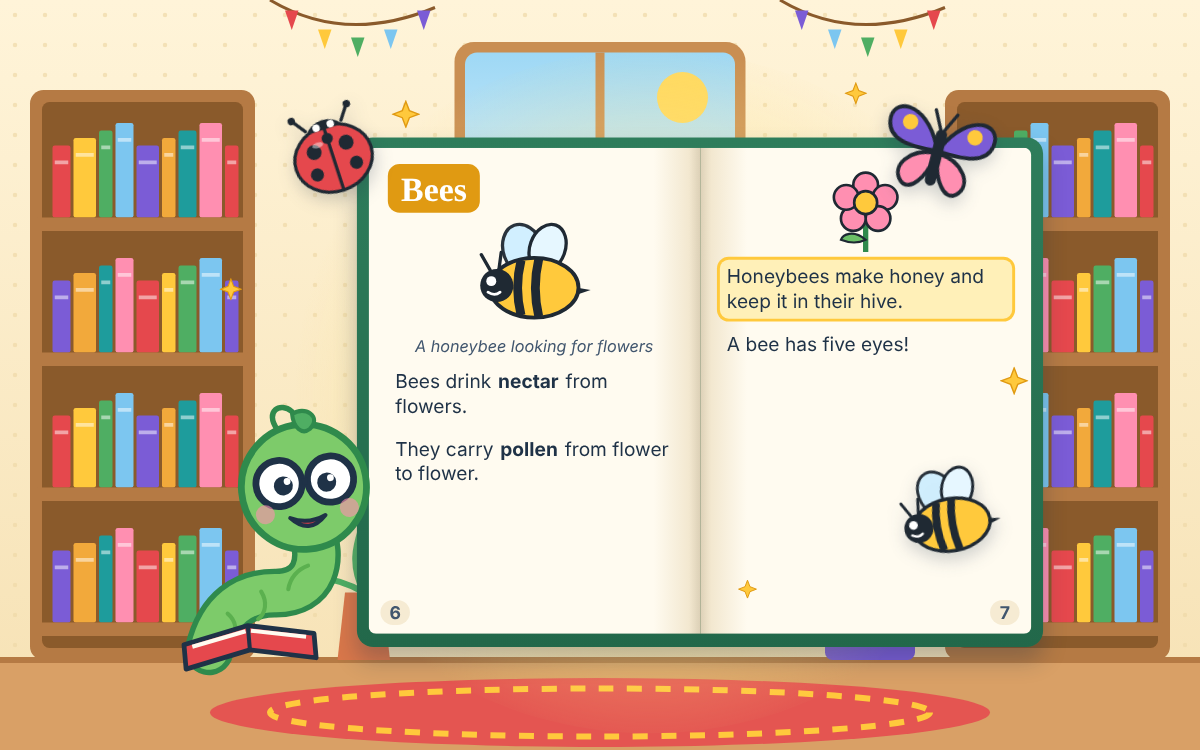
Non-fiction Book Features is an interactive game that teaches children aged 6–8 (KS1, Year 2) how headings, the contents page, the glossary and the index help you find facts in an information book. Pip the bookworm guides players through one illustrated fact book about minibeasts, with spoken instructions at every step.
Children tap headings and captions, follow a contents page to the right chapter, look up bold words in the glossary and use the index to jump to a single fact. They learn that the contents page is at the front and lists chapters in page order, while the glossary and index sit at the back in alphabetical order.
The last chapter shows that non-fiction is organised in different ways: instructions and life cycles go in time order, but a fact page grouped by headings can be read in any order. A ten-question challenge checks everything at the end.
Questions and answers
What is the difference between a contents page and an index?
A contents page is at the front of a book and lists the chapters in page order. An index is at the back and lists small topics in alphabetical order, with the page numbers where each one appears.
What is a glossary in a non-fiction book?
A glossary is a list of tricky words and their meanings, usually near the back of a non-fiction book. The words are in alphabetical order, and they often appear in bold in the main text so readers know they can look them up.
What are headings for in a non-fiction book?
Headings tell you what each part of a page is about, so you can find the facts you need without reading everything. Facts that go together are grouped under the same heading, a bit like signposts for the reader.
What age is this non-fiction book features game for?
The game is designed for children aged 6 to 8 and follows the KS1 Year 2 English reading curriculum. Younger confident readers and older children who need a refresher can also use it, as every instruction is read aloud.
How long does the game take and what does it include?
Playing everything takes about 40 minutes. There are five short chapters on headings, the contents page, the glossary, the index and how texts are ordered, plus a quick fact-or-story warm-up and a ten-question final challenge.
 TapLearn