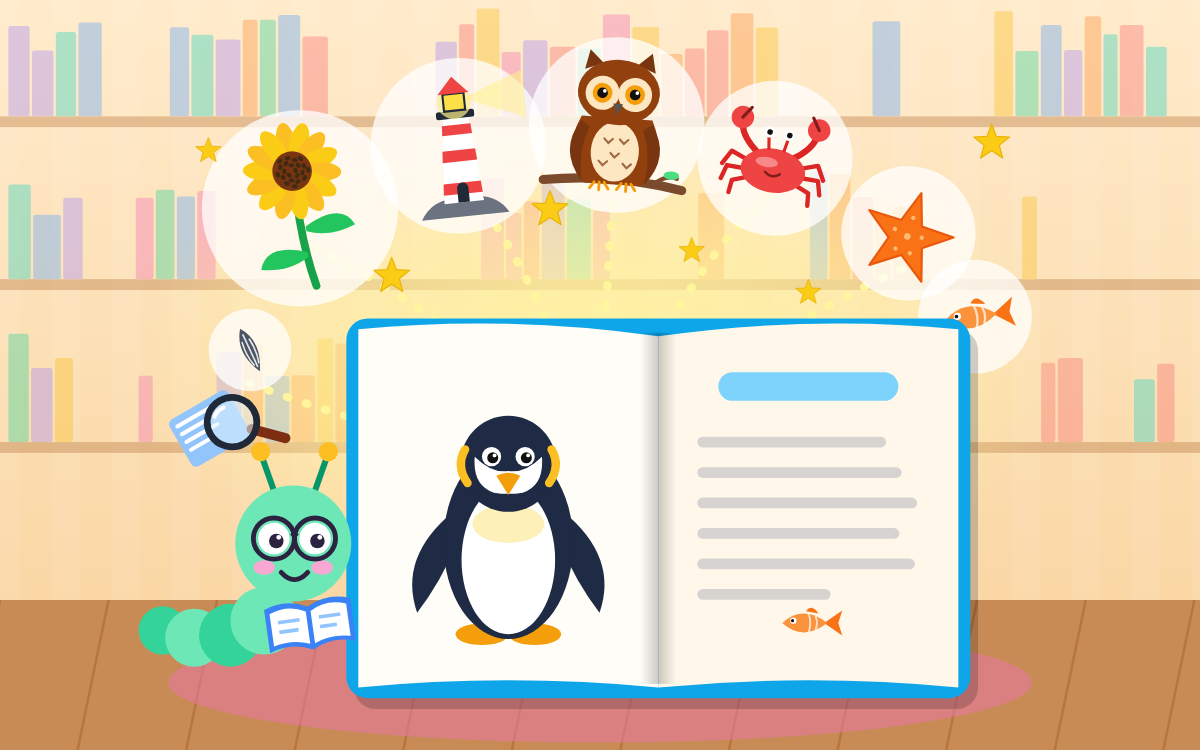
Information Books: Fact Finding with Pip the Bookworm
Learn how information books share true facts and new words, by exploring penguins, the seaside and a growing sunflower with Pip the bookworm.
- Ages 4–5
- About 35 min
- Easy start
- Reading & Stories
Learn how information books share true facts and new words, by exploring penguins, the seaside and a growing sunflower with Pip the bookworm.
Reception english · 1 Reception english · 2
Reception english · 3 Reception english · 4
Reception english · 3 Reception english · 4
Reception english · 3 Reception english · 4
Reception english · 1 Reception english · 2 Reception english · 4
See every English chapter in the chapter library
What the chapters cover in the national curriculum in England:
Information Books is an interactive game that teaches children aged 4–5 the difference between a made-up story book and a non-fiction information book, and how to find out true facts and new words from one. It follows the Reception (EYFS) goals for listening to, talking about and enjoying non-fiction.
Pip the bookworm reads every instruction aloud, so children do not need to read. They sort books by asking “could this really happen?”, spot labels on a page, and open three information books: one about an animal, one about a place and one that explains how something works. Along the way they tap, drag and build each scene, meeting words such as flipper, huddle, cliff, tide, root and shoot.
A final picture challenge checks what they remember, and each chapter ends with an idea to try with a grown-up.
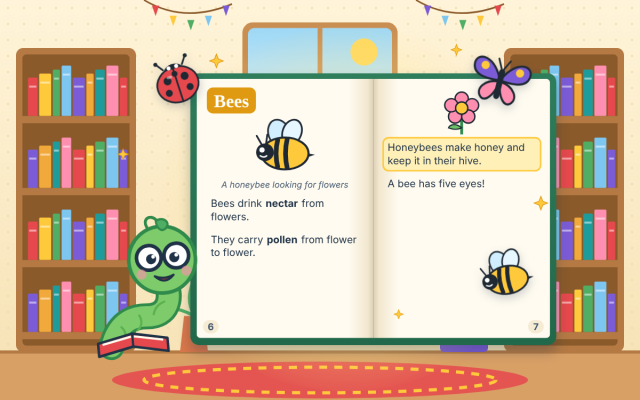
An information book, also called a non-fiction book, tells true facts about real things such as animals, places or machines. Unlike a story book, it is not made up, and it often has labels, real-looking pictures and pages you can open in any order.
A simple test is to ask, “Could this really happen?” A bear wearing a crown and riding a bike is made up, so it belongs in a story book, while a real owl sitting on a branch belongs in an information book.
No, penguins are birds but they cannot fly. Their wings are flippers, which they flap to swim very fast underwater, and their webbed feet help them steer while they chase fish.
It is designed for children aged 4 to 5 in Reception, the final year of the Early Years Foundation Stage. Every line is read aloud, so children who are not yet reading can play on their own or with a grown-up.
There are five chapters and an eight-question picture challenge, taking about 35 minutes in total. Children can pick any chapter from Pip's library and stop between chapters, so it also works as several short sessions.
 TapLearn
Getting it ready…
Great work on chapter 1! To open the next chapters, ask a grown-up to take a look.
To play this game, ask a grown-up to take a look. There are lots of free games you can play right now too!
Playing in class? Ask your teacher to get a free class link. Then your teacher can open every chapter on the board, and you can keep playing at home.
Teachers: play every chapter with your class, free
taplearn.co.uk/teachers
A free teacher account: games on the board, a class link for home, and no pupil data.
A teacher? Every chapter is free for your class. Get a free teacher account
A teacher? Every chapter is free for your class. Get a free teacher account
Create a free family account and your child can play every chapter of every game for 7 days, with no card needed. Their progress is kept. After that, the free plan is free for ever, and membership is £6.99 (about $9.35) a month if you'd like to keep every chapter.
That's all the learning time for today. Great work! Flip will be ready to play again tomorrow.