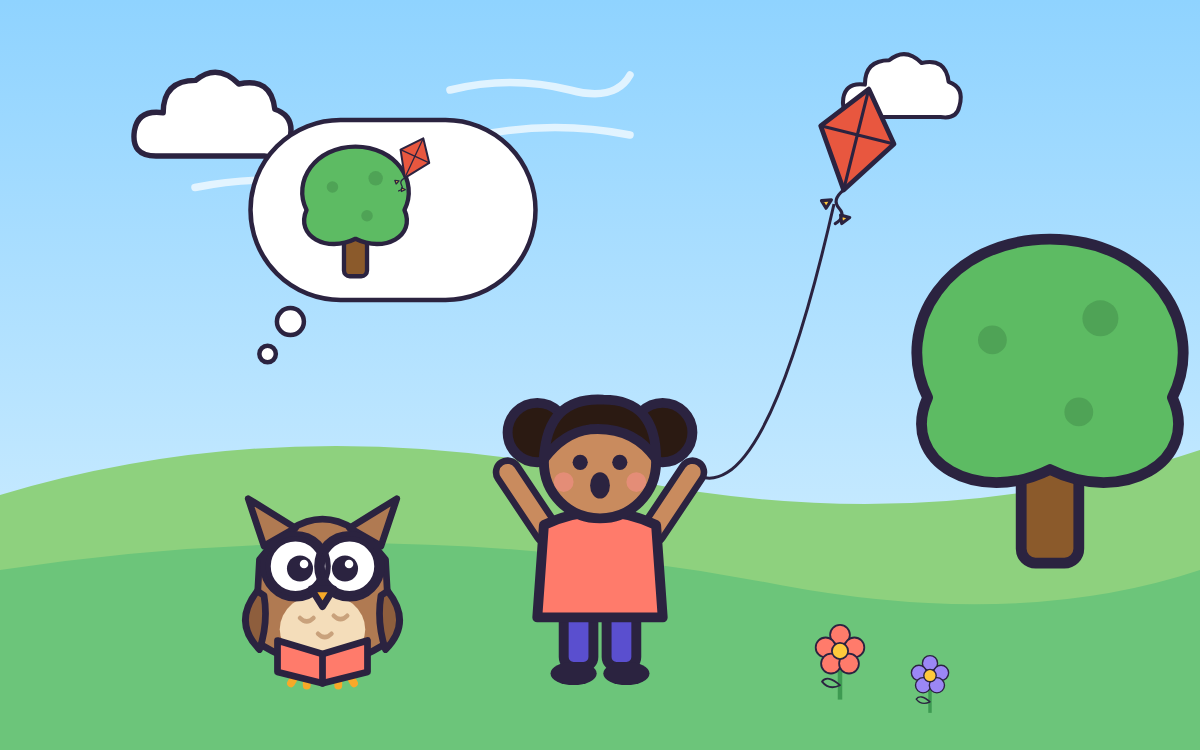
Making Predictions in Reading: Page Turners with Hazel
Learn how to make predictions in reading from a book's title and the story so far, then turn the pages, spot clues and fix misread words.
- Ages 5–7
- About 40 min
- Easy start
- Reading & Stories
Learn how to make predictions in reading from a book's title and the story so far, then turn the pages, spot clues and fix misread words.
Year 1 english · 1 Year 1 english · 2
Year 1 english · 2 Year 2 english · 3
Year 1 english · 2 Year 2 english · 3
Year 1 english · 1 Year 1 english · 2 Year 2 english · 3
Year 1 english · 4 Year 2 english · 5
See every English chapter in the chapter library
What the chapters cover in the national curriculum in England:
Making Predictions in Reading is an interactive storybook game that teaches children aged 5–7 to predict what might happen next from a book's title and the story so far, and to check that what they read makes sense. It follows the Year 1 and Year 2 reading comprehension curriculum in England.
Hazel the reading owl guides players through short original stories, pausing before each page turn. Children learn that a prediction is a thinking guess based on clues in the words and pictures, not a wild guess, and that good readers keep checking and change a prediction when new clues appear. They also spot the important event that changes a story and say what it leads to.
Bookbot, a robot learning to read, makes funny mistakes for children to catch. They stop, look at every letter, sound the word out and reread the sentence until it makes sense.
A prediction in reading is a thinking guess about what might happen next, based on clues from the title, the pictures and the story so far. It is different from a wild guess, which has no clue behind it.
Pause at an exciting moment and ask what might happen next, then ask which clue made them think so. Read on together to check, and praise changing the prediction when a new clue appears.
They should stop, look carefully at every letter in the tricky word, sound it out again and reread the sentence. Good readers notice when something sounds wrong and fix it, rather than guessing a word from the picture.
It is made for children aged 5 to 7, matching Year 1 and Year 2 in England. Stories and questions are read aloud, so early readers can play while they are still building their decoding skills.
The game has five chapters, each with an animated introduction, guided activities and a recap, plus a ten-question challenge at the end. Playing everything takes about 40 minutes, and children can start from any chapter.
 TapLearn
Getting it ready…
Great work on chapter 1! To open the next chapters, ask a grown-up to take a look.
To play this game, ask a grown-up to take a look. There are lots of free games you can play right now too!
Playing in class? Ask your teacher to get a free class link. Then your teacher can open every chapter on the board, and you can keep playing at home.
Teachers: play every chapter with your class, free
taplearn.co.uk/teachers
A free teacher account: games on the board, a class link for home, and no pupil data.
A teacher? Every chapter is free for your class. Get a free teacher account
A teacher? Every chapter is free for your class. Get a free teacher account
Create a free family account and your child can play every chapter of every game for 7 days, with no card needed. Their progress is kept. After that, the free plan is free for ever, and membership is £6.99 (about $9.35) a month if you'd like to keep every chapter.
That's all the learning time for today. Great work! Flip will be ready to play again tomorrow.