What you'll learn
- Measure from zero on a ruler in centimetres and millimetres
- Know that 1 cm = 10 mm and 1 m = 100 cm
- Work out what each small step on a scale is worth
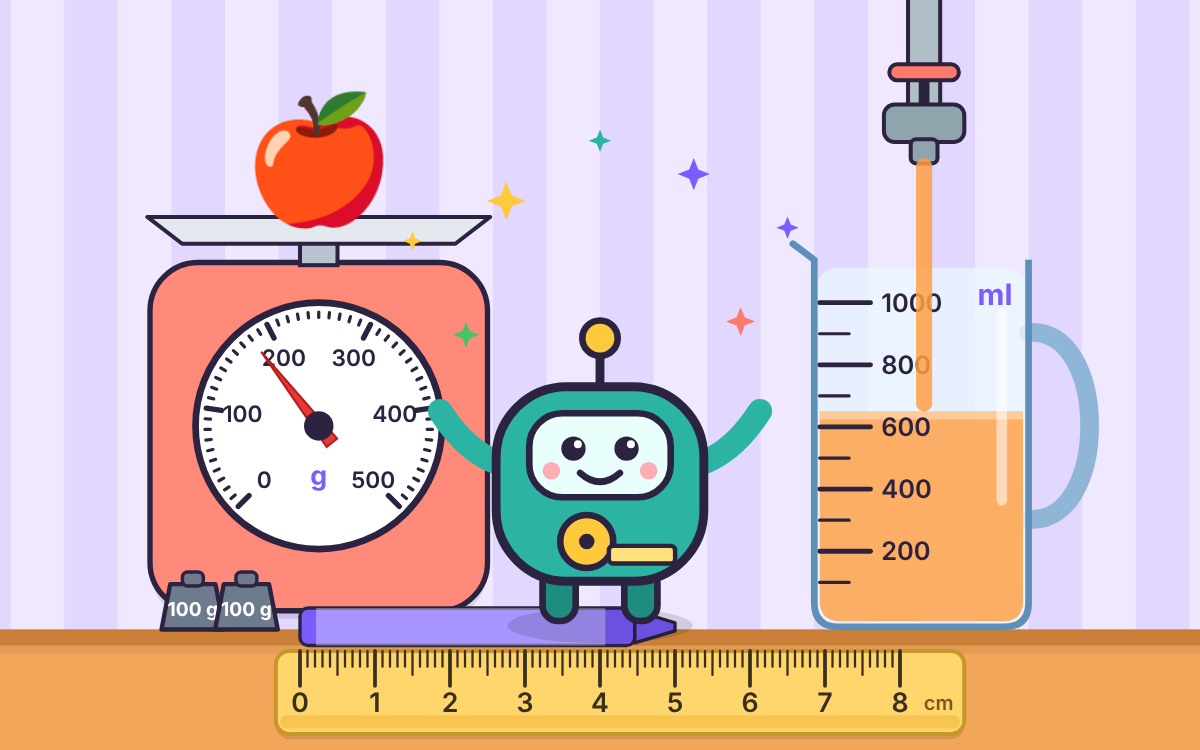
- Read kitchen scales in kilograms and grams, knowing 1 kg = 1000 g
- Tell capacity from volume and read jugs in litres and millilitres
- Compare, add and subtract measures by using the same unit first
Chapter by chapter
- Length: measuring in m, cm and mm Free to try
Year 3 maths · 1
- Length: comparing, adding and subtracting m, cm and mm
Year 3 maths · 1
- Mass: measuring in kg and g
Year 3 maths · 1
- Mass: comparing, adding and subtracting kg and g
Year 3 maths · 1
- Capacity and volume: measuring in l and ml
Year 3 maths · 1
- Capacity and volume: comparing, adding and subtracting l and ml
Year 3 maths · 1
- Measuring master quiz: length, mass and capacity (10 questions)
What the chapters cover in the national curriculum in England:
- Year 3 maths: Measure, compare, add and subtract: lengths (m/cm/mm); mass (kg/g); volume/capacity (l/ml)
About this adventure
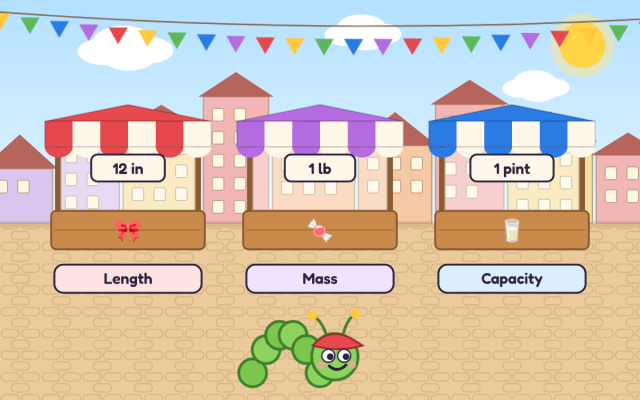
Measuring Length, Mass and Capacity is an interactive maths game for children aged 7–9 that teaches how to measure, compare, add and subtract lengths (m, cm, mm), mass (kg, g) and capacity (l, ml), matching Year 3 maths.
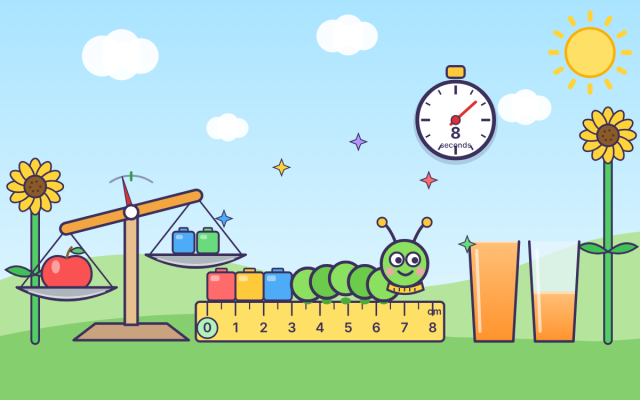
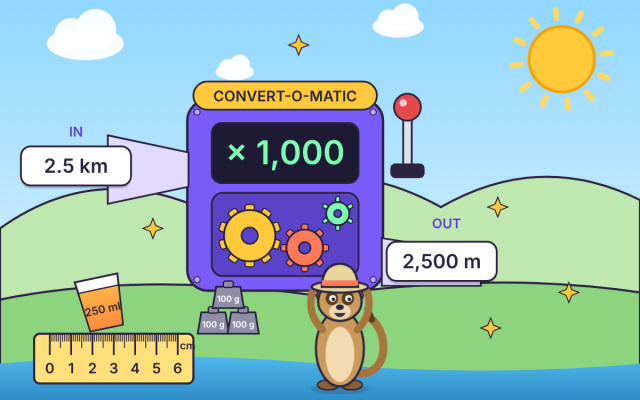
In Measuring Town, children drag a pencil to zero on a ruler, draw a worm to an exact length, add 100 g weights until a balance levels out and pour juice to a mark on a measuring jug. Before each scale reading they work out what every small step is worth.
They learn the unit facts 1 cm = 10 mm, 1 m = 100 cm, 1 kg = 1000 g and 1 l = 1000 ml, and change to the same unit before comparing or calculating. Children type their own answers and get hints after a mistake.
Questions and answers
How many centimetres are in a metre, and millimetres in a centimetre?
There are 100 centimetres in 1 metre and 10 millimetres in 1 centimetre. So 1 metre 40 centimetres is the same as 140 centimetres, and 4 centimetres 5 millimetres is the same as 45 millimetres.
How do you read a scale when not every mark has a number?
First work out what each small step is worth by counting the steps between two numbered marks. If there are 10 steps between 0 and 100 grams, each step is 10 grams, so you count on in tens from the last number.
What is the difference between capacity and volume?
Capacity is how much a container can hold when it is full, while volume is how much liquid is actually in it right now. A jug can have a capacity of 1 litre but hold a volume of only 400 millilitres.
What age is this measuring game for?
The game is designed for children aged 7 to 9 and matches the Year 3 measurement objective in the national curriculum in England. An optional warm-up recaps Year 2 ideas, so it also suits children who need a refresher.
What does the measuring game include and how long does it take?
It has six chapters covering length, mass and capacity, an optional warm-up and a 10-question final quiz. Playing everything takes about 45 minutes, and children can pick any chapter from the map and return later to carry on.



 TapLearn