Discover how the ancient Maya lived around AD 900: build a city, write in glyphs, count with dots and bars, and compare it all with Anglo-Saxon Britain.
Online game, chapter 1 free · Years 3 to 6 (KS2) · ages 8–11 · national curriculum in England · no adverts · plays on a phone, tablet or computer · no sign-up to start.
An online history game for Years 3 to 6 (KS2). It covers the national curriculum in England, Years 3–6 history: “A non-European society that provides contrasts with British history – one study chosen from: early Islamic civilization, including a study of Baghdad c. AD 900; Mayan civilization c. AD 900; Benin (West Africa) c. AD 900-1300”.
7 short chapters, about 60 minutes in all. Children can stop after any chapter.
Start playing for free. Plays in the browser on phones, tablets and computers: no app, no adverts.
Free for teachers: every chapter on the whiteboard with a free teacher account.
Last updated · Checked against the national curriculum in England by the TapLearn team
What you'll learn
Where the Maya lived and when their cities were greatest
How Maya city-states were ruled by their own holy lords
How glyphs worked as word signs and sound signs
Reading and writing Maya numbers in base 20, with zero
How the 365-day Haab' and 260-day Tzolk'in calendars worked
Why many cities were abandoned, and that the Maya still live there
Chapter by chapter
Where and when the Maya lived: maps and timelinesStart playing for free
Locate the Maya lowlands, highlands and coasts in today's Central America, then place the Classic period on a timeline beside the Romans, Anglo-Saxons, Vikings and the later Aztecs.
Years 3–6 history · 1
Maya city-states: kings, temples and daily life
Build a Maya city with a temple pyramid, palace, ball court, stela and maize fields, meet rival city-states such as Tikal and Calakmul, and arrange the levels of Maya society.
Years 3–6 history · 1
Maya writing: glyphs for words and sounds
Learn that glyphs were logograms and syllable signs by spelling balam (jaguar), read glyph blocks in the right order, and compare Maya writing with Anglo-Saxon letters on parchment.
Years 3–6 history · 1
Maya maths: dots, bars, zero and counting in twenties
Make and read Maya numbers with dots, bars and the shell for zero, then stack levels to count in twenties up to 399, contrasting zero with Roman numerals (base 20).
Years 3–6 history · 1
Maya astronomy: watching the sky and making calendars
Discover how Maya astronomers tracked the Sun, Moon and Venus, build the 365-day Haab' and turn the 260-day Tzolk'in wheels, and learn the truth about the 2012 myth.
Years 3–6 history · 1
Comparing the Maya with Anglo-Saxon Britain around AD 900
Compare buildings, towns, rulers, beliefs, food and tools in Maya cities and Anglo-Saxon England, sort features into each society, and spot what both had in common.
Years 3–6 history · 1
Why Maya cities were abandoned, and the Maya today
Weigh archaeological evidence such as lake mud, pollen and burned palaces to explain why southern cities emptied, then scan the forest with lidar and meet the Maya people of today.
What the chapters cover in the national curriculum in England:
Years 3–6 history: A non-European society that provides contrasts with British history – one study chosen from: early Islamic civilization, including a study of Baghdad c. AD 900; Mayan civilization c. AD 900; Benin (West Africa) c. AD 900-1300
About this adventure
The Maya Civilisation: Cities, Glyphs and Stars is an interactive history game that teaches children aged 8–11 about the Maya around AD 900 and how their world contrasts with Anglo-Saxon Britain at the same time.
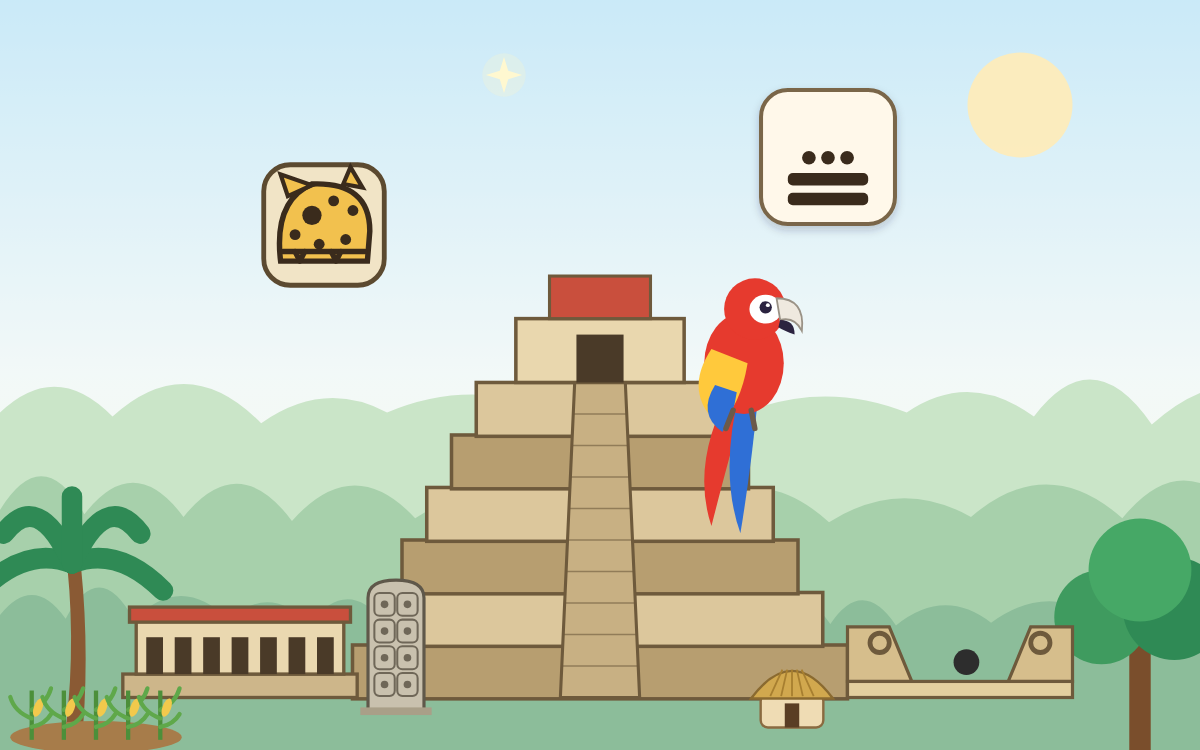
Guided by Kin, a scarlet macaw, players find the Maya lands on a map and place the Classic period (AD 250–900) on a timeline beside the Romans, Anglo-Saxons and Vikings. They build a city-state with a temple pyramid, palace and ball court, spell a word with glyphs, write numbers with dots, bars and a shell for zero, and turn the 365-day and 260-day calendar wheels.
Later, players sort features into Maya or Anglo-Saxon life, then act as history detectives, using clues such as dry lake mud and burned palaces to explain why many cities were abandoned. They also learn that millions of Maya people live in Central America today.
Questions and answers
Who were the Maya, in simple words?
The Maya are an Indigenous people of southern Mexico and Central America. Between about AD 250 and 900 they built great stone cities in the rainforest, each ruled by its own king, with temple pyramids, writing, mathematics and calendars.
How did Maya numbers work?
Maya numbers used just three symbols: a dot for one, a bar for five and a shell for zero. Numbers above 19 were stacked in levels, with each higher level worth twenty times more, so the system counted in base 20.
Why were Maya cities abandoned around AD 900?
Most historians think several problems added up: long droughts, more wars between cities, cleared forests and people losing faith in their kings. Many southern cities emptied, but northern cities such as Chichén Itzá carried on and the Maya people never disappeared.
What age is this Maya game for?
The game is designed for children aged 8 to 11, especially Year 5 and Year 6. It follows the KS2 history study of a non-European society that contrasts with British history, using short spoken explanations and hands-on tasks.
What does the Maya game include and how long does it take?
It has seven chapters and a final ten-question challenge, taking about an hour to play in full. Each chapter opens with an animated introduction, and players can start any chapter from the map and come back later.
We count visits to make TapLearn better.We use one cookie, only on this site, to see how families find and use it. No adverts, and nothing is shared.One cookie, only on this site. No adverts.How we measure
 TapLearn