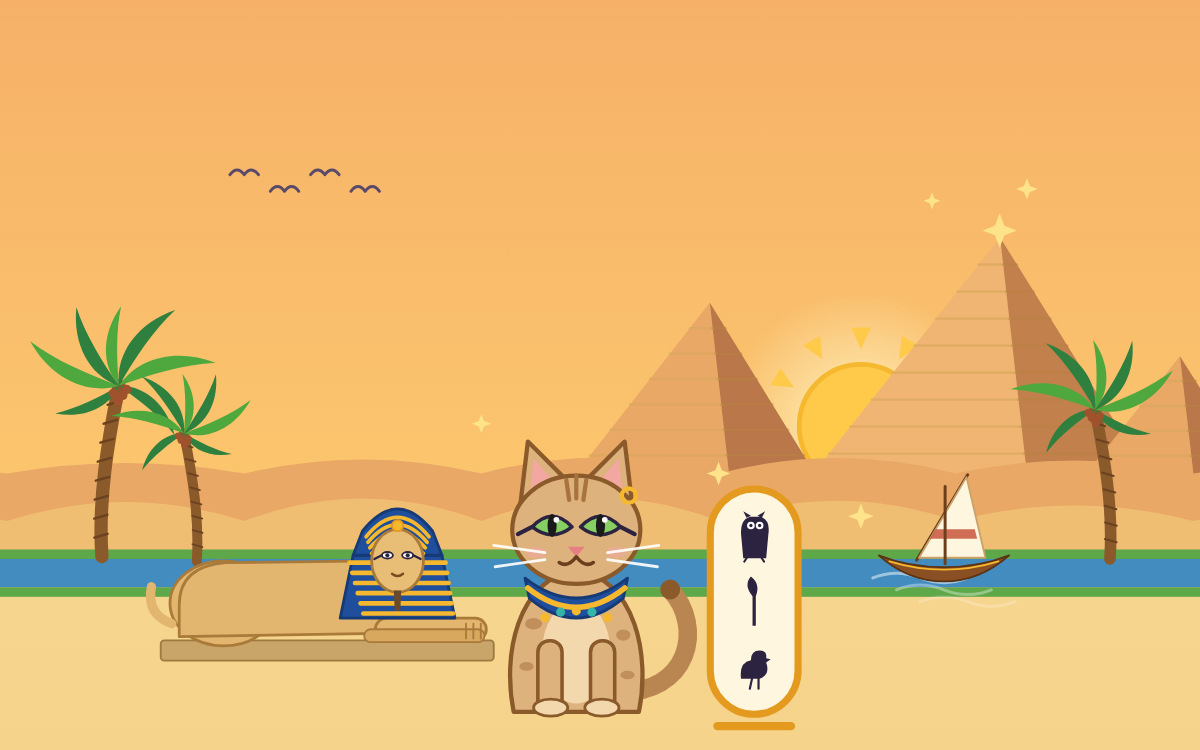
Ancient Egypt: Explore the Nile, Pyramids and Mummies
Learn how Ancient Egypt grew beside the Nile and where the first civilizations began, then build a pyramid, make a mummy and read hieroglyphs.
- Ages 7–11
- About 60 min
- Easy start
- Ancient World
Learn how Ancient Egypt grew beside the Nile and where the first civilizations began, then build a pyramid, make a mummy and read hieroglyphs.
Years 3–6 history · 1
Years 3–6 history · 1
Years 3–6 history · 1
Years 3–6 history · 1
Years 3–6 history · 1
Years 3–6 history · 1
Years 3–6 history · 1
What the chapters cover in the national curriculum in England:
Ancient Egypt Explorers is an interactive history game that teaches children aged 7–11 where and when the first civilizations began, and what the Ancient Egyptians achieved.
Guided by Miu the cat, players find the earliest civilizations on a real map and order them on a BC timeline, learning that a bigger BC number means longer ago. In Egypt they flood the Nile to see how it left fertile black mud called silt. They also sort out what a pharaoh did, pull a stone block up a pyramid ramp, and follow the embalming steps, putting organs into canopic jars and drying the body with natron salt. Finally, they decode royal names written inside a cartouche.
Every instruction is read aloud, and each chapter ends with a short quick check. A final Sphinx quiz brings everything together. The content follows the KS2 history objective on the achievements of the earliest civilizations.
The Nile gave the Egyptians water in a desert land. Every summer it flooded, and when the water went down it left rich black mud called silt, which was perfect for crops. The river also gave fish, papyrus reeds, mud for bricks and a road for boats.
The pyramids were built by thousands of paid, skilled workers, not by slaves. They cut stone blocks with copper tools and pulled them on wooden sledges up ramps, wetting the sand so the sledges slid more easily. The Great Pyramid, built for Pharaoh Khufu, took about 20 years.
Embalmers washed the body, removed the brain and organs, and stored the organs in canopic jars, but left the heart inside. They dried the body in natron salt for about 40 days, then wrapped it in linen. The whole process took around 70 days.
It is made for children aged 7 to 11 and pitched mainly at Year 3, when most schools in England teach the earliest civilizations. Every instruction is spoken aloud and the activities use simple taps and drags, so younger readers can follow along easily.
The game has seven narrated chapters, each with an animated introduction and a three-question quick check, followed by a ten-question Sphinx quiz. Playing everything takes about an hour, and children can start any chapter from the map and come back to it later.
 TapLearn
Getting it ready…
Great work on chapter 1! To open the next chapters, ask a grown-up to take a look.
To play this game, ask a grown-up to take a look. There are lots of free games you can play right now too!
Create a free family account and your child can play every chapter of every game for 7 days, with no card needed. Their progress is kept. After that, the free plan is free for ever, and membership is £6.99 a month if you'd like to keep every chapter.
That's all the learning time for today. Great work! Flip will be ready to play again tomorrow.