Human and Physical Features: Build an Island with Skerry the Puffin
Years 1 and 2: name physical features like mountains, rivers and cliffs, and human features like villages, farms and ports, by building Skerry's island.
Online game, chapter 1 free · Years 1 and 2 (KS1) · ages 5–7 · national curriculum in England · no adverts · plays on a phone, tablet or computer · no sign-up to start.
An online earth and geography game for Years 1 and 2 (KS1). It covers the national curriculum in England, Years 1–2 geography: “Use basic geographical vocabulary to refer to key physical features, including: beach, cliff, coast, forest, hill, mountain, sea, ocean, river, soil, valley, vegetation, season and weather”, and 1 more statement listed under the chapters.
5 short chapters, about 25 minutes in all. Children can stop after any chapter.
Start playing for free. Plays in the browser on phones, tablets and computers: no app, no adverts.
Free for teachers: every chapter on the whiteboard with a free teacher account.
Last updated · Checked against the national curriculum in England by the TapLearn team
What you'll learn
Sort features into physical (made by nature) and human (made by people)
Name mountains, hills, valleys, rivers, soil, vegetation and forests
Name the coast, beaches, cliffs, the sea and the ocean
Explain how a village, a town and a city differ in size
Say what farms, factories, shops and offices are for
Tell a harbour, where boats shelter, from a port, where ships unload
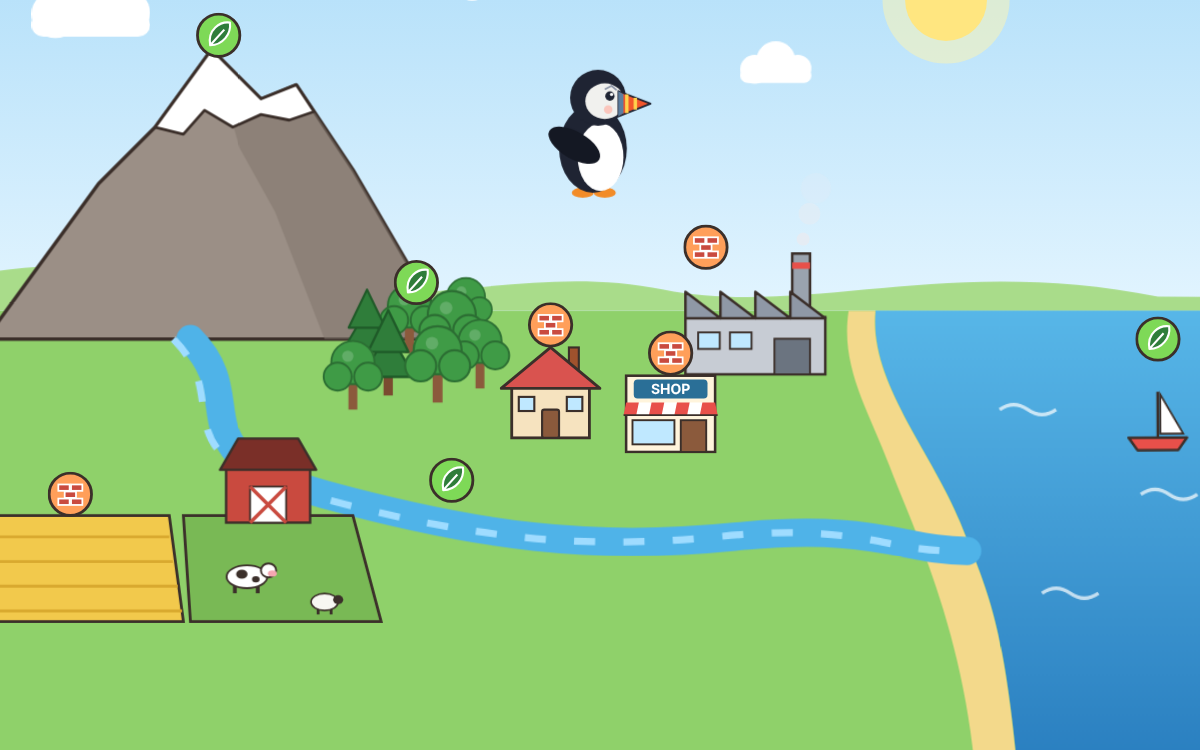
Learn that physical features are made by nature and human features are made by people, by deciding for each glowing feature on Skerry's island, from a mountain to a farm.
What the chapters cover in the national curriculum in England:
Years 1–2 geography: Use basic geographical vocabulary to refer to key physical features, including: beach, cliff, coast, forest, hill, mountain, sea, ocean, river, soil, valley, vegetation, season and weather
Years 1–2 geography: Use basic geographical vocabulary to refer to key human features, including: city, town, village, factory, farm, house, office, port, harbour and shop
How to play
Tap Start, then pick a chapter on the island map, or begin at number 1.
Skerry reads every instruction aloud and shows it as a caption; tap the yellow button to hear it again.
Tap the glowing spots to build each feature, and watch its name label appear in the scene.
In the checks, tap a feature in the picture or choose a word button; after a wrong answer Skerry explains and the child tries again.
The final quiz asks ten mixed questions, shows the right answer after each one and gives a score at the end.
A worked example
Question: Is a farm a physical feature or a human feature?
Step 1: Ask whether nature made it or people made it.
Step 2: Look closely: people ploughed and planted the fields.
Step 3: People built the barn and the fences too.
Answer: A farm is a human feature, even though it is in the countryside.
Common mistakes and how to fix them
Calls a farm natural because it is in the countrysideAsk who planted the crops and built the barn. If people made it, it is a human feature, wherever it is.
Calls a harbour or port physical because it is by the waterPoint out that the water is natural, but the harbour walls, quays and cranes were built by people.
Mixes up hills and mountainsSay that a mountain is much higher, with steep rocky sides and sometimes snow; a hill is lower and rounder.
Mixes up soil and vegetationSoil is the ground plants grow in; vegetation is all the plants growing there. Point to each in a garden or park.
Thinks a sea is bigger than an oceanShow a globe: the huge blue areas are oceans, and seas are smaller parts of them, close to land.
Try it at home
On a walk, take turns to spot one thing nature made (a tree, a hill, a stream) and one thing people made (a house, a shop, a road).
Build a mountain, a hill and a valley from sand, play dough or cushions, then pour a little water to make a river.
Pick something from the cupboard, like a loaf of bread, and talk about its journey: farm, factory, lorry, shop, home.
In the classroom
Play the first chapter on the whiteboard as a starter: children stand on one side for nature-made and the other for people-made.
In pairs on tablets, children play one chapter each, then teach their partner the new words.
As a plenary, show a photo of your local area and ask the class to label its human and physical features on mini whiteboards.
About this adventure
Human and Physical Features is an interactive online geography game for Years 1 and 2 (ages 5 to 7) that teaches children to name the natural and man-made features of a landscape and sort them into physical and human. It follows the KS1 national curriculum in England: use basic geographical vocabulary to refer to key physical features, such as beach, cliff, coast, forest, hill, mountain, sea, ocean, river, soil, valley and vegetation, and key human features, such as city, town, village, factory, farm, house, office, port, harbour and shop.
There are five chapters and a final quiz, guided by Skerry the puffin on her island. Every new word is shown and read aloud as the child builds it: they tap to push up a mountain, make it rain so a river flows, wash sand onto a beach, grow a village into a city and steer boats into a harbour. Then they find each feature or choose the right word.
Physical features are made by nature; human features are made by people. A farm is in the countryside but people made it, so it is human. A harbour shelters boats from waves; a port is where ships load and unload.
Questions and answers
What is the difference between human and physical features?
Physical features are made by nature, such as mountains, rivers, beaches and forests. Human features are made by people, such as houses, shops, farms, factories and ports. A quick test for children is to ask: did nature make it, or did people build it?
Is a farm a human or a physical feature?
A farm is a human feature. Children often call it natural because it sits in the countryside with fields and animals, but people planted the fields, put up the fences and built the barn, so geographers class it as human.
What is the difference between a port and a harbour, in simple words?
A harbour is a stretch of sheltered water, often with strong walls, where boats stay safe from big waves. A port is a place where ships load and unload goods and people. Many ports are built inside a harbour.
What do Year 1 and Year 2 children learn about human and physical features?
In Key Stage 1, children learn basic geographical words for key physical features, such as beach, cliff, coast, hill, mountain, river, soil, valley and vegetation, and key human features, such as city, town, village, factory, farm, port and harbour.
Is there an interactive human and physical features game for a Year 1 class?
Yes. Skerry's Island runs in a web browser on a classroom whiteboard, tablets or computers. The class can build each feature together, call out whether nature or people made it, then try the find-it challenges and final quiz in pairs.
What does the Skerry's Island game include?
It has five chapters and a ten-question final quiz, and takes about 25 minutes to play through once. Every instruction and explanation is read aloud with captions, so children who are still learning to read can play on their own.
We count visits to make TapLearn better.We use one cookie, only on this site, to see how families find and use it. No adverts, and nothing is shared.One cookie, only on this site. No adverts.How we measure

 TapLearn