Contrasting Places: My Home and Far Away: Breezy's Balloon Trip
Years 1 and 2: compare a UK town with a town in Kenya, from maps and mountains to weather, homes and travel, and sort what's the same and different.
Online game, chapter 1 free · Years 1 and 2 (KS1) · ages 5–7 · national curriculum in England · no adverts · plays on a phone, tablet or computer · no sign-up to start.
An online earth and geography game for Years 1 and 2 (KS1). It covers the national curriculum in England, Years 1–2 geography: “Understand geographical similarities and differences through studying the human and physical geography of a small area of the United Kingdom, and of a small area in a contrasting non-European country”.
5 short chapters, about 25 minutes in all. Children can stop after any chapter.
Start playing for free. Plays in the browser on phones, tablets and computers: no app, no adverts.
Free for teachers: every chapter on the whiteboard with a free teacher account.
Last updated · Checked against the national curriculum in England by the TapLearn team
What you'll learn
Find the UK and Kenya on a world map and name their continents
Name the mountains, rivers and lake around Keswick and Nanyuki
Compare the UK's four seasons with Kenya's rainy and dry seasons
Describe homes, school, jobs and travel in both towns
Sort facts about two places into similarities and differences
Explain that Africa is a continent with 54 countries, not a country
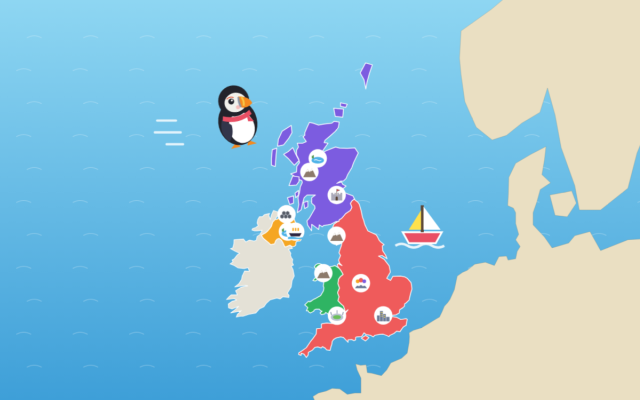
Find the United Kingdom and Kenya on a world map, learn that the UK is in Europe and Kenya is in Africa, spot the equator and fly Breezy from Keswick to Nanyuki.
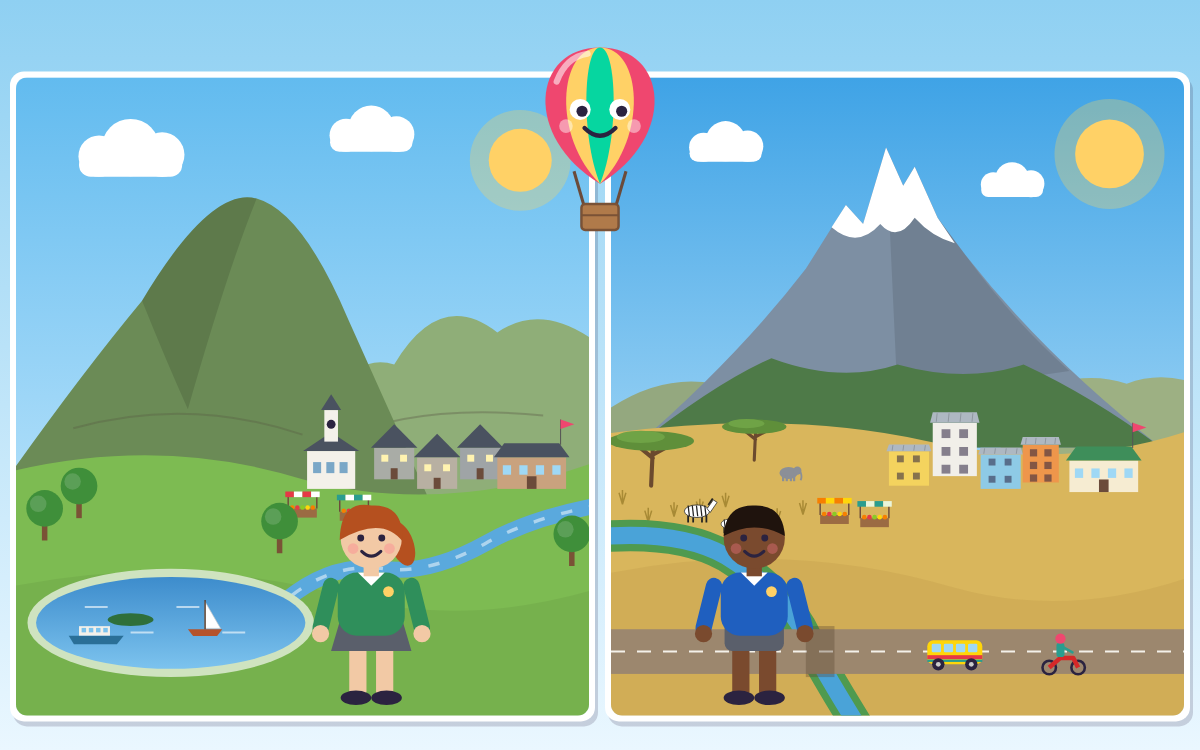
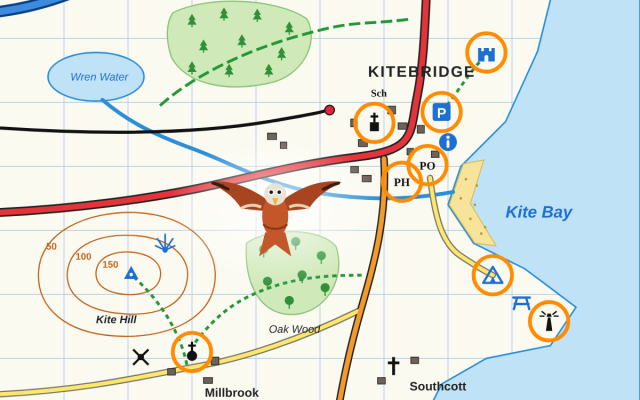
Build each landscape by dragging Skiddaw, Derwentwater, the River Greta, Mount Kenya, the Nanyuki River and grassy plains into place, then stack Skiddaws to compare mountain heights and find a feature both towns share.
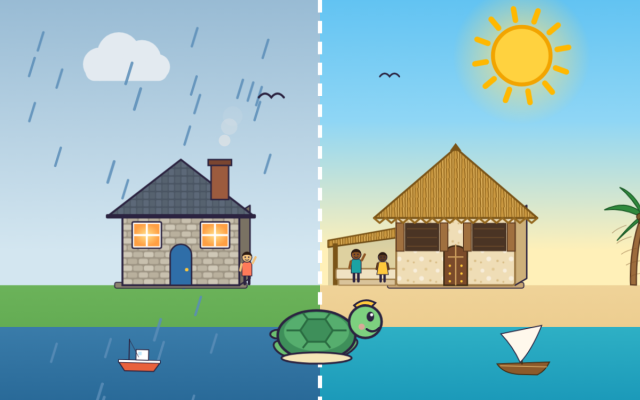
Compare Keswick's spring, summer, autumn and winter with Nanyuki's long rains, short rains and dry seasons near the equator, then choose clothes for Isla and Baraka in January, April and July.
Explore stone houses, markets, schools, farms and jobs with visitors in each town, then sort ways of travelling such as matatus, boda-bodas and lake boats into Keswick, Nanyuki or both.
Sort eleven facts about Keswick and Nanyuki into a Venn diagram of similarities and differences, check common myths about Africa on postcards, then choose which town to visit first.
Years 1–2 geography
Pen-pal challenge: Keswick and Nanyuki quiz (10 questions)
What the chapters cover in the national curriculum in England:
Years 1–2 geography: Understand geographical similarities and differences through studying the human and physical geography of a small area of the United Kingdom, and of a small area in a contrasting non-European country
How to play
Press Start, then pick a postcard on the map screen: each postcard is one chapter.
Breezy reads every instruction aloud and the words appear at the bottom of the screen; the round arrow plays them again.
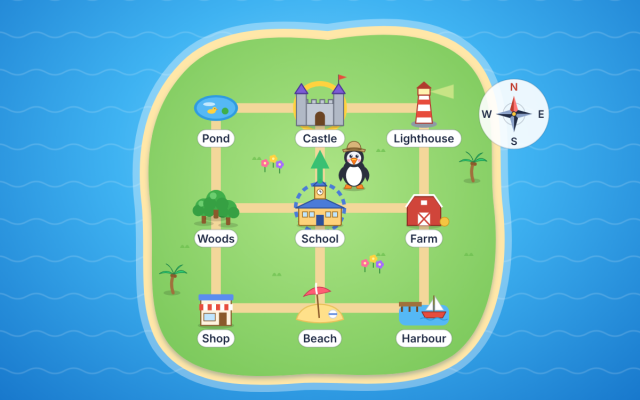
Children tap places on the map, drag features into a picture, choose answers from buttons and sort cards into two overlapping circles.
After a wrong answer Breezy explains the right idea and the child has another go; on the map, a Show me button makes the answer glow.
The Pen-pal challenge asks 10 questions with one try each, then shows the right answer with a short reason.
A worked example
Question: is having a river a similarity or a difference between Keswick and Nanyuki?
Does Keswick have a river? Yes, the River Greta flows through the town.
Does Nanyuki have a river? Yes, the Nanyuki River flows through the town.
It is true in both towns, so the card goes in the middle where the circles overlap.
Answer: having a river is a similarity.
Common mistakes and how to fix them
Calls Africa a countryShow a map: Africa is a continent with 54 countries and Kenya is one of them, just as the UK is one country in Europe.
Thinks it is hot and dry in Kenya every dayExplain that Nanyuki has two rainy seasons and chilly mornings because it is high up, and ask what Baraka wears on a July morning.
Thinks everyone in Kenya lives in the countrysidePoint out that Nanyuki is a busy town with shops, banks, a supermarket and schools, like many towns in the UK.
Spots only the differences between two placesAsk what is the same first: both towns have mountains, rivers, markets, schools and lots of visitors.
Mixes up the words similarity and differenceSay 'similar sounds like same': a similarity is the same in both places, a difference is true in only one.
Try it at home
Find the UK and Kenya on a globe or world map together, then trace the equator with your finger.
Look out of the window at today's weather and decide what Isla and Baraka would each wear this month.
On a walk, spot homes, shops and ways people travel, and ask whether Baraka would see the same in Nanyuki.
Compare your home with a relative's home or a holiday place: name two things that are the same and two that are different.
In the classroom
Play a chapter on the whiteboard and let the class vote on each answer before a pupil taps it.
Lay two hoops on the floor as a Venn diagram and have pupils place picture cards of Keswick and Nanyuki.
Use the weather chapter as a starter, then ask pupils to dress a paper figure for Nanyuki in April.
After the Pen-pal challenge, ask pairs to write one similarity and one difference on mini-whiteboards.
About this adventure
Contrasting Places: My Home and Far Away is an interactive online game for Years 1 and 2 (ages 5 to 7) that teaches children to compare a small area of the UK with a small area of a non-European country. It follows the Key Stage 1 geography curriculum in England: understand geographical similarities and differences through studying the human and physical geography of a small area of the United Kingdom, and of a small area in a contrasting non-European country.
There are five chapters and a final quiz. Breezy the hot-air balloon floats between Keswick in the Lake District and Nanyuki at the foot of Mount Kenya, home of pen pals Isla and Baraka. Each idea is shown and read aloud first, then tried with help, then alone: tapping a map, dragging lakes into place, dressing the children for the weather and sorting facts.
Physical features are made by nature, such as mountains, rivers and lakes; human features are made by people, such as homes, schools and roads. A similarity is the same in both places, and a difference is true in only one. Places near the equator are warm all year, with rainy and dry seasons instead of four.
Questions and answers
What is a contrasting locality in KS1 geography?
A contrasting locality is a small place, such as a town or village, that is different from where a child lives, usually in a non-European country. Children compare its human and physical features with a small area of the UK.
How do I explain similarities and differences between places to my Year 2 child?
Say that a similarity is something that is the same in both places and a difference is something true in only one. Draw two overlapping circles and put shared things, like rivers and schools, in the middle.
Is Africa a country or a continent?
Africa is a continent: a huge area of land with 54 countries. Kenya is one of those countries, on the east side of Africa where the equator crosses, just as the UK is one country in Europe.
What do Year 1 and Year 2 children learn about contrasting places?
They learn to understand geographical similarities and differences by studying the human and physical geography of a small area of the UK and a small area in a contrasting non-European country, using words such as mountain, river, town and farm.
Is there an interactive contrasting localities game for a KS1 class?
Yes. This game plays in a web browser on a classroom whiteboard, tablets or computers. The class can find both places on the map, sort facts about Keswick and Nanyuki together and explain each similarity or difference aloud.
What does the Contrasting Places game include?
It has five chapters and a 10-question final quiz, and takes about 25 minutes to play through. Every instruction and fact is read aloud, so children who are still learning to read can play on their own.
We count visits to make TapLearn better.We use one cookie, only on this site, to see how families find and use it. No adverts, and nothing is shared.One cookie, only on this site. No adverts.How we measure

 TapLearn