What you'll learn
- Name circles, triangles, rectangles and squares
- Why a square is a special kind of rectangle
- A shape keeps its name when turned, stretched or resized
- Name cubes, cuboids, pyramids, spheres, cylinders and cones
- Which 3D shapes roll and which stack
- Tell flat 2D shapes from solid 3D shapes in everyday objects
Chapter by chapter
- Naming 2D shapes: circles, triangles, rectangles and squares Free to try
Year 1 maths · 1
- Spotting 2D shapes in any size or turn, and what is not a triangle
Year 1 maths · 1
- Naming 3D shapes: cubes, cuboids, pyramids, spheres, cylinders and cones
Year 1 maths · 1
- 3D shapes turned round, rolling and stacking, and in everyday objects
Year 1 maths · 1
- Telling flat 2D shapes from solid 3D shapes all around us
Year 1 maths · 1
- Shape Castle Challenge: 2D and 3D shapes quiz (10 questions)
What the chapters cover in the national curriculum in England:
- Year 1 maths: Recognise and name common 2-D and 3-D shapes, including: 2-D shapes; 3-D shapes
About this adventure
2D and 3D Shapes is an interactive maths game that teaches children aged 5–7 to recognise and name common 2D and 3D shapes, following the Year 1 national curriculum in England. Bo, a friendly robot built from shapes, guides players around Shape Island with spoken instructions and short captions.
Children meet circles, triangles, rectangles and squares, which are flat 2D shapes, then cubes, cuboids, pyramids, spheres, cylinders and cones, which are solid 3D shapes they can drag to spin round. They stretch a rectangle until it becomes a square, test which solids roll down a ramp and build a tower from shapes that stack.
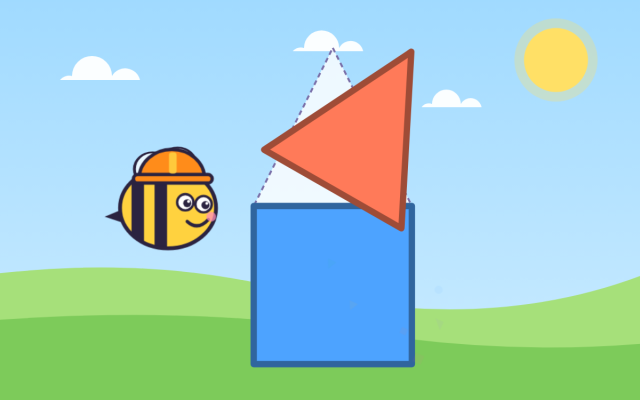
The game tackles common mix-ups head on: a square on its corner is still a square, a sphere is not a circle, and thin objects such as coins are still solid. Hints after a wrong answer help children correct themselves.
Questions and answers
What is the difference between 2D and 3D shapes?
2D shapes are flat, like a drawing on paper, so you cannot pick them up. 3D shapes are solid and can be held, so a circle drawn on a page is 2D, while a ball, which is a sphere, is 3D.
Is a square turned on its corner called a diamond?
No, it is still a square. Turning a shape never changes its name, and diamond is not a mathematical shape name. In the game, children spin a square and watch its name stay the same.
Which 3D shapes roll and which ones stack?
Spheres roll because they are curved all over, and cylinders roll on their curved side. Cubes, cuboids and pyramids have flat faces, so they slide rather than roll and can be stacked into towers.
What age is this 2D and 3D shapes game for?
It is made for children aged 5 to 7, matching the Year 1 shapes objective in the national curriculum for England. Reception children ready for shape names and Year 2 children wanting a recap can enjoy it too.
What does the shapes game include and how long does it take?
It has five chapters, an optional warm-up on straight lines, curved lines and corners, and a 10-question final challenge. Playing everything takes about 40 minutes, and children can play one chapter at a time.


 TapLearn