What children learn, year by year
- Reception: holding a pencil comfortably, and forming most letters correctly. Lots of play builds hand strength: playdough, threading, drawing and climbing.
- Year 1: starting and finishing each letter in the right place, capital letters and digits 0 to 9, and knowing letter "families" that are formed the same way (c, a, d, o, g, q).
- Year 2: letters the right size compared with each other, spaces between words, and the first joins.
- Years 3 and 4: joined handwriting becomes the usual way of writing, and it gets neater and more even.
- Years 5 and 6: writing quickly while staying legible, and choosing when to join and when to print, for example labelling a diagram.
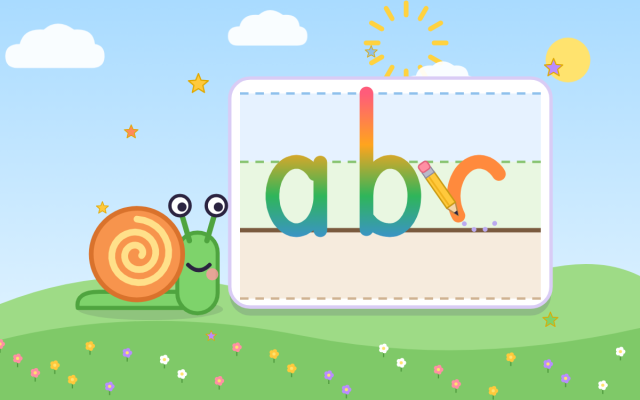
Letter Formation: Trace and Write with Squiggle the Snail
Learn letter formation: where each letter starts and which way to go. Trace, then write lower-case and capita…
Year 1 Handwriting: Trace Letters and Digits with Poppy
Learn Year 1 handwriting: hold a pencil well, start each letter in the right place and form capitals and digi…
Joined Handwriting: Learn the Joins with Loopy the Pencil
Learn joined handwriting with diagonal and horizontal joins, which letters stay unjoined and how to write nea…Getting the basics right
- Grip: the pencil rests between thumb and first finger, supported by the middle finger. A chunky pencil or a grip can help small hands.
- Posture: feet flat, back supported, the paper tilted a little, and the other hand holding the paper still.
- Starting points: most lowercase letters start at the top. If your child starts "o" or "d" at the bottom, joining later becomes much harder, so it's worth gently fixing early.
- Left-handers: tilt the paper the other way, sit them on the left of a right-hander, and hold the pencil a little further from the tip so they can see what they write.
Messy handwriting
Lots of children's writing is messy, especially when they're thinking hard about what to write. Look at one thing at a time: letter starting points, size, or spaces between words. If writing seems painful, very slow or tiring, or your child avoids it completely, mention it to the teacher; sometimes an occupational therapist can help.
Ideas for home
- Write for real reasons: shopping lists, birthday cards, labels for a model.
- Practise patterns and letters in sand, shaving foam or with a finger on your child's back.
- Five minutes of careful writing is better than a page of rushed writing.
- Ask the school which handwriting style they teach, so home and school match.
 TapLearn