Sentence writing worksheet for Year 3: Say it, then write it
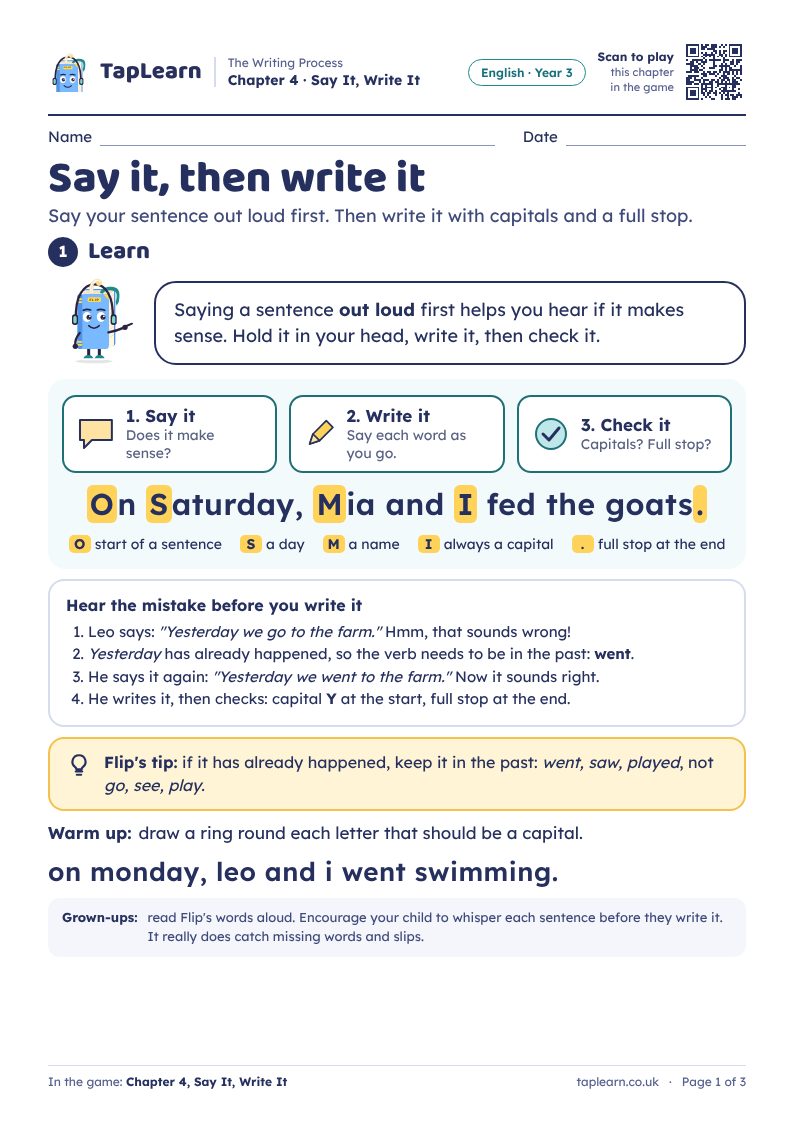
Say It, Then Write It is a printable sentence writing worksheet for Year 3 (ages 7 to 8) that teaches children to say a sentence aloud, write it, then check for capital letters, a full stop and the right tense. Children correct sentences, choose full stops or question marks and keep verbs in the past.
Free to print, no account needed.
Print it on A4, in colour or black and white. Do it after the chapter, or before it to see what your child already knows.
What's on the worksheet
Your child says a sentence aloud before writing it, then checks capital letters, full stops and question marks, and keeps it in the past tense. Includes a pass-the-sentence game and an answers sheet.
- Page 1 · Learn
- Say it, write it, check it, a sentence showing where capitals go, a worked example hearing "Yesterday we go" is wrong, Flip's tip on the past tense, and a capitals warm-up.
- Page 2 · Try it together
- Pass the sentence: pass a soft toy and take turns saying a sentence about something you can see, add one new word, then write it and tick capital letter, full stop and makes sense.
- Page 3 · Practise
- Correct three sentences, choose full stops or question marks, ring the past tense verb, say and write a sentence about a picture, and a challenge with 5 mistakes.
- Answers sheet
- Every answer, mix-ups like tense slips, and say-it-first and yesterday-game ideas.
3 A4 pages and an answers sheet · about 25 minutes
In the classroom
- Use Leo's challenge as a starter: pupils find all 5 mistakes on mini whiteboards.
- Play pass the sentence round a group with a soft toy, building better sentences together.
Questions from the worksheet
- Each sentence has a mistake. Write it correctly: my dog loves the park. We went swimming on friday. Sam and I played football
- Full stop or question mark? Where is my hat. Can you help me. The cake is in the oven.
- Keep it in the past. Draw a ring round the right word: Yesterday we go / went to the shops. This morning I eat / ate toast for breakfast.
- Leo wrote: "yesterday we go to the park and i play on the swings". How many mistakes can you find? Write it correctly.
The answers are on the answers sheet, for grown-ups.
Using it at home
- Encourage your child to whisper each sentence before they write it. It catches missing words and slips.
- If a sentence goes on and on with "and... and...", say it back and ask, "Where could we stop and start a new sentence?"
- Play the yesterday game: say "Today I eat..." and your child changes it to "Yesterday I ate..."
Watch out for
- Missing capitals.
- Capitals go at the start of a sentence, for names and days of the week, and for I on its own.
- Missing full stops, or a full stop on a question.
- Ask, "Is it asking something?" If so, it needs a question mark.
- Tense slips, like "yesterday we go".
- Saying the sentence aloud first usually catches it: "Does that sound right?"
Questions and answers
Why should children say a sentence before writing it?
Saying it aloud first helps them hear whether it makes sense, so they catch missing words and tense slips before they write.
Where do capital letters go?
At the start of a sentence, for names and days of the week, and for I on its own.
How do you keep writing in the past tense?
If it has already happened, use past verbs like went, saw and played, not go, see and play.
 TapLearn