Boxing up worksheet for Year 3: Boxing up a plan
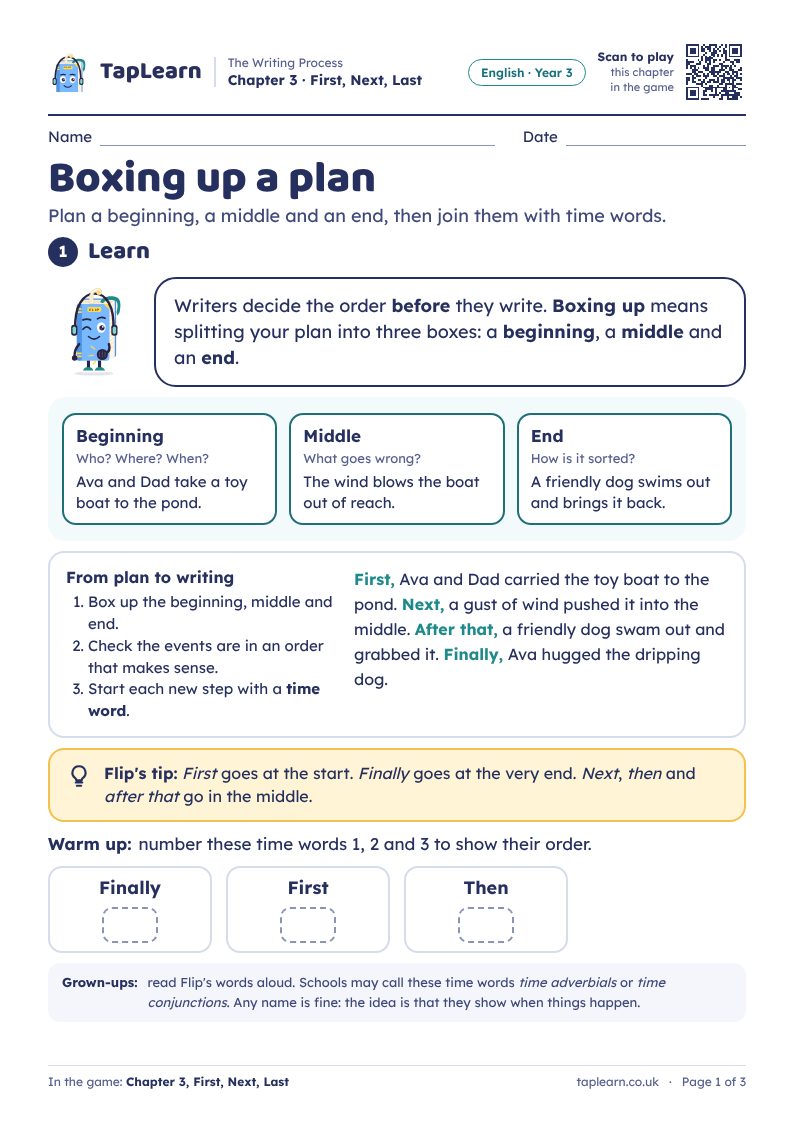
Boxing Up a Plan is a printable boxing up worksheet for Year 3 (ages 7 to 8) that teaches children to split a plan into a beginning, a middle with a problem and an end, then start each step with a time word like first or finally. Children order a seed growing, fill gaps in bean-planting instructions and box up a story called The lost teddy.
Free to print, no account needed.
Print it on A4, in colour or black and white. Do it after the chapter, or before it to see what your child already knows.
What's on the worksheet
Your child boxes up a plan into a beginning, a middle and an end, puts events in a sensible order and uses time words like first, next, after that and finally. Includes a tower-talk instructions game and an answers sheet.
- Page 1 · Learn
- Three boxes planning Ava's toy boat story, the plan turned into writing with time words, Flip's tip on where first and finally go, and an order-the-time-words warm-up.
- Page 2 · Try it together
- Tower talk: the child builds a hidden cup tower and writes the steps with First, Next, After that and Finally, then the grown-up builds exactly what the words say. Compare the towers.
- Page 3 · Practise
- Number jumbled seed pictures, mark kite story sentences B, M or E, fill gaps in bean instructions, box up The lost teddy, and a challenge about a jumbled trip.
- Answers sheet
- Every answer, mix-ups like mixing up the boxes, and today's-story and three-box-story ideas.
3 A4 pages and an answers sheet · about 25 minutes
In the classroom
- Play tower talk in pairs with cups or blocks to show why clear order matters.
- Make up a three-box story as a class: one sentence each for the beginning, problem and ending.
Questions from the worksheet
- Is each sentence from the beginning, middle or end of the story? Write B, M or E: One windy morning, Leo took his new kite to the park. Suddenly, the kite got stuck in a tall tree.
- Fill each gap with a time word. Use each word once: First, Next, After that, Finally. How to plant a bean.
- Box up your own story called The lost teddy. Write a note in each box: beginning, middle, end.
- Sam wrote: "Finally, we got on the bus. First, we went home. Next, we saw the sea." Is it right? Write it again in an order that makes sense.
The answers are on the answers sheet, for grown-ups.
Using it at home
- Schools may call these time words time adverbials or time conjunctions. Any name is fine: the idea is that they show when things happen.
- In tower talk, follow the words kindly but exactly. If a step is missing, your tower will come out different, which shows why order matters.
- Retell your day together using first, next, after that and finally.
Watch out for
- Events in an order that doesn't make sense.
- Ask your child to act it out or picture it: "Could that happen before this?"
- Time words in the wrong place, such as Finally in the middle.
- First starts, Finally ends, and the rest go between.
- Mixing up the boxes.
- The beginning sets the scene (who, where, when), the middle has the problem, the end sorts it out.
Questions and answers
What is boxing up in writing?
Boxing up means splitting a plan into three boxes: a beginning, a middle and an end, before writing.
What goes in the beginning, middle and end of a story?
The beginning says who, where and when. The middle has the problem. The end shows how it is sorted out.
Where do first and finally go?
First goes at the start and finally goes at the very end. Next, then and after that go in the middle.
 TapLearn