Proofreading worksheet for Year 3: Check and improve
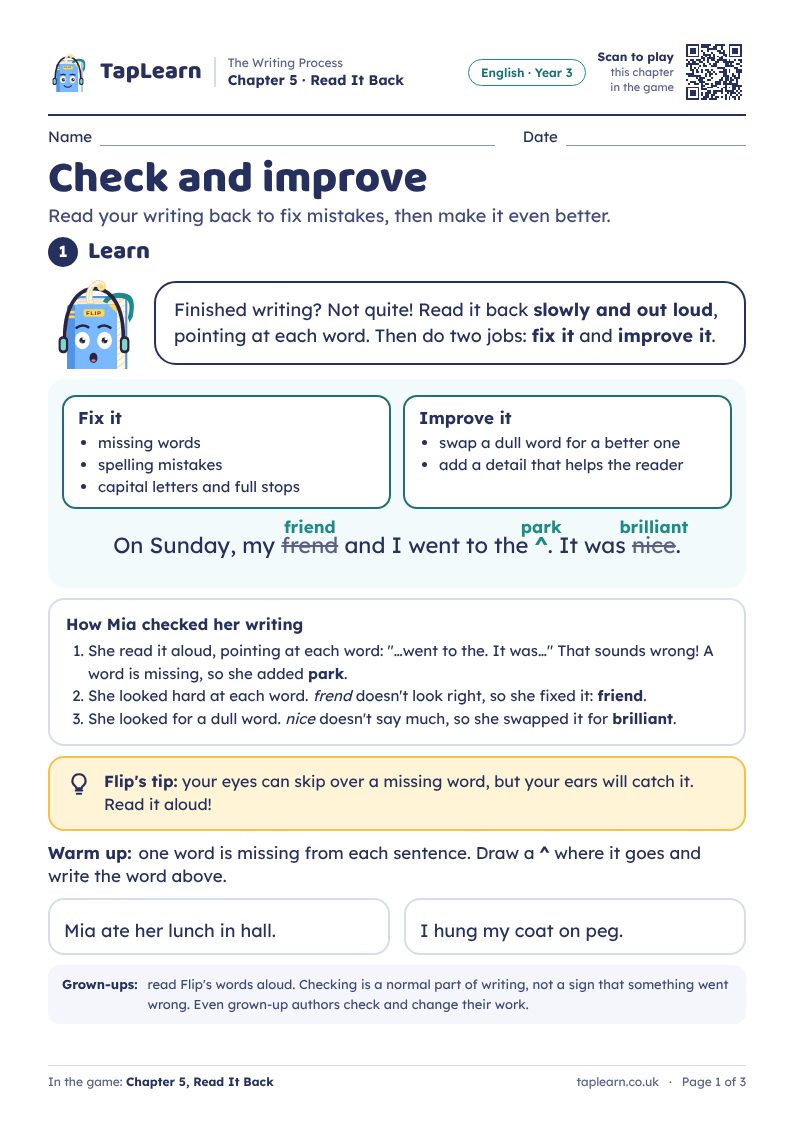
Check and Improve is a printable proofreading worksheet for Year 3 (ages 7 to 8) that teaches children to read their writing back aloud, pointing at each word, to fix mistakes and then improve it with better words. Children add missing words, correct spellings like becos and frend, and check Mia's writing for four changes.
Free to print, no account needed.
Print it on A4, in colour or black and white. Do it after the chapter, or before it to see what your child already knows.
What's on the worksheet
Your child reads writing back aloud to spot missing words, spelling mistakes and missing capitals, then swaps dull words like nice for better ones. Includes a be-the-checker game and an answers sheet.
- Page 1 · Learn
- Fix it and improve it, a worked example of Mia checking her sentence aloud, Flip's tip that your ears catch missing words, and a missing-word warm-up.
- Page 2 · Try it together
- Be the checker: the grown-up writes three sentences with sneaky mistakes, the child reads them aloud, fixes each in colour and swaps a dull word. Then swap jobs.
- Page 3 · Practise
- Add missing words, ring and correct spelling mistakes, swap dull words for better ones, check Mia's writing for four changes, and a challenge about reading aloud.
- Answers sheet
- Every answer, mix-ups like keeping dull words, and read-it-to-me and better-word ideas.
3 A4 pages and an answers sheet · about 25 minutes
In the classroom
- Display a short paragraph with planted mistakes and have pairs proofread it aloud.
- Build a class word wall of better words to swap for nice, good, big and said.
Questions from the worksheet
- A word is missing from each sentence. Draw a ^ where it goes and write a word that fits: Leo kicked ball over the fence.
- Draw a ring round the spelling mistake. Write the word correctly: I was happy becos it was my birthday. Gran gave me a big suprise.
- Swap the dull word for a better one: The cake was nice. The dog was big.
- Check Mia's writing. Find a missing capital, a missing word, a spelling mistake and a dull word: last Saturday we went to the zoo. We saw a lion and tall giraffe.
- Ava read her story with her eyes only, very fast, and missed out a word. Why is it better to read it aloud and point to each word?
The answers are on the answers sheet, for grown-ups.
Using it at home
- Checking is a normal part of writing, not a sign that something went wrong. Even grown-up authors check and change their work.
- In be the checker, you could "miss" a mistake on purpose when it's your turn and see if your child spots it.
- Play the better word game: say a dull word like nice, big or said, and take turns giving a better one.
Watch out for
- Not spotting missing words.
- Ask your child to point under each word as they read, and to read what is written, not what they meant.
- Not spotting spelling mistakes.
- Ask, "Does that word look right?" Because, friend and favourite are worth learning.
- Keeping dull words like nice, good and big.
- Ask, "What sort of nice? Tasty? Kind? Sunny?"
Questions and answers
What is proofreading?
Proofreading means reading your writing back carefully to find and fix mistakes, such as missing words, spellings, capital letters and full stops.
Why should children read their writing aloud?
Eyes can skip over a missing word, but reading aloud and pointing at each word makes you say every word, so you hear the gap.
What is the difference between fixing and improving writing?
Fixing corrects mistakes. Improving makes the writing better, such as swapping a dull word for a stronger one or adding a helpful detail.
 TapLearn