Planning writing worksheet for Year 3: Catching ideas
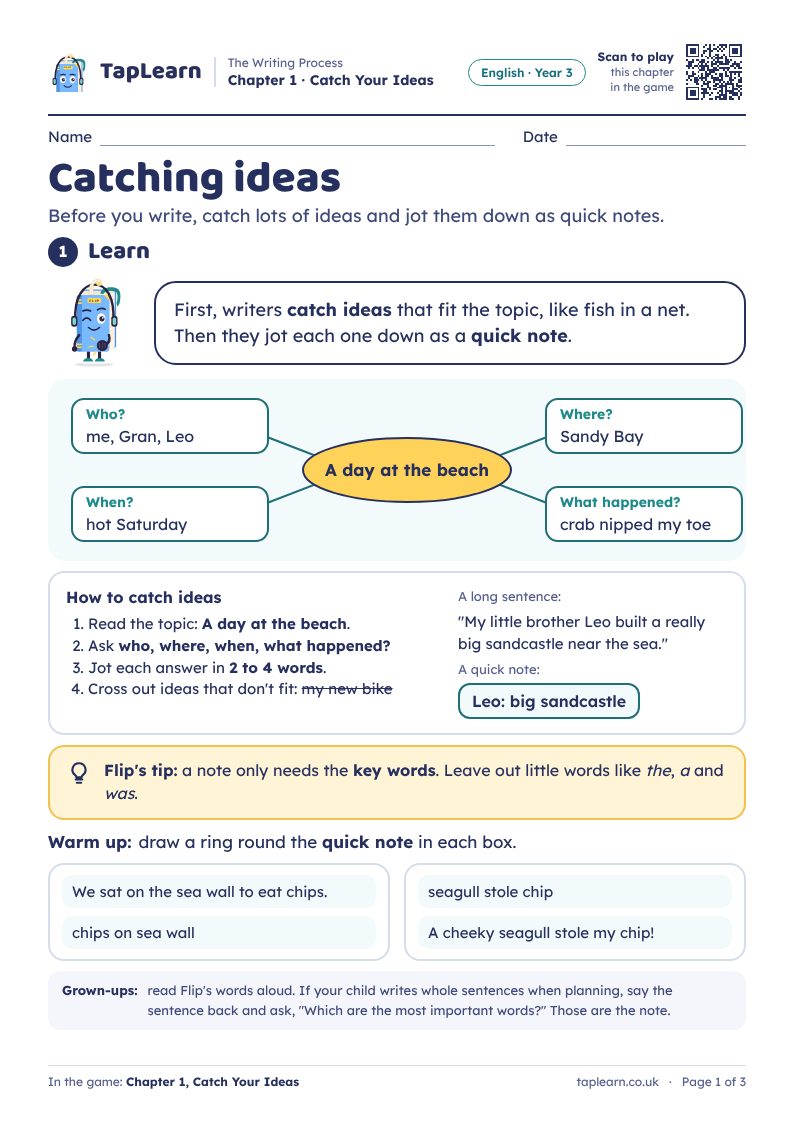
Catching Ideas is a printable planning writing worksheet for Year 3 (ages 7 to 8) that teaches children to ask who, where, when and what happened, then jot each idea as a quick note of 2 to 4 words. Children sort zoo ideas that fit or don't, turn long sentences into notes and make their own idea web.
Free to print, no account needed.
Print it on A4, in colour or black and white. Do it after the chapter, or before it to see what your child already knows.
What's on the worksheet
Your child gathers ideas that fit a topic by asking who, where, when and what happened, then jots them as quick notes instead of long sentences. Includes an idea hunt round the home and an answers sheet.
- Page 1 · Learn
- An idea web for a day at the beach, how to catch ideas in four steps, a long sentence turned into a quick note, Flip's tip to leave out little words, and a warm-up.
- Page 2 · Try it together
- Idea hunt: pick a topic from a cup, such as Our kitchen or A rainy day, then look, listen and think together, jotting what you see, hear, smell and feel as quick notes.
- Page 3 · Practise
- Ring zoo ideas that fit and cross out those that don't, turn long sentences into notes, match Mia's notes to questions, make an idea web, and a challenge about Sam's notes.
- Answers sheet
- Every answer, mix-ups like ideas that wander off the topic, and idea ping-pong and sense-walk ideas.
3 A4 pages and an answers sheet · about 25 minutes
In the classroom
- Play idea ping-pong as a starter: pick a topic and go round the class, each pupil adding a two- or three-word note.
- Model an idea web on the board for a shared topic before pupils make their own.
Questions from the worksheet
- The topic is A trip to the zoo. Draw a ring round each idea that fits. Cross out each idea that doesn't fit: lion roaring, my spelling test, penguins, new school shoes.
- Turn each long sentence into a quick note of 2 to 4 words: Our grey cat, Smudge, sleeps on the warm sofa all afternoon.
- Mia jotted notes about her day. Draw a line from each question to its note: Who? Where? When? What happened?
- Sam is planning My pet dog. His notes include "I like pizza" and a long sentence. Are his notes ready? What two things would you change?
The answers are on the answers sheet, for grown-ups.
Using it at home
- If your child writes whole sentences when planning, say the sentence back and ask, "Which are the most important words?" Those are the note.
- In the idea hunt, take turns adding a note. If an idea wanders off the topic, ask kindly, "Does that belong to our kitchen?"
- Spelling in notes can wait: it gets checked at the end of the writing process.
Watch out for
- Ideas that wander off the topic.
- Ask, "Does that belong to a trip to the zoo?" If your child can explain a good link, accept it.
- Long sentences instead of notes.
- Ask, "What are the key words?" and write only those.
- Getting stuck for ideas.
- Use the four questions (who, where, when, what happened?) or the senses.
Questions and answers
How do children plan their writing in Year 3?
They gather ideas that fit the topic, often by asking who, where, when and what happened, and jot each one as a quick note before writing.
What is a quick note?
A quick note is 2 to 4 key words, like "Leo: big sandcastle". It leaves out little words like the, a and was.
What is an idea web?
An idea web puts the topic in the middle with boxes round it for ideas, such as who, where, when and what happened.
 TapLearn