Audience and purpose worksheet for Year 3: Reader and purpose
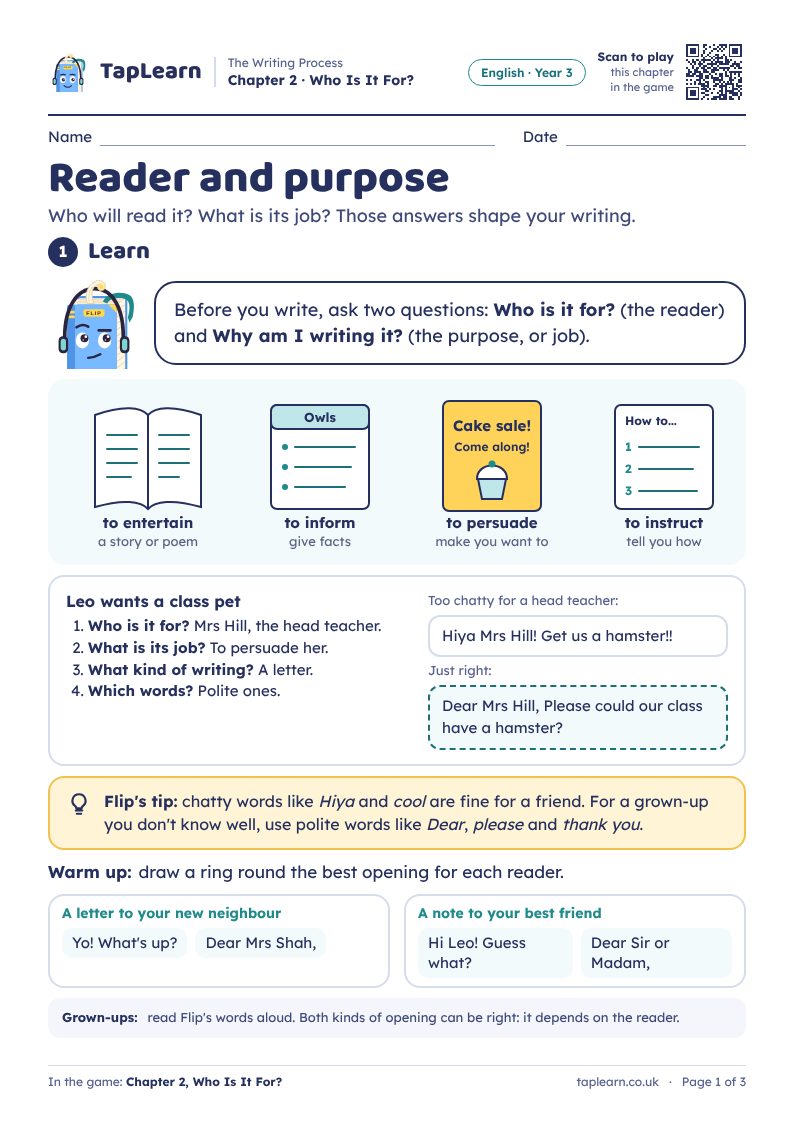
Reader and Purpose is a printable audience and purpose worksheet for Year 3 (ages 7 to 8) that teaches children to ask who a piece of writing is for and whether its job is to entertain, inform, persuade or instruct. Children match writing to its job, sort chatty and polite words, and rewrite a rude note to the head teacher.
Free to print, no account needed.
Print it on A4, in colour or black and white. Do it after the chapter, or before it to see what your child already knows.
What's on the worksheet
Your child works out who a piece of writing is for and what its job is (to entertain, inform, persuade or instruct), then chooses the right kind of writing and polite or chatty words. Includes a writing detectives hunt and an answers sheet.
- Page 1 · Learn
- The four jobs of writing, a worked example planning Leo's letter to the head teacher, chatty and polite openings compared, Flip's tip on polite words, and a warm-up.
- Page 2 · Try it together
- Writing detectives: find four pieces of writing at home, like a food packet, leaflet, storybook and recipe, and fill in who each is for, its job and a clue word.
- Page 3 · Practise
- Match writing to its job, mark chatty or polite words, ring the right kind of writing for each job, rewrite Leo's note politely, and a challenge about a fact file.
- Answers sheet
- Every answer, mix-ups like persuading instead of giving facts, and breakfast-detectives and two-readers ideas.
3 A4 pages and an answers sheet · about 25 minutes
In the classroom
- Bring in a mix of real texts and have groups sort them by job: entertain, inform, persuade or instruct.
- Use Leo's note as a shared rewrite, comparing pupils' polite versions.
Questions from the worksheet
- Draw a line from each piece of writing to its job: a bedtime story, a "Come to our cake sale!" poster, how to play a board game, a fact file about owls.
- Chatty or polite? Write C or P: See you later, mate! Thank you for visiting our school. I am writing to ask about the library.
- Which kind of writing fits the job? Get people to come to the school fair: a shopping list, a poster or a diary?
- Leo wrote this to the head teacher. Write it again with polite words: Oi! We want more playtime, yeah?
The answers are on the answers sheet, for grown-ups.
Using it at home
- Both kinds of opening can be right: it depends on the reader. Ask "Would you say that to the head teacher?"
- Some writing has more than one job: a cereal box gives facts and wants you to buy it. Ask, "What is its main job?"
- Tell some news, like "I lost a tooth!", to a close friend, then to the head teacher, and talk about which words change.
Watch out for
- Using chatty words for a polite reader.
- Ask, "Would you say that to the head teacher?"
- Mixing up persuading and giving facts.
- A fact can be checked; an opinion is what someone thinks. Fact files give facts; posters and adverts persuade.
- Choosing a kind of writing that doesn't fit the job, like a story to remember the shopping.
- Ask, "What do you need it to do?"
Questions and answers
What do audience and purpose mean in writing?
The audience is who will read the writing. The purpose is its job, such as to entertain, inform, persuade or instruct.
What are the four purposes of writing?
To entertain (a story or poem), to inform (give facts), to persuade (make you want to) and to instruct (tell you how).
When should children use polite words?
Use polite words like Dear, please and thank you for a grown-up you don't know well. Chatty words are fine for a friend.
 TapLearn