Reading a little book worksheet for Reception: My little book
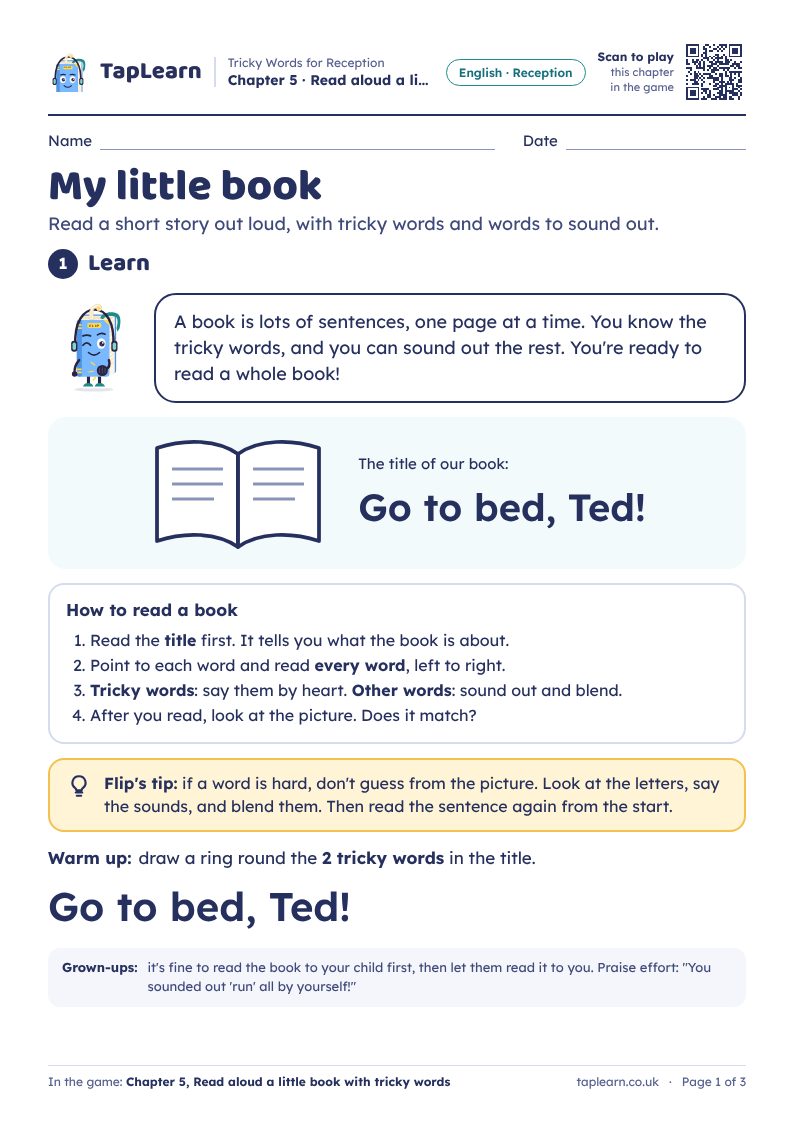
My Little Book is a printable reading a little book worksheet for Reception (ages 4 to 5) that teaches children to read a short story, Go to Bed, Ted!, pointing to every word and checking the picture afterwards. It covers the Reception (EYFS) English goal to read aloud simple sentences and books that are consistent with their phonic knowledge, including some common exception words.
This worksheet is for members
Membership opens every chapter of every game and every worksheet, for all your children.
See the plansAlready a member? Log in to print it.
Start with the free one: The and I (chapter 1).
Print it on A4, in colour or black and white. Do it after the chapter, or before it to see what your child already knows.
What's on the worksheet
Your child reads a four-page story, Go to Bed, Ted!, out loud, reading tricky words by heart and sounding out the rest, then finds the tricky words. Includes reading to a teddy and an answers sheet.
- Page 1 · Learn
- How to read a book in four steps, from the title to checking the picture, Flip's tip to sound out a hard word instead of guessing, and a find-the-tricky-words-in-the-title warm-up.
- Page 2 · Try it together
- Read to a teddy: sit a teddy next to you, read the title, then your child reads each page of the little book to the teddy, pointing to every word, and ticks it off.
- Page 3 · Practise
- Ring every tricky word in the story and count them, answer yes or no questions about Ted, and a challenge about reading the words, not the picture.
- Answers sheet
- Every answer, mix-ups like guessing from the picture, and act-it-out and re-read ideas.
3 A4 pages and an answers sheet · about 20 minutes
Using it at home
- It's fine to read the book to your child first, then let them read it to you.
- Praise effort, like "You sounded out run all by yourself!"
- Read the little book again tomorrow: each time, it gets smoother.
Watch out for
- Guessing from the picture.
- Cover the picture, read the words, then uncover it to check.
- Skipping little words like to and the.
- Keep a finger under each word.
- Reading look-alikes wrongly, like no for on or to for go.
- Ask: "What's the first sound?"
Questions from the worksheet
- Draw a ring round every tricky word. How many did you find? Go to bed, Ted! No! I can run. I can hop and hop. Ted got in the bed.
- Read the question. Draw a ring round yes or no: Can Ted hop? Did Ted get in the bed? Is Ted a cat?
- Mia looks at page 2 and says "Ted is running fast!" Is that what the words say?
The answers are on the answers sheet, for grown-ups.
National curriculum in England
This worksheet practises these statements from the Reception english programme of study:
- Read a few common exception words matched to the school's phonic programme
- Read aloud simple sentences and books that are consistent with their phonic knowledge, including some common exception words
In the classroom
- Pupils read the little book to a partner, then act out each page together.
- Use Practise A as a whole-class count of tricky words on the board.
Questions and answers
What should a Reception child's first reading book have in it?
It should use sounds your child knows and a few tricky words they've learned, so they can read every word themselves.
What should my child do with a word they can't read?
Look at the letters, say the sounds and blend them, then read the sentence again from the start. Don't guess from the picture.
Why read the same little book again?
Each time your child re-reads it, the reading gets smoother and they have more space to think about the story.
 TapLearn