Reading sentences with tricky words worksheet for Reception: Reading sentences
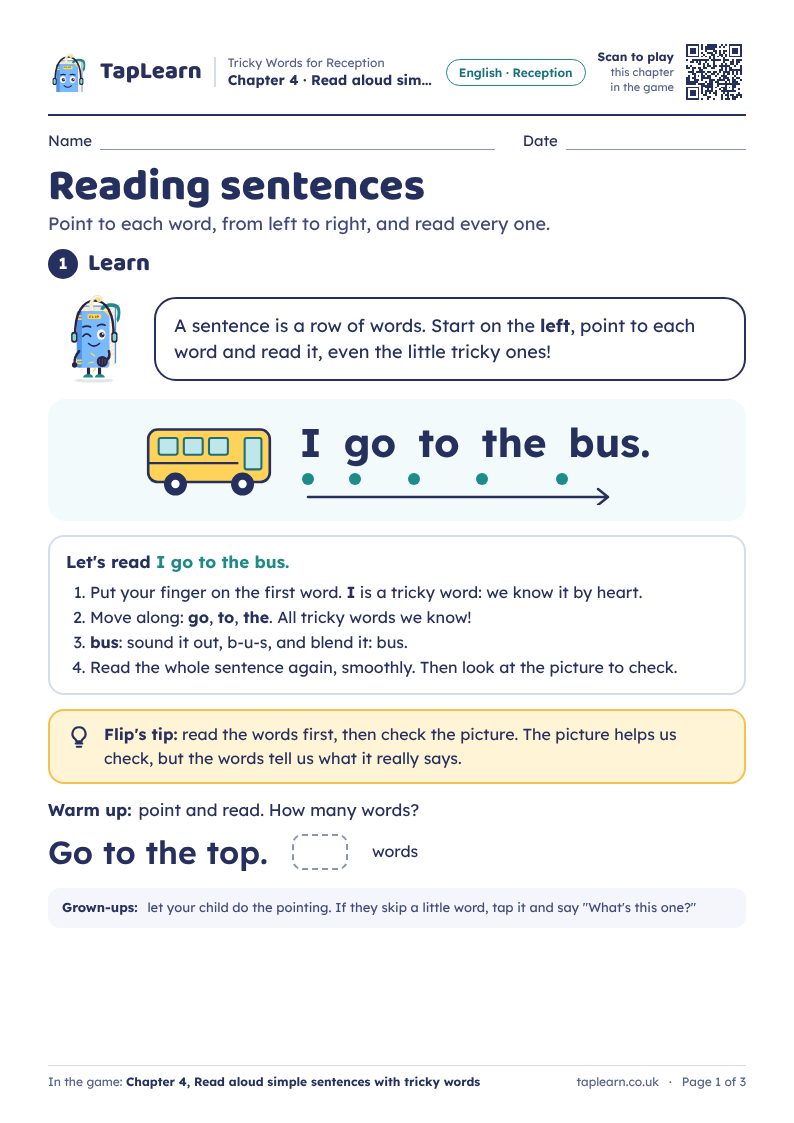
Reading Sentences is a printable reading sentences with tricky words worksheet for Reception (ages 4 to 5) that teaches children to point to each word from left to right and read every one, like I go to the bus. It covers the Reception (EYFS) English goal to read aloud simple sentences and books that are consistent with their phonic knowledge, including some common exception words.
This worksheet is for members
Membership opens every chapter of every game and every worksheet, for all your children.
See the plansAlready a member? Log in to print it.
Start with the free one: The and I (chapter 1).
Print it on A4, in colour or black and white. Do it after the chapter, or before it to see what your child already knows.
What's on the worksheet
Your child reads short sentences out loud, pointing to each word from left to right, reading tricky words by heart and sounding out the rest. Includes a word card sentence game and an answers sheet.
- Page 1 · Learn
- How to read I go to the bus, word by word, with tricky words read by heart and bus sounded out, Flip's read-then-check-the-picture tip, and a count-the-words warm-up.
- Page 2 · Try it together
- Word card sentences: write I, can, go, to, the, bus, bed and no on scraps of paper, lay out a sentence, point and read it, then swap one word and read the new sentence.
- Page 3 · Practise
- Match sentences to pictures, tick the sentence that matches the picture, write the missing tricky word, and a challenge about skipped words.
- Answers sheet
- Every answer, mix-ups like skipping little words, and finger-walk ideas.
3 A4 pages and an answers sheet · about 20 minutes
Using it at home
- Let your child do the pointing. If they skip a little word, tap it and ask "What's this one?"
- Silly sentences like "No bed to go!" are fine with the word cards: they're fun to read.
- In any picture book, let your child walk a finger under each word while you read a line.
Watch out for
- Skipping small words like the and to.
- Ask your child to point to each word as they read it.
- Mixing up look-alikes like to and go.
- Ask: "What's the first sound?"
- Guessing from the picture.
- Say: "Read it first, then check the picture." In Practise B both sentences use the same words.
Questions from the worksheet
- Read each sentence. Draw a line to its picture: The cat sat on the mat. I go to the bus. A pig in a hat.
- Read both sentences carefully. Tick the one that matches the picture: The cat is on the hat. The hat is on the cat.
- Write the missing tricky word. Use I, the or to: ___ can hop. Sit on ___ mat. Run ___ the bus!
- Leo reads I go to the bus. as "I go bus." Which words did he skip?
The answers are on the answers sheet, for grown-ups.
National curriculum in England
This worksheet practises this statement from the Reception english programme of study:
- Read aloud simple sentences and books that are consistent with their phonic knowledge, including some common exception words
In the classroom
- Build word card sentences with the class on the board, then change one word at a time.
- Say a sentence with I, go, to and the and clap once for each word.
Questions and answers
How do Reception children read a sentence?
They point to each word from left to right, read tricky words by heart and sound out the rest, then read the whole sentence again smoothly.
Why does my child skip little words?
Small tricky words like the and to are easy to miss. Pointing to every word helps, because without them the sentence doesn't make sense.
Should my child use the picture to read?
Read the words first, then use the picture to check. The words tell you what it really says.
 TapLearn