Common exception words worksheet for Reception: Find the tricky part
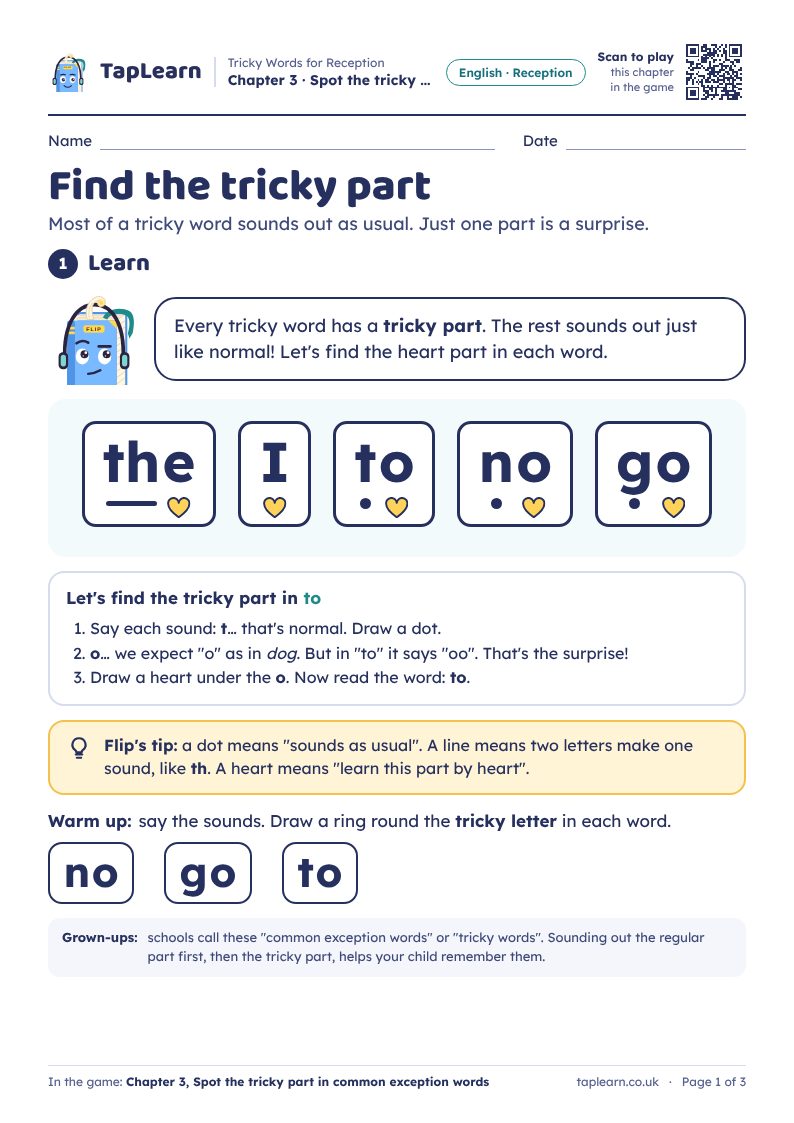
Find the Tricky Part is a printable common exception words worksheet for Reception (ages 4 to 5) that teaches children to sound out the regular part of a tricky word and spot the one part that is a surprise, like the o in to. It covers the Reception (EYFS) English goal to read a few common exception words matched to the school's phonic programme.
This worksheet is for members
Membership opens every chapter of every game and every worksheet, for all your children.
See the plansAlready a member? Log in to print it.
Start with the free one: The and I (chapter 1).
Print it on A4, in colour or black and white. Do it after the chapter, or before it to see what your child already knows.
What's on the worksheet
Your child says each sound in the, I, to, no and go and finds the one part that doesn't sound out as usual, then draws a heart under it. Includes a heart words drawing activity and an answers sheet.
- Page 1 · Learn
- Dots, lines and hearts explained, a worked example finding the tricky o in to, Flip's tip on what each mark means, and a ring-the-tricky-letter warm-up.
- Page 2 · Try it together
- Heart words: the grown-up writes a tricky word in big letters, the child says each sound and points to the tricky part, and together you draw and colour a big heart under it.
- Page 3 · Practise
- Draw hearts under tricky parts, tick whether hearts are in the right place, match dog, go and to to what their o says, ring the 4 tricky words, and a challenge.
- Answers sheet
- Every answer, mix-ups like a heart under th in the, and air-hearts and rhyme ideas.
3 A4 pages and an answers sheet · about 20 minutes
Using it at home
- Sound out the regular part first, then the tricky part: it helps your child remember the word.
- If your child points to a letter that sounds normal, say that sound together ("t, yes, that's a normal t") and move on to the next letter.
- Try air hearts: say a tricky word, spell it out together and draw a heart in the air at the tricky letter.
Watch out for
- Pointing to a normal letter, like the t in to or the g in go.
- Say each sound together: "g, that's normal… o, that's the surprise!"
- Thinking the o in to sounds like the o in go.
- Say them side by side: to rhymes with zoo, go rhymes with toe.
- Putting the heart under th in the.
- t and h together make a normal sound, th. The e is the tricky part.
Questions from the worksheet
- Draw a heart under the tricky part: the, I, to, no, go.
- The letter o says different things! Draw a line from each word to what its o says: dog, go, to and "oo", "o", "oh".
- Some words sound out, some are tricky. Draw a ring round the 4 tricky words: cat, the, dog, go, sun, to, pig, I.
- Ava draws the heart under the t in to. Is she right? Which letter is the tricky part?
The answers are on the answers sheet, for grown-ups.
National curriculum in England
This worksheet practises this statement from the Reception english programme of study:
- Read a few common exception words matched to the school's phonic programme
In the classroom
- Write tricky words on the board and invite pupils to draw the heart under the tricky part.
- Use Practise B in pairs: one pupil explains why each heart is right or wrong.
Questions and answers
What are common exception words?
Common exception words are words where part of the word doesn't follow the usual phonics rules. Schools often call them tricky words, and children learn the tricky part by heart.
What is the tricky part of a word?
It's the part that doesn't sound out the usual way. In to, the t is normal but the o says "oo", so the o is the tricky part.
Why do schools draw a heart under tricky parts?
The heart is a reminder to learn that part by heart. The rest of the word can still be sounded out as usual.
 TapLearn