Sight words worksheet for Reception: The and I
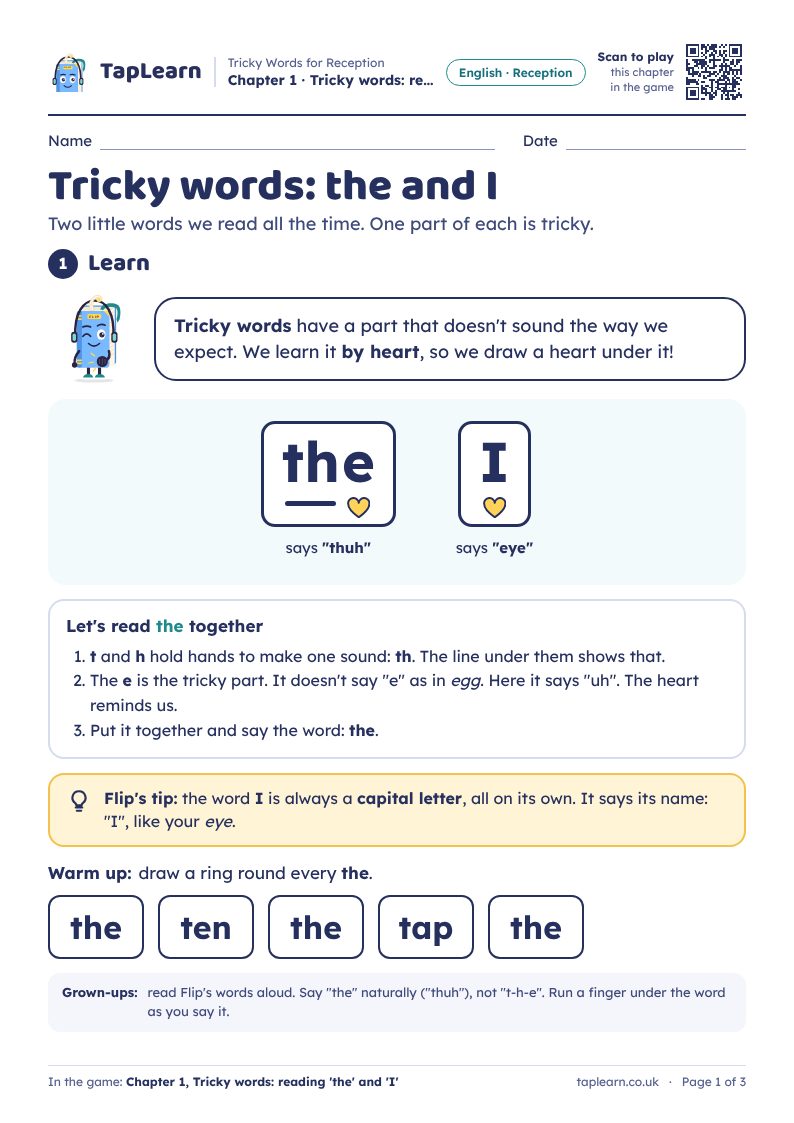
The and I is a printable sight words worksheet for Reception (ages 4 to 5) that teaches children to read the tricky words the and I by heart, knowing that t and h make one sound and the e is the tricky part. It covers the Reception (EYFS) English goal to read a few common exception words matched to the school's phonic programme.
Free to print, no account needed.
▶ Play chapter 1 in the game · How the tricky words (common exception words) works
Print it on A4, in colour or black and white. Do it after the chapter, or before it to see what your child already knows.
What's on the worksheet
Your child reads the tricky words the and I, learns that th is one sound and the e is the tricky part, and traces and writes both words. Includes a sticky-note word hunt and an answers sheet.
- Page 1 · Learn
- How to read the, with th as one sound and a heart under the tricky e, Flip's tip that I is always a capital letter, and a ring-every-the warm-up.
- Page 2 · Try it together
- Word hunt: the grown-up writes the and I on sticky notes and hides them around one room, then the child finds each one, reads it out loud and ticks the right box.
- Page 3 · Practise
- Colour every box that says the, draw a heart under the tricky part, trace and write the and I, ring the and I in two short sentences, and a challenge about t-h-e.
- Answers sheet
- Every answer, mix-ups like sounding out t-h-e, and spot-it-in-books ideas.
3 A4 pages and an answers sheet · about 20 minutes
Using it at home
- Say "the" naturally, like "thuh", not "t-h-e", and run a finger under the word as you say it.
- At bedtime, ask your child to point to every the on one page of a book.
- Play the I game: take turns saying "I can…" and doing the action, like "I can hop!"
Watch out for
- Sounding out letter by letter, like t-h-e.
- Say "This is a tricky word. We know it by heart," then read it together.
- Pointing to a letter that sounds normal, like the t in the.
- Say each sound together: th is fine, the e is the surprise.
- Writing a small i for the word I.
- On its own, I is always a capital letter.
Questions from the worksheet
- Colour each box that says the: the, he, the, then, she, the, ten, the.
- Draw a heart under the tricky part: the, I.
- Read it with a grown-up. Draw a ring round the and I: I pat the cat. I got the hat.
- Sam reads the like this: "t… h… e". Is that right? How should he say it?
The answers are on the answers sheet, for grown-ups.
National curriculum in England
This worksheet practises this statement from the Reception english programme of study:
- Read a few common exception words matched to the school's phonic programme
In the classroom
- Hide the and I cards around the classroom for a word hunt in small groups.
- Use Practise A as a quick starter: pupils point to every the as you count them together.
Questions and answers
What are sight words in Reception?
Sight words, also called tricky words or common exception words, are words with a part that doesn't sound out the usual way, like the and I. Children learn that part by heart.
Why is the a tricky word?
The t and h join to make one sound, th, which is normal. The e is tricky: it says "uh", not "e" as in egg.
Why is I always a capital letter?
When I is a word on its own, meaning me, it is always written as a capital letter. It says its name, like eye.
 TapLearn