Tricky words worksheet for Reception: To, no and go
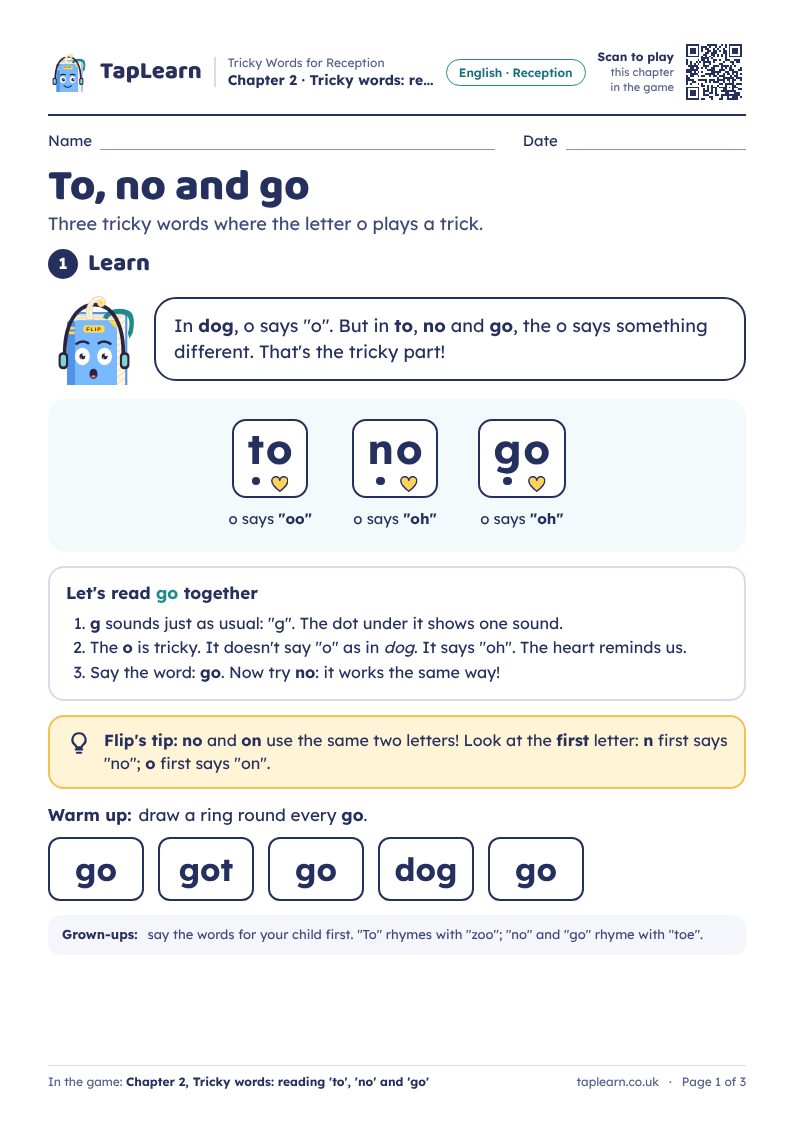
To, No and Go is a printable tricky words worksheet for Reception (ages 4 to 5) that teaches children to read to, no and go, where the o is the tricky part, saying "oo" in to and "oh" in no and go. It covers the Reception (EYFS) English goal to read a few common exception words matched to the school's phonic programme.
This worksheet is for members
Membership opens every chapter of every game and every worksheet, for all your children.
See the plansAlready a member? Log in to print it.
Start with the free one: The and I (chapter 1).
Print it on A4, in colour or black and white. Do it after the chapter, or before it to see what your child already knows.
What's on the worksheet
Your child reads the tricky words to, no and go, hears that the o says "oo" in to but "oh" in no and go, and tells no from on. Includes a go-and-freeze word game and an answers sheet.
- Page 1 · Learn
- How the o plays a trick in to, no and go, a worked example reading go, Flip's tip for telling no from on by the first letter, and a ring-every-go warm-up.
- Page 2 · Try it together
- Go and no: hold up word cards, and the child reads go and marches, reads no and freezes, or reads to and walks to the door. Colour a star each time a word is read.
- Page 3 · Practise
- Ring the same word among look-alikes, draw a heart under the tricky part, write to, no or go in three sentences, and a challenge about no and on.
- Answers sheet
- Every answer, mix-ups like the o from dog in go, and yes-or-no and ready-steady-go ideas.
3 A4 pages and an answers sheet · about 20 minutes
Using it at home
- Say the words first: "to" rhymes with "zoo"; "no" and "go" rhyme with "toe".
- If your child says go with the o from dog, say it back slowly, "g… oh: go!", and let them copy you.
- Ask silly questions like "Can a cat swim to the moon?" so your child gets to say "No!"
Watch out for
- Reading go, no or to with the o from dog.
- Say "This o is tricky. In go it says 'oh'." Model it and let your child copy.
- Mixing up look-alike words like no and on, or to and go.
- Ask your child to say the first sound before reading the word.
- Thinking to and go sound the same at the end.
- Say them side by side: to rhymes with zoo, go rhymes with toe.
Questions from the worksheet
- Look at the word in the box. Draw a ring round the same word: no (on, no, an). to (go, top, to). go (go, got, to).
- Draw a heart under the tricky part: to, no, go.
- Write the missing word: to, no or go. I can ___ to the bus. Go ___ bed, Sam. A cat? ___, a dog!
- Leo reads no as "on". What should he look at to get it right?
The answers are on the answers sheet, for grown-ups.
National curriculum in England
This worksheet practises this statement from the Reception english programme of study:
- Read a few common exception words matched to the school's phonic programme
In the classroom
- Play go and no as a whole-class movement game with big word cards.
- Use Practise A on mini-whiteboards: show a word and pupils write the one that matches.
Questions and answers
Why are to, no and go tricky words?
The o in each one doesn't make the sound it makes in dog. In to it says "oo", and in no and go it says "oh".
How can my child tell no from on?
Look at the first letter. No starts with n and on starts with o, so saying the first sound first helps.
Do to and go rhyme?
No. To rhymes with zoo and go rhymes with toe, even though they end with the same letter.
 TapLearn