Reversible and irreversible changes worksheet for Year 5: Reversible or not?
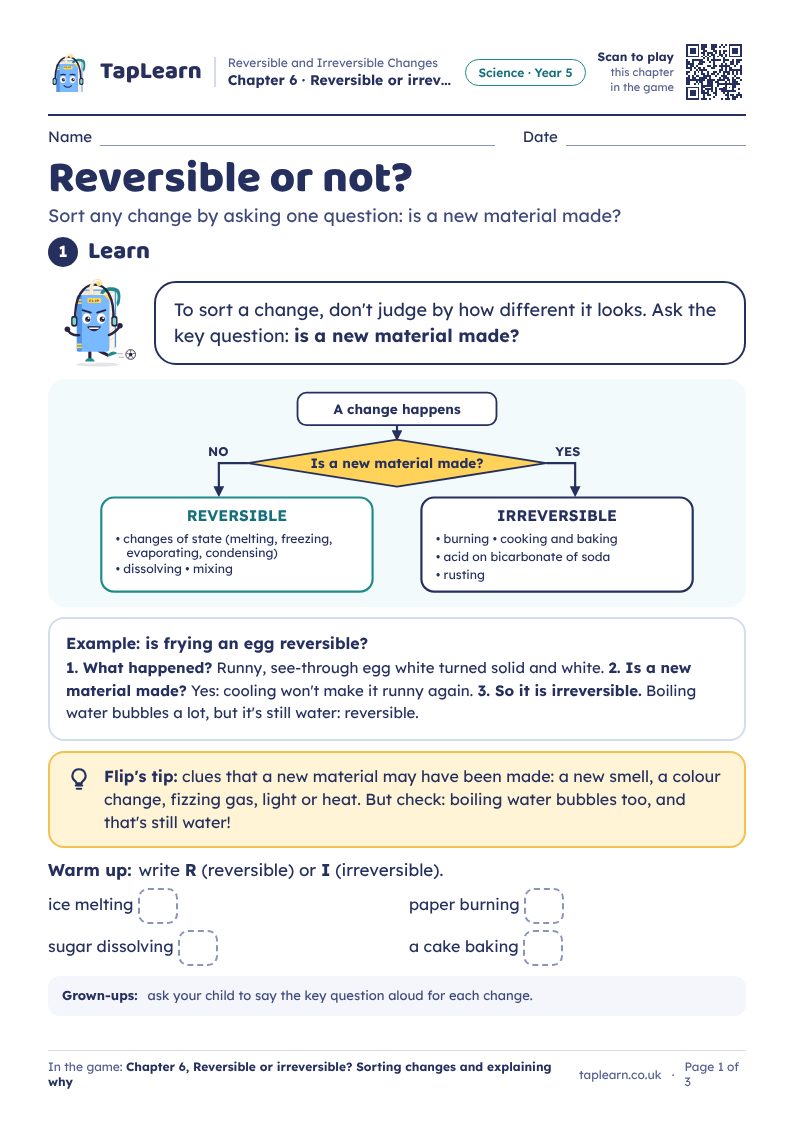
Reversible or Not? is a printable reversible and irreversible changes worksheet for Year 5 (ages 9 to 10) that teaches children to sort everyday changes by asking whether a new material is made. It follows the Year 5 national curriculum in England for science: dissolving, mixing and changes of state are reversible, while changes that form new materials, such as burning, are not usually reversible.
This worksheet is for members
Membership opens every chapter of every game and every worksheet, for all your children.
See the plansAlready a member? Log in to print it.
Start with the free one: Changing state (chapter 1).
Print it on A4, in colour or black and white. Do it after the chapter, or before it to see what your child already knows.
What's on the worksheet
Children sort everyday changes as reversible or irreversible and explain each choice by asking whether a new material is made. Includes a kitchen change hunt and an answers sheet.
- Page 1 · Learn
- A flow chart sorts any change with the question "Is a new material made?", and a worked example compares frying an egg with boiling water.
- Page 2 · Try it together
- Kitchen change hunt: find changes around the kitchen, such as ice, soft butter, toast and a cooked egg, and write each in the reversible or irreversible column.
- Page 2–3 · Practise
- Sort five changes and say if a new material is made, find the odd one out, explain why looks can trick you, and write examples of your own.
- Answers sheet
- Every answer by page, notes on missing a new material or judging by looks, and quick sorting games.
3 A4 pages and an answers sheet · about 35 minutes
Using it at home
- Do the change hunt while you're in the kitchen anyway: it needs no cooking, just looking and talking.
- Ask your child to say the key question aloud each time: "Is a new material made?"
Watch out for
- Calling a change reversible even though a new material is made, like cooking an egg.
- Ask: "Can it go back to exactly how it was?" Cooling a cooked egg never makes it runny again.
- Deciding by how different something looks, not by whether a new material is made.
- Boiling water looks dramatic but is still water. Always ask the key question.
Questions from the worksheet
- Reversible or irreversible? A bike chain going rusty. Is a new material made?
- Draw a ring round the odd one out: melting butter, dissolving salt, burning wood.
- Melted chocolate looks very different from a bar, but melting is reversible. Toast only looks a little different from bread, but toasting is irreversible. Explain why.
- Mia says, "Cooking an egg is reversible, because you can cool it down again." Is she right?
The answers are on the answers sheet, for grown-ups.
National curriculum in England
This worksheet practises these statements from the Year 5 science programme of study:
- Demonstrate that dissolving, mixing and changes of state are reversible changes
- Explain that some changes result in the formation of new materials, and that this kind of change is not usually reversible, including changes associated with burning and the action of acid on bicarbonate of soda
Source: National curriculum in England: science programmes of study (DfE)
In the classroom
- Give groups a set of change cards to sort on a large flow chart, then ask each group to defend one tricky choice.
- Use the warm-up as a quick-fire mini-whiteboard check with R or I.
Questions and answers
How do you tell if a change is reversible or irreversible?
Ask whether a new material is made. If not, as with melting, dissolving or mixing, it's reversible; if a new material is made, as with burning or cooking, it's usually irreversible.
Is cooking an egg reversible?
No. Heat turns the runny egg into a new, solid material. Cooling it down doesn't make it runny again, so it's an irreversible change.
More worksheets from Reversible and Irreversible Changes: Melt, Mix and Fizz
- Chapter 1: Changes of state worksheet: Changing state Free
- Chapter 2: Dissolving and evaporating worksheet: Salt comes back Members
- Chapter 3: Separating mixtures worksheet Members
- Chapter 4: Burning as an irreversible change worksheet: Burning makes new things Members
- Chapter 5: Vinegar and bicarbonate of soda worksheet: Fizz! A new gas Members
 TapLearn