Changes of state worksheet for Year 5: Changing state
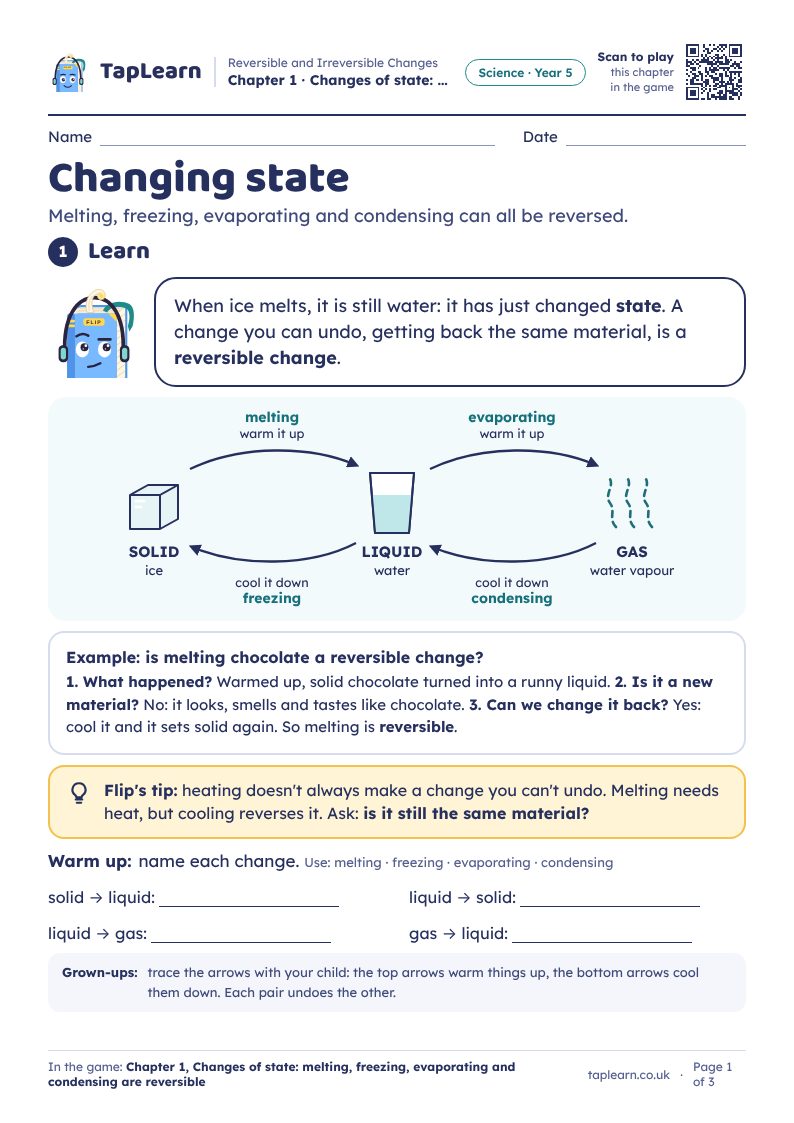
Changing State is a printable changes of state worksheet for Year 5 (ages 9 to 10) that teaches children to name melting, freezing, evaporating and condensing and show that each can be reversed. It follows the Year 5 national curriculum in England for science: demonstrate that dissolving, mixing and changes of state are reversible changes.
Free to print, no account needed.
Print it on A4, in colour or black and white. Do it after the chapter, or before it to see what your child already knows.
What's on the worksheet
Children name melting, freezing, evaporating and condensing and show that each change of state can be reversed, because no new material is made. Includes an ice cube round-trip activity and an answers sheet.
- Page 1 · Learn
- A diagram links solid ice, liquid water and water vapour with arrows for the four changes, and a worked example shows why melting chocolate is reversible.
- Page 2 · Try it together
- Ice cube round trip: melt an ice cube in warm hands, refreeze the water in the freezer, and spot condensation on a glass of iced water.
- Page 2–3 · Practise
- Name the change of state in everyday examples, write how to reverse melting and freezing, sort true and false sentences and explain where a puddle goes.
- Answers sheet
- Every answer by page, notes on thinking melted chocolate is a new material or that heating can't be undone, and ideas to try at home.
3 A4 pages and an answers sheet · about 35 minutes
Using it at home
- Start the ice cube activity first, then do the Practise pages while the saucer of water refreezes.
- When your child says something has melted, ask: "Is it still the same material? How could we change it back?"
Watch out for
- Thinking a melted material, like runny chocolate, is a new material.
- Ask: "Does it still smell and taste like chocolate? Can we make it solid again?"
- Thinking any change caused by heating can't be undone.
- Melting and evaporating use heat, but cooling reverses them: the material is the same.
Questions from the worksheet
- Name the change of state: steam on a bathroom mirror turns into drops of water.
- How could you reverse each change? Chocolate melted in the sun.
- True or false: anything you heat up can never be changed back.
- Mia says, "When a puddle evaporates, the water is gone for ever." Explain where the water goes, and how it could become liquid again.
- Leo leaves melting chocolate on the heat too long and it smells burnt. Is this still a reversible change?
The answers are on the answers sheet, for grown-ups.
National curriculum in England
This worksheet practises this statement from the Year 5 science programme of study:
- Demonstrate that dissolving, mixing and changes of state are reversible changes
Source: National curriculum in England: science programmes of study (DfE)
In the classroom
- Use the warm-up as a mini-whiteboard check: show a state change and ask pupils to write its name.
- Put a glass of iced water on each table at the start of the lesson and discuss the condensation at the end.
Questions and answers
What are the four changes of state?
The four changes of state taught in KS2 are melting (solid to liquid), freezing (liquid to solid), evaporating (liquid to gas) and condensing (gas to liquid).
Why are changes of state reversible?
No new material is made when something changes state, so it can be changed back. Melted ice is still water and freezes again when it gets cold enough.
More worksheets from Reversible and Irreversible Changes: Melt, Mix and Fizz
- Chapter 2: Dissolving and evaporating worksheet: Salt comes back Members
- Chapter 3: Separating mixtures worksheet Members
- Chapter 4: Burning as an irreversible change worksheet: Burning makes new things Members
- Chapter 5: Vinegar and bicarbonate of soda worksheet: Fizz! A new gas Members
- Chapter 6: Reversible and irreversible changes worksheet: Reversible or not? Members
 TapLearn