Burning as an irreversible change worksheet for Year 5: Burning makes new things
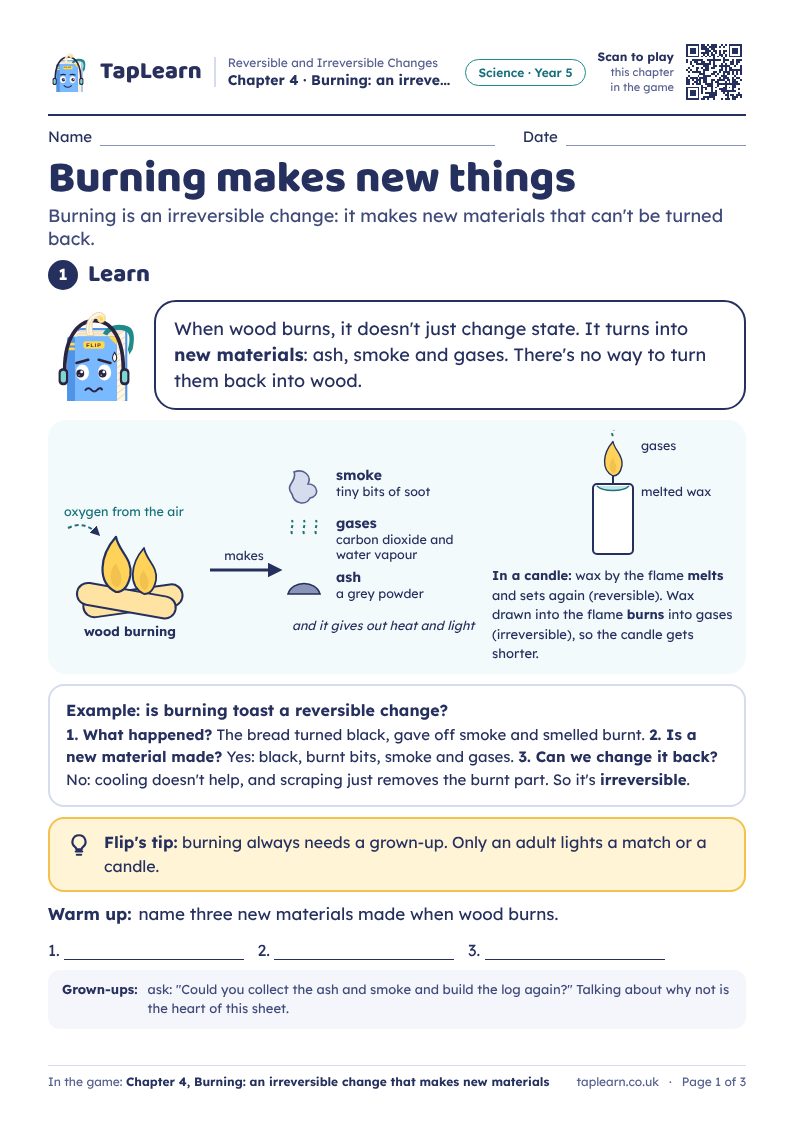
Burning Makes New Things is a printable worksheet on burning as an irreversible change for Year 5 (ages 9 to 10) that teaches children that burning makes new materials such as ash, smoke and gases. It follows the Year 5 national curriculum in England for science: explain that some changes form new materials and are not usually reversible, including burning and the action of acid on bicarbonate of soda.
This worksheet is for members
Membership opens every chapter of every game and every worksheet, for all your children.
See the plansAlready a member? Log in to print it.
Start with the free one: Changing state (chapter 1).
Print it on A4, in colour or black and white. Do it after the chapter, or before it to see what your child already knows.
What's on the worksheet
Children explain that burning makes new materials, such as ash, smoke and gases, so it can't be reversed, and tell apart melting and burning wax in a candle. Includes a burnt toast detective activity and answers.
- Page 1 · Learn
- A diagram shows burning wood using oxygen and making ash, smoke and gases, a candle shows melting versus burning wax, and a worked example asks if burnt toast is reversible.
- Page 2 · Try it together
- Toast detective: compare a slice of bread with cold, very dark toast by colour, feel and smell, and try scraping to see whether the bread comes back.
- Page 2–3 · Practise
- Sort burning and melting changes, sort true and false sentences, explain where a candle's wax goes and why melting wax is reversible but burning wax is not.
- Answers sheet
- Every answer by page, notes on thinking a burning candle is only melting or that ash can be put back, and ideas to go further.
3 A4 pages and an answers sheet · about 35 minutes
Using it at home
- Make the dark toast earlier and let it cool completely before the activity: the child only looks, smells and scrapes.
- When a grown-up next lights a candle, point out the melted wax around the wick and the candle getting shorter.
Watch out for
- Thinking a burning candle is only melting.
- Point out that the candle gets shorter: some wax melts and sets, but the wax in the flame burns into gases.
- Thinking ash or burnt food can be put back by gluing or scraping.
- The original material has become new materials; there's nothing left to put back together.
Questions from the worksheet
- Reversible or irreversible? Candle wax melting and setting again.
- True or false: if you cool ash down, it turns back into wood.
- A candle gets shorter as it burns. Where has the wax gone? Explain.
- Explain why melting wax is reversible, but burning wax is irreversible.
- Sam says, "If I glue the ash back together, I'll have my letter again." Is he right? Explain.
The answers are on the answers sheet, for grown-ups.
National curriculum in England
This worksheet practises this statement from the Year 5 science programme of study:
- Explain that some changes result in the formation of new materials, and that this kind of change is not usually reversible, including changes associated with burning and the action of acid on bicarbonate of soda
Source: National curriculum in England: science programmes of study (DfE)
In the classroom
- Demonstrate a candle burning safely at the front and ask pupils to spot one reversible and one irreversible change.
- Use the true or false table as a quick thumbs up or down check.
Questions and answers
Why is burning an irreversible change?
Burning makes new materials, such as ash, smoke, carbon dioxide and water vapour, so the original material can't be got back.
Is a burning candle a reversible or irreversible change?
Both happen. The wax near the flame melts and sets again, which is reversible, but the wax that burns turns into gases, which is irreversible.
More worksheets from Reversible and Irreversible Changes: Melt, Mix and Fizz
- Chapter 1: Changes of state worksheet: Changing state Free
- Chapter 2: Dissolving and evaporating worksheet: Salt comes back Members
- Chapter 3: Separating mixtures worksheet Members
- Chapter 5: Vinegar and bicarbonate of soda worksheet: Fizz! A new gas Members
- Chapter 6: Reversible and irreversible changes worksheet: Reversible or not? Members
 TapLearn