Dissolving and evaporating worksheet for Year 5: Salt comes back
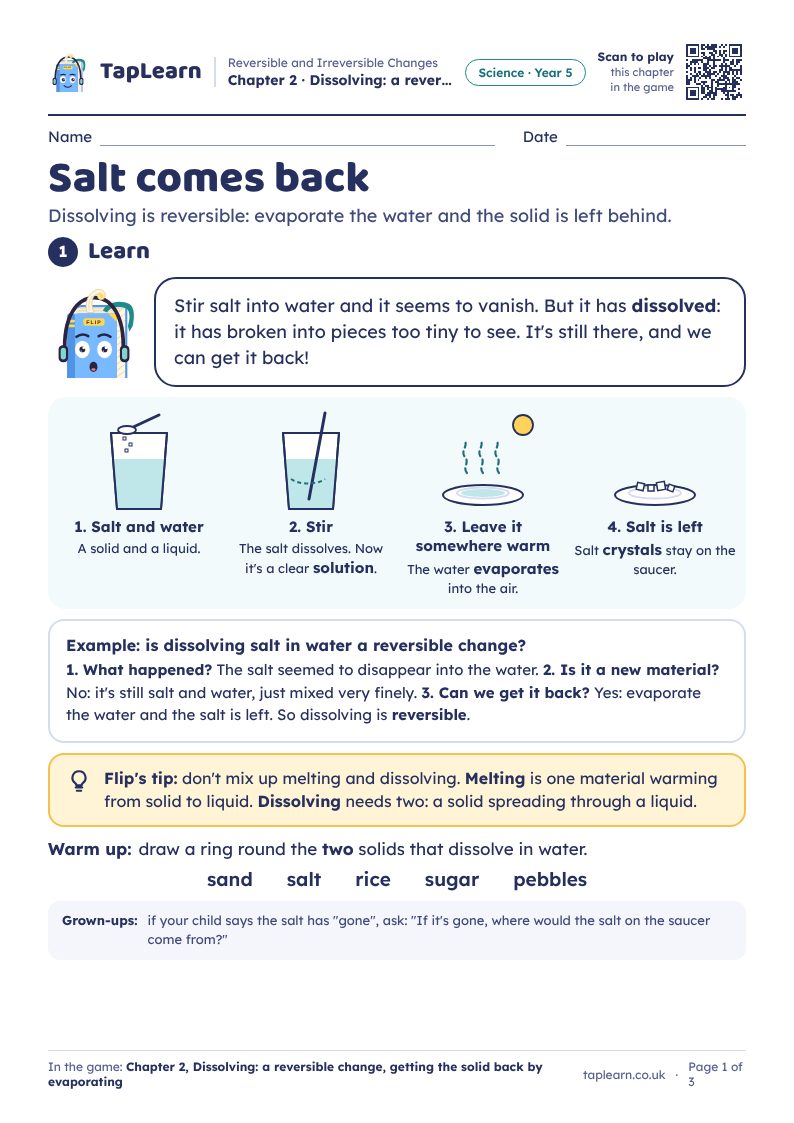
Salt Comes Back is a printable dissolving and evaporating worksheet for Year 5 (ages 9 to 10) that teaches children that a dissolved solid stays in the solution and can be recovered by evaporating the water. It follows the Year 5 national curriculum in England for science: demonstrate that dissolving, mixing and changes of state are reversible changes.
This worksheet is for members
Membership opens every chapter of every game and every worksheet, for all your children.
See the plansAlready a member? Log in to print it.
Start with the free one: Changing state (chapter 1).
Print it on A4, in colour or black and white. Do it after the chapter, or before it to see what your child already knows.
What's on the worksheet
Children explain that a dissolved solid is still in the solution and get it back by evaporating the water, showing dissolving is reversible. Includes a salt detective activity with a filter and saucers, and answers.
- Page 1 · Learn
- Four pictures show salt dissolving, the solution evaporating on a saucer and salt crystals left behind, with a worked example and a tip on melting versus dissolving.
- Page 2 · Try it together
- Salt detective: dissolve salt in warm water, pour half through kitchen roll, then leave both on saucers to evaporate and compare what is left.
- Page 2–3 · Practise
- Fill gaps about dissolving, order the steps to get sugar back, sort true and false sentences and explain the difference between melting and dissolving.
- Answers sheet
- Every answer by page, notes on thinking a dissolved solid has gone for good or that a filter can catch it, and ideas to go further.
3 A4 pages and an answers sheet · about 35 minutes
In the classroom
- Run the salt detective activity as a class investigation, with filtered and unfiltered saucers left on the windowsill for a few days.
- Use the melting or dissolving question as a talk-partner task before pupils write.
Questions from the worksheet
- Put the steps in order to get sugar back from sugary water.
- True or false: a filter can catch dissolved salt.
- Explain the difference between melting and dissolving. Use an ice cube and a spoonful of sugar in your answer.
- Ava stirs sugar into her drink and says, "Look, the sugar has gone!" Is she right? How could she prove where the sugar is?
The answers are on the answers sheet, for grown-ups.
National curriculum in England
This worksheet practises this statement from the Year 5 science programme of study:
- Demonstrate that dissolving, mixing and changes of state are reversible changes
Source: National curriculum in England: science programmes of study (DfE)
Using it at home
- Set up the saucers on a sunny windowsill and check them each morning: the salt can take a few days to appear.
- Let your child pour the salty water through the kitchen roll and predict whether the salt will be caught before you check.
Watch out for
- Thinking a dissolved solid has disappeared for good.
- Point to the salt crystals left on the saucer: "It was in the water all along, in pieces too small to see."
- Thinking a filter can catch dissolved salt.
- Dissolved pieces are far too small to be caught: they pass straight through. Only evaporating gets them back.
Questions and answers
Is dissolving a reversible change?
Yes, dissolving is a reversible change. The solid is still in the solution, and evaporating the water leaves it behind, for example as salt crystals.
What is the difference between melting and dissolving?
Melting is one material changing from solid to liquid when it is heated. Dissolving needs a solid and a liquid: the solid spreads through the liquid to make a solution.
More worksheets from Reversible and Irreversible Changes: Melt, Mix and Fizz
- Chapter 1: Changes of state worksheet: Changing state Free
- Chapter 3: Separating mixtures worksheet Members
- Chapter 4: Burning as an irreversible change worksheet: Burning makes new things Members
- Chapter 5: Vinegar and bicarbonate of soda worksheet: Fizz! A new gas Members
- Chapter 6: Reversible and irreversible changes worksheet: Reversible or not? Members
 TapLearn