Vinegar and bicarbonate of soda worksheet for Year 5: Fizz! A new gas
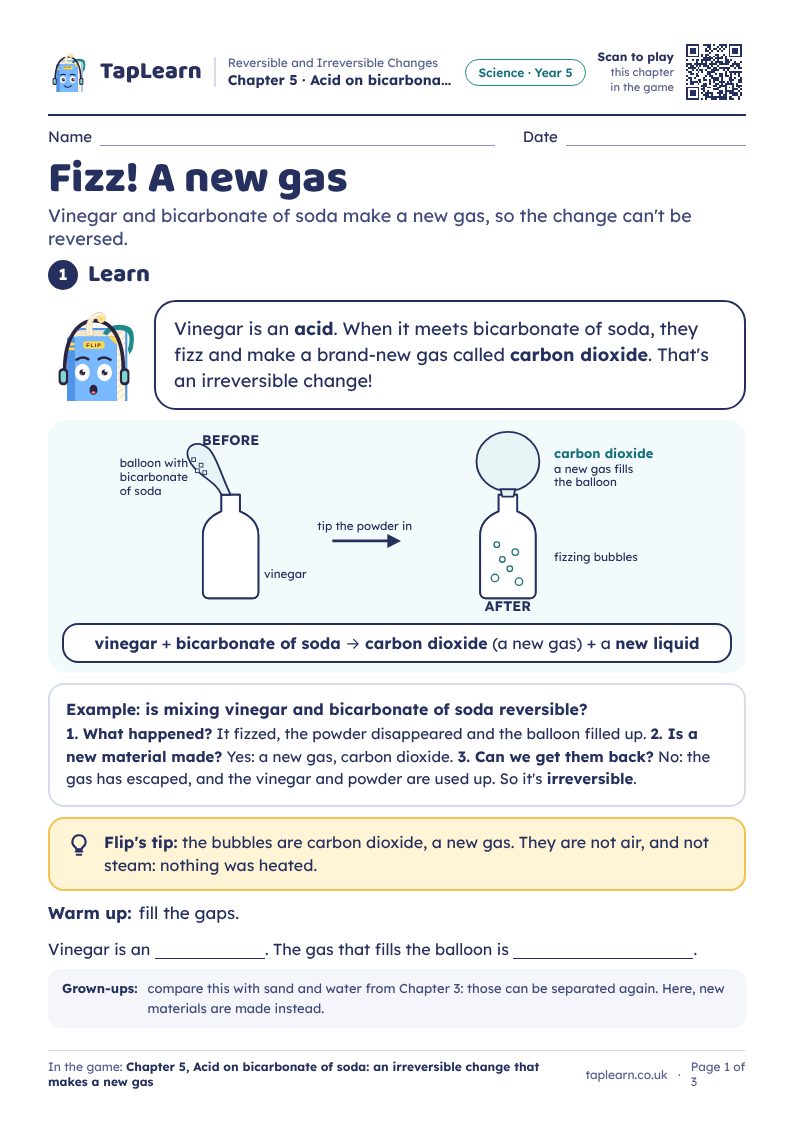
Fizz! A New Gas is a printable vinegar and bicarbonate of soda worksheet for Year 5 (ages 9 to 10) that teaches children that an acid and bicarbonate of soda make a new gas, carbon dioxide. It follows the Year 5 national curriculum in England for science: explain that some changes form new materials and are not usually reversible, including burning and the action of acid on bicarbonate of soda.
This worksheet is for members
Membership opens every chapter of every game and every worksheet, for all your children.
See the plansAlready a member? Log in to print it.
Start with the free one: Changing state (chapter 1).
Print it on A4, in colour or black and white. Do it after the chapter, or before it to see what your child already knows.
What's on the worksheet
Children explain that vinegar, an acid, reacts with bicarbonate of soda to make a new gas, carbon dioxide, so the change is irreversible. Includes a balloon blow-up activity and an answers sheet.
- Page 1 · Learn
- Before and after pictures show a balloon filling with carbon dioxide on a bottle of vinegar, with a word equation and a worked example on why the change is irreversible.
- Page 2 · Try it together
- Balloon blow-up: put bicarbonate of soda in a balloon, stretch it over a bottle of vinegar, tip the powder in and record what you see and hear.
- Page 2–3 · Practise
- Sort true and false sentences, compare bicarbonate of soda in water and in vinegar, fill gaps, and explain why evaporating won't get the powder back.
- Answers sheet
- Every answer by page, notes on thinking it's just mixing or that the bubbles are air, and ideas to go further.
3 A4 pages and an answers sheet · about 35 minutes
Using it at home
- Do the balloon activity on a tray by a sink, keeping faces away from the bottle top, as vinegar stings eyes.
- Afterwards, stir a little bicarbonate of soda into plain water and compare: no fizz means no new gas.
Watch out for
- Thinking vinegar and bicarbonate of soda are just mixing and could be separated.
- Ask: "When we mixed sand and water, did anything fizz or make a gas?" Here a new material is made.
- Thinking the bubbles are just air or water vapour.
- Nothing was heated, and one spoonful of powder makes enough gas to blow up a balloon: it's a new gas, carbon dioxide.
Questions from the worksheet
- True or false: vinegar and bicarbonate of soda are just mixing.
- Compare bicarbonate of soda with water and with vinegar: does it fizz, is a new material made, and is it reversible?
- Ava plans to evaporate the liquid left in the bottle to get her bicarbonate of soda back. Will she get it back? Explain.
- Leo says, "The fizzing is just like boiling water. The bubbles are water vapour." Is he right? Explain.
The answers are on the answers sheet, for grown-ups.
National curriculum in England
This worksheet practises this statement from the Year 5 science programme of study:
- Explain that some changes result in the formation of new materials, and that this kind of change is not usually reversible, including changes associated with burning and the action of acid on bicarbonate of soda
Source: National curriculum in England: science programmes of study (DfE)
In the classroom
- Run the balloon activity as a group investigation, changing the amount of bicarbonate of soda and comparing balloon sizes.
- Use the comparison table as a paired discussion before pupils fill it in.
Questions and answers
What gas is made when vinegar and bicarbonate of soda mix?
Vinegar and bicarbonate of soda make carbon dioxide gas. It is a new material, which is why the mixture fizzes and can blow up a balloon.
Is vinegar and bicarbonate of soda a reversible change?
No, it is irreversible. New materials are made: carbon dioxide escapes, and evaporating the liquid leaves a different white solid, not bicarbonate of soda.
More worksheets from Reversible and Irreversible Changes: Melt, Mix and Fizz
- Chapter 1: Changes of state worksheet: Changing state Free
- Chapter 2: Dissolving and evaporating worksheet: Salt comes back Members
- Chapter 3: Separating mixtures worksheet Members
- Chapter 4: Burning as an irreversible change worksheet: Burning makes new things Members
- Chapter 6: Reversible and irreversible changes worksheet: Reversible or not? Members
 TapLearn